Rosa Catania, George R. Heath, Michael Rappolt, Stephen P. Muench, Paul A. Beales and Lars J. C. Jeuken
{"title":"Solid-supported polymer–lipid hybrid membrane for bioelectrochemistry of a membrane redox enzyme†","authors":"Rosa Catania, George R. Heath, Michael Rappolt, Stephen P. Muench, Paul A. Beales and Lars J. C. Jeuken","doi":"10.1039/D4LF00362D","DOIUrl":null,"url":null,"abstract":"<p >Hybrid membranes, consisting of phospholipids and amphiphilic block polymers, offer enhanced stability compared to liposomes and greater biocompatibility than polymersomes. These qualities make them a versatile platform for a wide range of applications across various fields. In this study, we have investigated the ability of solid-supported polymer–lipid hybrid membranes (SSHM) to act as a platform for bioelectrochemistry of membrane proteins. The redox enzyme, cytochrome <em>bo</em><small><sub><em>3</em></sub></small> (cyt <em>bo</em><small><sub><em>3</em></sub></small>), a terminal oxidase in <em>Escherichia coli</em>, was reconstituted into hybrid vesicles (HVs), which were subsequently tested for their ability to form SSHMs on different self-assembled monolayers (SAMs) on gold electrodes. SSHM formation was monitored with electrochemical impedance spectroscopy (EIS), quartz crystal microbalance with dissipation (QCM-D), and atomic force microscopy (AFM). SSHMs were successfully formed on gold electrodes with mixed SAMs of 6-mercapto-1-hexanol and 1-hexanethiol at a 1 : 1 ratio. The activity of cyt <em>bo</em><small><sub><em>3</em></sub></small> was confirmed using cyclic voltammetry (CV), with electron transfer to cyt <em>bo</em><small><sub><em>3</em></sub></small> mediated by a lipophilic substrate-analogue decylubiquinone (DQ). SSHMs formed with HVs-cyt <em>bo</em><small><sub><em>3</em></sub></small> samples, stored for more than one year before use, remain bioelectrocatalytically active, confirming our previously established longevity and stability of HV systems.</p>","PeriodicalId":101138,"journal":{"name":"RSC Applied Interfaces","volume":" 3","pages":" 665-672"},"PeriodicalIF":0.0000,"publicationDate":"2025-02-11","publicationTypes":"Journal Article","fieldsOfStudy":null,"isOpenAccess":false,"openAccessPdf":"https://www.ncbi.nlm.nih.gov/pmc/articles/PMC11834424/pdf/","citationCount":"0","resultStr":null,"platform":"Semanticscholar","paperid":null,"PeriodicalName":"RSC Applied Interfaces","FirstCategoryId":"1085","ListUrlMain":"https://pubs.rsc.org/en/content/articlelanding/2025/lf/d4lf00362d","RegionNum":0,"RegionCategory":null,"ArticlePicture":[],"TitleCN":null,"AbstractTextCN":null,"PMCID":null,"EPubDate":"","PubModel":"","JCR":"","JCRName":"","Score":null,"Total":0}
引用次数: 0
Abstract
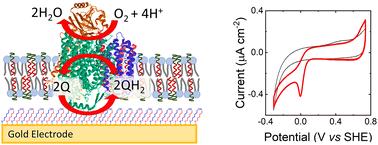
Hybrid membranes, consisting of phospholipids and amphiphilic block polymers, offer enhanced stability compared to liposomes and greater biocompatibility than polymersomes. These qualities make them a versatile platform for a wide range of applications across various fields. In this study, we have investigated the ability of solid-supported polymer–lipid hybrid membranes (SSHM) to act as a platform for bioelectrochemistry of membrane proteins. The redox enzyme, cytochrome bo3 (cyt bo3), a terminal oxidase in Escherichia coli, was reconstituted into hybrid vesicles (HVs), which were subsequently tested for their ability to form SSHMs on different self-assembled monolayers (SAMs) on gold electrodes. SSHM formation was monitored with electrochemical impedance spectroscopy (EIS), quartz crystal microbalance with dissipation (QCM-D), and atomic force microscopy (AFM). SSHMs were successfully formed on gold electrodes with mixed SAMs of 6-mercapto-1-hexanol and 1-hexanethiol at a 1 : 1 ratio. The activity of cyt bo3 was confirmed using cyclic voltammetry (CV), with electron transfer to cyt bo3 mediated by a lipophilic substrate-analogue decylubiquinone (DQ). SSHMs formed with HVs-cyt bo3 samples, stored for more than one year before use, remain bioelectrocatalytically active, confirming our previously established longevity and stability of HV systems.



 京公网安备 11010802042870号
京ICP备2023020795号-1
京公网安备 11010802042870号
京ICP备2023020795号-1

 分享
分享

 求助内容:
求助内容: 应助结果提醒方式:
 扫码关注我们
