Decomposable STING nanoagonist-amplified oncolytic virotherapy through remodeling the immunosuppressive microenvironment of triple-negative breast cancer†
Min Mu, Guoqing Wang, Bo Chen, Hui Li, Chenqian Feng, Rangrang Fan, Nianyong Chen, Bo Han, Aiping Tong, Bingwen Zou and Gang Guo
{"title":"Decomposable STING nanoagonist-amplified oncolytic virotherapy through remodeling the immunosuppressive microenvironment of triple-negative breast cancer†","authors":"Min Mu, Guoqing Wang, Bo Chen, Hui Li, Chenqian Feng, Rangrang Fan, Nianyong Chen, Bo Han, Aiping Tong, Bingwen Zou and Gang Guo","doi":"10.1039/D4TB02565B","DOIUrl":null,"url":null,"abstract":"<p >Oncolytic viruses (OVs) are promising for cancer treatment as they specifically replicate in tumor cells. However, the systemic delivery of OVs still faces the challenges of poor tumor targeting, short circulation periods, and limited lytic efficacy. Herein, an OV-concealed targeting nanoagonist (OV-MnO<small><sub>2</sub></small>/HE) was prepared to enhance the delivery of OVs to triple-negative breast cancer (TNBC) <em>via</em> intravenous administration. Decomposable MnO<small><sub>2</sub></small> biomineral shells covered the surface antigens of OVs to prevent their clearance after systemic administration. The targeting materials of HA-EGCG (HE) enhanced intratumoral accumulation <em>via</em> active targeting. After entering tumors, OV-MnO<small><sub>2</sub></small>/HE readily released Mn<small><sup>2+</sup></small> and OVs, which could enhance the number of CD4<small><sup>+</sup></small>/CD8<small><sup>+</sup></small> T cells and maturation dendritic cells (DCs) due to the synergetic effect of the STING pathway and OVs, thereby activating the immune response, resulting in the significant inhibition of TNBC growth. This work highlights the potential of the STING agonist in enhancing the antitumor efficacy of OVs and provides a potent platform for TNBC therapy.</p>","PeriodicalId":83,"journal":{"name":"Journal of Materials Chemistry B","volume":" 11","pages":" 3685-3699"},"PeriodicalIF":6.1000,"publicationDate":"2025-02-11","publicationTypes":"Journal Article","fieldsOfStudy":null,"isOpenAccess":false,"openAccessPdf":"","citationCount":"0","resultStr":null,"platform":"Semanticscholar","paperid":null,"PeriodicalName":"Journal of Materials Chemistry B","FirstCategoryId":"1","ListUrlMain":"https://pubs.rsc.org/en/content/articlelanding/2025/tb/d4tb02565b","RegionNum":3,"RegionCategory":"医学","ArticlePicture":[],"TitleCN":null,"AbstractTextCN":null,"PMCID":null,"EPubDate":"","PubModel":"","JCR":"Q1","JCRName":"MATERIALS SCIENCE, BIOMATERIALS","Score":null,"Total":0}
引用次数: 0
Abstract
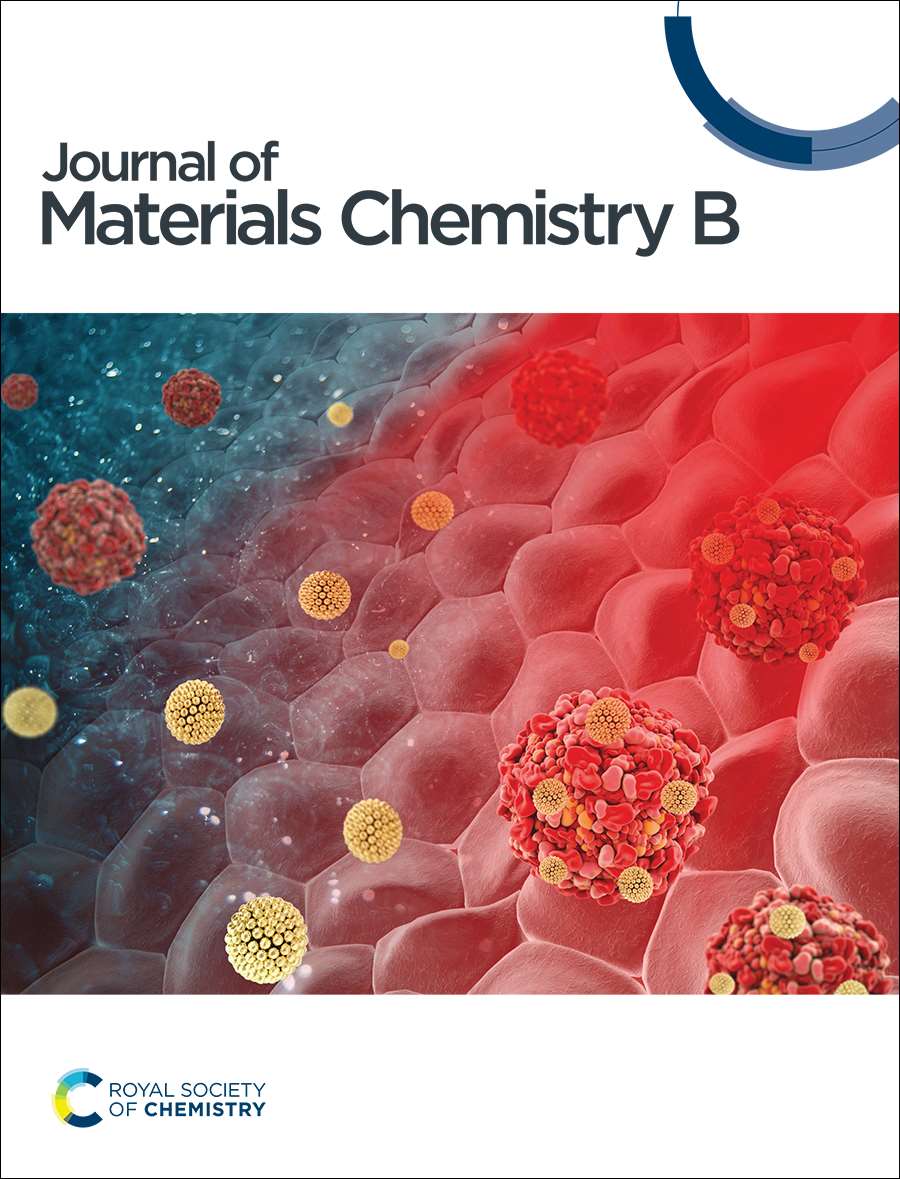
Oncolytic viruses (OVs) are promising for cancer treatment as they specifically replicate in tumor cells. However, the systemic delivery of OVs still faces the challenges of poor tumor targeting, short circulation periods, and limited lytic efficacy. Herein, an OV-concealed targeting nanoagonist (OV-MnO2/HE) was prepared to enhance the delivery of OVs to triple-negative breast cancer (TNBC) via intravenous administration. Decomposable MnO2 biomineral shells covered the surface antigens of OVs to prevent their clearance after systemic administration. The targeting materials of HA-EGCG (HE) enhanced intratumoral accumulation via active targeting. After entering tumors, OV-MnO2/HE readily released Mn2+ and OVs, which could enhance the number of CD4+/CD8+ T cells and maturation dendritic cells (DCs) due to the synergetic effect of the STING pathway and OVs, thereby activating the immune response, resulting in the significant inhibition of TNBC growth. This work highlights the potential of the STING agonist in enhancing the antitumor efficacy of OVs and provides a potent platform for TNBC therapy.
期刊介绍:
Journal of Materials Chemistry A, B & C cover high quality studies across all fields of materials chemistry. The journals focus on those theoretical or experimental studies that report new understanding, applications, properties and synthesis of materials. Journal of Materials Chemistry A, B & C are separated by the intended application of the material studied. Broadly, applications in energy and sustainability are of interest to Journal of Materials Chemistry A, applications in biology and medicine are of interest to Journal of Materials Chemistry B, and applications in optical, magnetic and electronic devices are of interest to Journal of Materials Chemistry C.Journal of Materials Chemistry B is a Transformative Journal and Plan S compliant. Example topic areas within the scope of Journal of Materials Chemistry B are listed below. This list is neither exhaustive nor exclusive:
Antifouling coatings
Biocompatible materials
Bioelectronics
Bioimaging
Biomimetics
Biomineralisation
Bionics
Biosensors
Diagnostics
Drug delivery
Gene delivery
Immunobiology
Nanomedicine
Regenerative medicine & Tissue engineering
Scaffolds
Soft robotics
Stem cells
Therapeutic devices




 京公网安备 11010802042870号
京ICP备2023020795号-1
京公网安备 11010802042870号
京ICP备2023020795号-1

 分享
分享
 求助内容:
求助内容: 应助结果提醒方式:
 扫码关注我们
