{"title":"Cationic-anionic synchronous ring-opening polymerization","authors":"Wenli Wang, Xue Liang, Hengxu Liu, Jiamin Zhang, Yuanzu Zhang, Beibei Zhang, Jianhua Li, Yunqing Zhu, Jianzhong Du","doi":"10.1038/s41467-025-56953-0","DOIUrl":null,"url":null,"abstract":"<p>Chemical reactions with incompatible mechanisms (such as nucleophilic reactions and electrophilic reactions, cationic polymerization and anionic polymerization) are usually difficult to perform simultaneously in one-pot. In particular, synchronous cationic-anionic polymerization has been an important challenge in the field of polymer synthesis due to possible coupling termination of both chain ends. We recently found that such terminal couplings can be significantly inhibited by a bismuth salt with a strong nucleophilic anion (e.g., BiCl<sub>3</sub>) and disclosed the mechanism. Accordingly, we propose a cationic-anionic polymerization (CAP) method where cationic ring-opening polymerization (CROP) of 2-oxazolines (Ox) and anionic ring-opening polymerization (AROP) of cyclic esters (CE) can be initiated sequentially and propagated simultaneously in one-pot, using bismuth salts as the initial initiators, to afford a multifunctional copolymer polyoxazoline-<i>block</i>-polyester (POx-<i>b</i>-PCE). Furthermore, a block copolymer PAPOZ<sub>20</sub>-<i>b</i>-PCL<sub>5</sub> synthesized by CAP can self-assemble into micellar aggregates, which exhibit excellent intrinsic antibacterial activities without loading any extra antibiotic components. Overall, such a CAP method opens new avenues for synthesizing multi-component copolymers and biomaterials.</p>","PeriodicalId":19066,"journal":{"name":"Nature Communications","volume":"479 1","pages":""},"PeriodicalIF":15.7000,"publicationDate":"2025-02-22","publicationTypes":"Journal Article","fieldsOfStudy":null,"isOpenAccess":false,"openAccessPdf":"","citationCount":"0","resultStr":null,"platform":"Semanticscholar","paperid":null,"PeriodicalName":"Nature Communications","FirstCategoryId":"103","ListUrlMain":"https://doi.org/10.1038/s41467-025-56953-0","RegionNum":1,"RegionCategory":"综合性期刊","ArticlePicture":[],"TitleCN":null,"AbstractTextCN":null,"PMCID":null,"EPubDate":"","PubModel":"","JCR":"Q1","JCRName":"MULTIDISCIPLINARY SCIENCES","Score":null,"Total":0}
引用次数: 0
Abstract
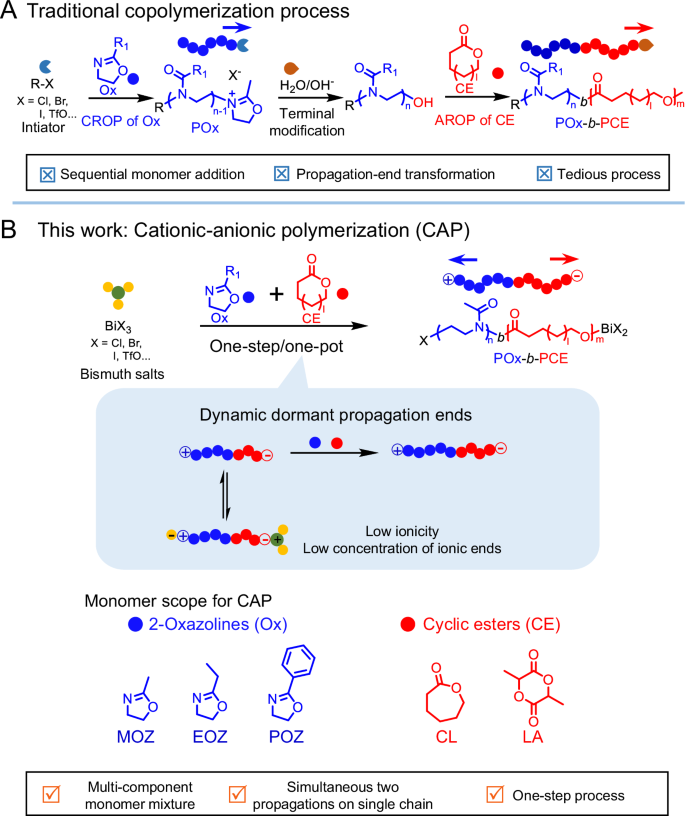
Chemical reactions with incompatible mechanisms (such as nucleophilic reactions and electrophilic reactions, cationic polymerization and anionic polymerization) are usually difficult to perform simultaneously in one-pot. In particular, synchronous cationic-anionic polymerization has been an important challenge in the field of polymer synthesis due to possible coupling termination of both chain ends. We recently found that such terminal couplings can be significantly inhibited by a bismuth salt with a strong nucleophilic anion (e.g., BiCl3) and disclosed the mechanism. Accordingly, we propose a cationic-anionic polymerization (CAP) method where cationic ring-opening polymerization (CROP) of 2-oxazolines (Ox) and anionic ring-opening polymerization (AROP) of cyclic esters (CE) can be initiated sequentially and propagated simultaneously in one-pot, using bismuth salts as the initial initiators, to afford a multifunctional copolymer polyoxazoline-block-polyester (POx-b-PCE). Furthermore, a block copolymer PAPOZ20-b-PCL5 synthesized by CAP can self-assemble into micellar aggregates, which exhibit excellent intrinsic antibacterial activities without loading any extra antibiotic components. Overall, such a CAP method opens new avenues for synthesizing multi-component copolymers and biomaterials.
期刊介绍:
Nature Communications, an open-access journal, publishes high-quality research spanning all areas of the natural sciences. Papers featured in the journal showcase significant advances relevant to specialists in each respective field. With a 2-year impact factor of 16.6 (2022) and a median time of 8 days from submission to the first editorial decision, Nature Communications is committed to rapid dissemination of research findings. As a multidisciplinary journal, it welcomes contributions from biological, health, physical, chemical, Earth, social, mathematical, applied, and engineering sciences, aiming to highlight important breakthroughs within each domain.



 京公网安备 11010802042870号
京ICP备2023020795号-1
京公网安备 11010802042870号
京ICP备2023020795号-1

 分享
分享
 求助内容:
求助内容: 应助结果提醒方式:
 扫码关注我们
