Gabrielle Hoyer, Kenneth T. Gao, Felix G. Gassert, Johanna Luitjens, Fei Jiang, Sharmila Majumdar, Valentina Pedoia
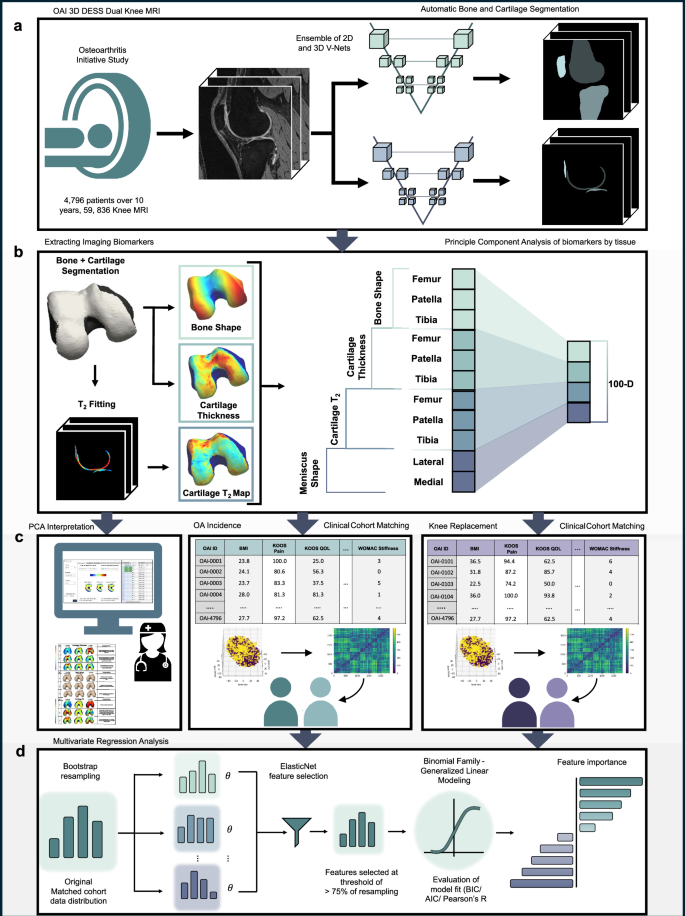
{"title":"Foundations of a knee joint digital twin from qMRI biomarkers for osteoarthritis and knee replacement","authors":"Gabrielle Hoyer, Kenneth T. Gao, Felix G. Gassert, Johanna Luitjens, Fei Jiang, Sharmila Majumdar, Valentina Pedoia","doi":"10.1038/s41746-025-01507-3","DOIUrl":null,"url":null,"abstract":"<p>This study forms the basis of a digital twin system of the knee joint, using advanced quantitative MRI (qMRI) and machine learning to advance precision health in osteoarthritis (OA) management and knee replacement (KR) prediction. We combined deep learning-based segmentation of knee joint structures with dimensionality reduction to create an embedded feature space of imaging biomarkers. Through cross-sectional cohort analysis and statistical modeling, we identified specific biomarkers, including variations in cartilage thickness and medial meniscus shape, that are significantly associated with OA incidence and KR outcomes. Integrating these findings into a comprehensive framework represents a considerable step toward personalized knee-joint digital twins, which could enhance therapeutic strategies and inform clinical decision-making in rheumatological care. This versatile and reliable infrastructure has the potential to be extended to broader clinical applications in precision health.</p>","PeriodicalId":19349,"journal":{"name":"NPJ Digital Medicine","volume":"15 1","pages":""},"PeriodicalIF":15.1000,"publicationDate":"2025-02-21","publicationTypes":"Journal Article","fieldsOfStudy":null,"isOpenAccess":false,"openAccessPdf":"","citationCount":"0","resultStr":null,"platform":"Semanticscholar","paperid":null,"PeriodicalName":"NPJ Digital Medicine","FirstCategoryId":"3","ListUrlMain":"https://doi.org/10.1038/s41746-025-01507-3","RegionNum":1,"RegionCategory":"医学","ArticlePicture":[],"TitleCN":null,"AbstractTextCN":null,"PMCID":null,"EPubDate":"","PubModel":"","JCR":"Q1","JCRName":"HEALTH CARE SCIENCES & SERVICES","Score":null,"Total":0}
引用次数: 0
Abstract
This study forms the basis of a digital twin system of the knee joint, using advanced quantitative MRI (qMRI) and machine learning to advance precision health in osteoarthritis (OA) management and knee replacement (KR) prediction. We combined deep learning-based segmentation of knee joint structures with dimensionality reduction to create an embedded feature space of imaging biomarkers. Through cross-sectional cohort analysis and statistical modeling, we identified specific biomarkers, including variations in cartilage thickness and medial meniscus shape, that are significantly associated with OA incidence and KR outcomes. Integrating these findings into a comprehensive framework represents a considerable step toward personalized knee-joint digital twins, which could enhance therapeutic strategies and inform clinical decision-making in rheumatological care. This versatile and reliable infrastructure has the potential to be extended to broader clinical applications in precision health.
这项研究为膝关节数字孪生系统奠定了基础,利用先进的定量磁共振成像(qMRI)和机器学习技术,推进骨关节炎(OA)管理和膝关节置换(KR)预测方面的精准医疗。我们将基于深度学习的膝关节结构分割与降维相结合,创建了成像生物标记物的嵌入式特征空间。通过横断面队列分析和统计建模,我们确定了特定的生物标志物,包括软骨厚度和内侧半月板形状的变化,这些生物标志物与 OA 发病率和 KR 结果显著相关。将这些发现整合到一个综合框架中,代表着向个性化膝关节数字双胞胎迈出了重要一步,它可以加强治疗策略,为风湿病护理的临床决策提供信息。这种多功能、可靠的基础设施有望扩展到精准健康领域更广泛的临床应用。
期刊介绍:
npj Digital Medicine is an online open-access journal that focuses on publishing peer-reviewed research in the field of digital medicine. The journal covers various aspects of digital medicine, including the application and implementation of digital and mobile technologies in clinical settings, virtual healthcare, and the use of artificial intelligence and informatics.
The primary goal of the journal is to support innovation and the advancement of healthcare through the integration of new digital and mobile technologies. When determining if a manuscript is suitable for publication, the journal considers four important criteria: novelty, clinical relevance, scientific rigor, and digital innovation.




 京公网安备 11010802042870号
京ICP备2023020795号-1
京公网安备 11010802042870号
京ICP备2023020795号-1

 分享
分享
 求助内容:
求助内容: 应助结果提醒方式:
 扫码关注我们
