Yohei Cho, Mengya Yang, Junyi Cui, Yue Yang, Surya Pratap Singh, Salvador Eslava, Daniele Benetti, James R Durrant, Akira Yamaguchi, Masahiro Miyauchi, Fumiaki Amano
{"title":"Analysis of the TiO2 Photoanode Process Using Intensity Modulated Photocurrent Spectroscopy and Distribution of Relaxation Times","authors":"Yohei Cho, Mengya Yang, Junyi Cui, Yue Yang, Surya Pratap Singh, Salvador Eslava, Daniele Benetti, James R Durrant, Akira Yamaguchi, Masahiro Miyauchi, Fumiaki Amano","doi":"10.1021/jacs.4c17345","DOIUrl":null,"url":null,"abstract":"Photoelectrochemical water splitting offers a promising pathway for green hydrogen production, but its efficiency is limited by electron−hole recombination. Overcoming this challenge requires detailed analysis of the relationship between charge separation and charge transfer kinetics under operando conditions. Here, we applied intensity-modulated photocurrent spectroscopy (IMPS) combined with distribution of relaxation times (DRT) analysis to the photoanodic process under varying light intensities. This approach revealed three distinct applied potential regions: a high-potential region with constant admittance independent of light intensity; a midpotential region strongly influenced by light intensity; and a low-potential region with back electron−hole recombination (BER). Crucially, our analysis demonstrated that what has traditionally been viewed as a single bulk recombination process can be resolved into distinct mechanisms based on light intensity dependence. Additionally, we identified satellite peaks in the slow kinetic regions for the first time. These peaks, influenced by light intensity and reaction conditions, revealed novel insights into surface-trapped hole dynamics. Based on these insights, we propose tailored band bending models for each kinetic scenario and discuss the implications of satellite peaks for reaction bottlenecks. These results offer new perspectives on understanding and optimizing photoelectrochemical systems.","PeriodicalId":49,"journal":{"name":"Journal of the American Chemical Society","volume":"11 1","pages":""},"PeriodicalIF":15.6000,"publicationDate":"2025-02-22","publicationTypes":"Journal Article","fieldsOfStudy":null,"isOpenAccess":false,"openAccessPdf":"","citationCount":"0","resultStr":null,"platform":"Semanticscholar","paperid":null,"PeriodicalName":"Journal of the American Chemical Society","FirstCategoryId":"92","ListUrlMain":"https://doi.org/10.1021/jacs.4c17345","RegionNum":1,"RegionCategory":"化学","ArticlePicture":[],"TitleCN":null,"AbstractTextCN":null,"PMCID":null,"EPubDate":"","PubModel":"","JCR":"Q1","JCRName":"CHEMISTRY, MULTIDISCIPLINARY","Score":null,"Total":0}
引用次数: 0
Abstract
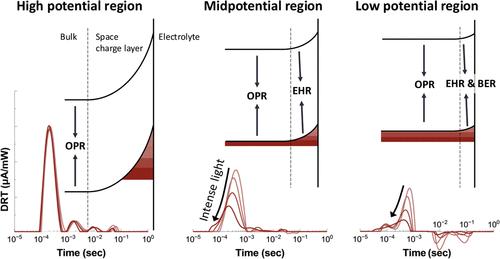
Photoelectrochemical water splitting offers a promising pathway for green hydrogen production, but its efficiency is limited by electron−hole recombination. Overcoming this challenge requires detailed analysis of the relationship between charge separation and charge transfer kinetics under operando conditions. Here, we applied intensity-modulated photocurrent spectroscopy (IMPS) combined with distribution of relaxation times (DRT) analysis to the photoanodic process under varying light intensities. This approach revealed three distinct applied potential regions: a high-potential region with constant admittance independent of light intensity; a midpotential region strongly influenced by light intensity; and a low-potential region with back electron−hole recombination (BER). Crucially, our analysis demonstrated that what has traditionally been viewed as a single bulk recombination process can be resolved into distinct mechanisms based on light intensity dependence. Additionally, we identified satellite peaks in the slow kinetic regions for the first time. These peaks, influenced by light intensity and reaction conditions, revealed novel insights into surface-trapped hole dynamics. Based on these insights, we propose tailored band bending models for each kinetic scenario and discuss the implications of satellite peaks for reaction bottlenecks. These results offer new perspectives on understanding and optimizing photoelectrochemical systems.
期刊介绍:
The flagship journal of the American Chemical Society, known as the Journal of the American Chemical Society (JACS), has been a prestigious publication since its establishment in 1879. It holds a preeminent position in the field of chemistry and related interdisciplinary sciences. JACS is committed to disseminating cutting-edge research papers, covering a wide range of topics, and encompasses approximately 19,000 pages of Articles, Communications, and Perspectives annually. With a weekly publication frequency, JACS plays a vital role in advancing the field of chemistry by providing essential research.



 京公网安备 11010802042870号
京ICP备2023020795号-1
京公网安备 11010802042870号
京ICP备2023020795号-1

 分享
分享
 求助内容:
求助内容: 应助结果提醒方式:
 扫码关注我们
