Francois Nkurunziza, Saudagar Dongare, Soumya Chatterjee, Bhavi Shah, Manu Gautam, Baleeswaraiah Muchharla, Bijandra Kumar, Michael J. Janik, Burcu Gurkan, Robert L. Sacci, Joshua M. Spurgeon
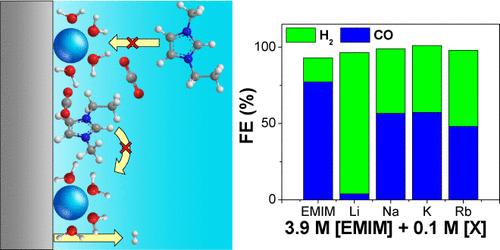
{"title":"Alkali Cation Inhibition of Imidazolium-Mediated Electrochemical CO2 Reduction on Silver","authors":"Francois Nkurunziza, Saudagar Dongare, Soumya Chatterjee, Bhavi Shah, Manu Gautam, Baleeswaraiah Muchharla, Bijandra Kumar, Michael J. Janik, Burcu Gurkan, Robert L. Sacci, Joshua M. Spurgeon","doi":"10.1021/jacs.4c16635","DOIUrl":null,"url":null,"abstract":"Imidazolium-based ionic liquids have led to enhanced CO<sub>2</sub> electroreduction activity due to cation effects at the cathode surface, stabilizing the reaction intermediates and decreasing the activation energy. In aqueous media, alkali cations are also known to improve CO<sub>2</sub> reduction activity on metals such as Ag, with the enhancement attributed to electrical double layer effects and trending with the size of the alkali cation. However, the effect of a mixed catholyte solution of alkali cations in the presence of an imidazolium-based ionic liquid has not been well-explored. Herein, 1-ethyl-3-methylimidazolium tetrafluoroborate, [EMIM][BF<sub>4</sub>], in water was investigated with alkali salts to unravel the interaction effects for CO<sub>2</sub> electroreduction on Ag. Although both [EMIM]<sup>+</sup> and alkali cations have individually improved CO<sub>2</sub> to CO conversion on Ag in water, electrochemical results showed that alkali cations hindered imidazolium-mediated CO<sub>2</sub> electroreduction in most conditions. Li<sup>+</sup>, in particular, was sharply inhibitory compared to other alkali cations and strongly redirected the selectivity to hydrogen evolution. The nature of the alkali cation inhibition was investigated with spectroscopic techniques, including in situ surface-enhanced Raman spectroscopy (SERS) and dynamic electrochemical impedance spectroscopy (DEIS). Along with computational insights from density functional theory (DFT), the electrochemical and spectroscopic data suggest that alkali cations inhibit [EMIM]-mediated CO<sub>2</sub> reduction by competing for surface adsorption sites, preventing the potential-dependent structural reorientation of imidazolium, and promoting hydrogen evolution by bringing solvated water to the cathode surface.","PeriodicalId":49,"journal":{"name":"Journal of the American Chemical Society","volume":"65 1","pages":""},"PeriodicalIF":15.6000,"publicationDate":"2025-02-21","publicationTypes":"Journal Article","fieldsOfStudy":null,"isOpenAccess":false,"openAccessPdf":"","citationCount":"0","resultStr":null,"platform":"Semanticscholar","paperid":null,"PeriodicalName":"Journal of the American Chemical Society","FirstCategoryId":"92","ListUrlMain":"https://doi.org/10.1021/jacs.4c16635","RegionNum":1,"RegionCategory":"化学","ArticlePicture":[],"TitleCN":null,"AbstractTextCN":null,"PMCID":null,"EPubDate":"","PubModel":"","JCR":"Q1","JCRName":"CHEMISTRY, MULTIDISCIPLINARY","Score":null,"Total":0}
引用次数: 0
Abstract
Imidazolium-based ionic liquids have led to enhanced CO2 electroreduction activity due to cation effects at the cathode surface, stabilizing the reaction intermediates and decreasing the activation energy. In aqueous media, alkali cations are also known to improve CO2 reduction activity on metals such as Ag, with the enhancement attributed to electrical double layer effects and trending with the size of the alkali cation. However, the effect of a mixed catholyte solution of alkali cations in the presence of an imidazolium-based ionic liquid has not been well-explored. Herein, 1-ethyl-3-methylimidazolium tetrafluoroborate, [EMIM][BF4], in water was investigated with alkali salts to unravel the interaction effects for CO2 electroreduction on Ag. Although both [EMIM]+ and alkali cations have individually improved CO2 to CO conversion on Ag in water, electrochemical results showed that alkali cations hindered imidazolium-mediated CO2 electroreduction in most conditions. Li+, in particular, was sharply inhibitory compared to other alkali cations and strongly redirected the selectivity to hydrogen evolution. The nature of the alkali cation inhibition was investigated with spectroscopic techniques, including in situ surface-enhanced Raman spectroscopy (SERS) and dynamic electrochemical impedance spectroscopy (DEIS). Along with computational insights from density functional theory (DFT), the electrochemical and spectroscopic data suggest that alkali cations inhibit [EMIM]-mediated CO2 reduction by competing for surface adsorption sites, preventing the potential-dependent structural reorientation of imidazolium, and promoting hydrogen evolution by bringing solvated water to the cathode surface.
由于阴极表面的阳离子效应,咪唑基离子液体可提高二氧化碳的电还原活性,稳定反应中间产物并降低活化能。众所周知,在水介质中,碱阳离子也能提高银等金属的二氧化碳还原活性,其增强作用归因于电双层效应,并随碱阳离子的大小而变化。然而,碱阳离子的混合阴离子溶液在咪唑基离子液体存在下的效果还没有得到很好的研究。本文研究了水中的 1-乙基-3-甲基咪唑鎓四氟硼酸盐 [EMIM][BF4]与碱盐的相互作用,以揭示 CO2 在 Ag 上的电还原效应。虽然[EMIM]+ 和碱阳离子都能单独改善 Ag 在水中将 CO2 转化为 CO 的过程,但电化学结果表明,在大多数条件下,碱阳离子阻碍了咪唑鎓介导的 CO2 电还原。尤其是 Li+,与其他碱阳离子相比,它具有明显的抑制作用,并强烈地将选择性转向氢气进化。通过光谱技术,包括原位表面增强拉曼光谱(SERS)和动态电化学阻抗光谱(DEIS),研究了碱阳离子抑制作用的性质。电化学和光谱数据以及密度泛函理论(DFT)的计算结果表明,碱阳离子通过竞争表面吸附位点、阻止咪唑鎓随电位变化的结构重新定向以及通过将溶解的水带到阴极表面来促进氢进化,从而抑制了[EMIM]介导的二氧化碳还原。
期刊介绍:
The flagship journal of the American Chemical Society, known as the Journal of the American Chemical Society (JACS), has been a prestigious publication since its establishment in 1879. It holds a preeminent position in the field of chemistry and related interdisciplinary sciences. JACS is committed to disseminating cutting-edge research papers, covering a wide range of topics, and encompasses approximately 19,000 pages of Articles, Communications, and Perspectives annually. With a weekly publication frequency, JACS plays a vital role in advancing the field of chemistry by providing essential research.



 京公网安备 11010802042870号
京ICP备2023020795号-1
京公网安备 11010802042870号
京ICP备2023020795号-1

 分享
分享
 求助内容:
求助内容: 应助结果提醒方式:
 扫码关注我们
