{"title":"Synergistic catalysis at in situ-formed Pt–NiOOH nanodot interfaces for highly efficient ammonia borane hydrolysis†","authors":"Shuo Zhang, Yao Chen, Zhenbo Xu, Keju Sun, Xin Xiao, Xiaolei Sun, Yuanyuan Li, Jiong Zhao, Ding Chen and Qiang Xu","doi":"10.1039/D4TA08797F","DOIUrl":null,"url":null,"abstract":"<p >Hydrolysis of ammonia borane (AB) comprising multiple intermediate steps is a representative catalytic reaction for hydrogen generation, usually requiring noble metal Pt as a catalyst. Constructing heterostructures is an effective strategy to improve the catalytic activity while reducing Pt usage. Herein, tailored nanodot–nanodot heterostructures of Pt–Ni(OH)<small><sub><em>x</em></sub></small> on reduced graphene oxide (RGO) are realized by the one-step solvothermal method. It is intriguingly found that local NiOOH nanodots, rather than Ni(OH)<small><sub>2</sub></small>, are <em>in situ</em> formed when encountering Pt on RGO, forming the heterointerface. Subsequently, the optimized Pt–Ni(OH)<small><sub><em>x</em></sub></small>/RGO catalyst exhibits the highest turnover frequency (TOF) of 17 740 min<small><sup>−1</sup></small> based on the Pt loading for hydrogen generation from AB hydrolysis at 303 K, which is 28 times as high as that of Pt/RGO. Theoretical calculations reveal that the heterojunction catalyst promotes the chemisorption and dissociation of water molecules, accelerating H<small><sub>2</sub></small> generation from AB hydrolysis. This one-step solvothermal method to produce the Pt–Ni(OH)<small><sub><em>x</em></sub></small>/RGO catalyst provides a general route to high-performance nanodot–nanodot heterostructure catalysts for various hydrogen-generation catalytic domains.</p>","PeriodicalId":82,"journal":{"name":"Journal of Materials Chemistry A","volume":" 13","pages":" 9372-9380"},"PeriodicalIF":9.5000,"publicationDate":"2025-02-22","publicationTypes":"Journal Article","fieldsOfStudy":null,"isOpenAccess":false,"openAccessPdf":"","citationCount":"0","resultStr":null,"platform":"Semanticscholar","paperid":null,"PeriodicalName":"Journal of Materials Chemistry A","FirstCategoryId":"88","ListUrlMain":"https://pubs.rsc.org/en/content/articlelanding/2025/ta/d4ta08797f","RegionNum":2,"RegionCategory":"材料科学","ArticlePicture":[],"TitleCN":null,"AbstractTextCN":null,"PMCID":null,"EPubDate":"","PubModel":"","JCR":"Q1","JCRName":"CHEMISTRY, PHYSICAL","Score":null,"Total":0}
引用次数: 0
Abstract
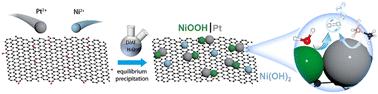
Hydrolysis of ammonia borane (AB) comprising multiple intermediate steps is a representative catalytic reaction for hydrogen generation, usually requiring noble metal Pt as a catalyst. Constructing heterostructures is an effective strategy to improve the catalytic activity while reducing Pt usage. Herein, tailored nanodot–nanodot heterostructures of Pt–Ni(OH)x on reduced graphene oxide (RGO) are realized by the one-step solvothermal method. It is intriguingly found that local NiOOH nanodots, rather than Ni(OH)2, are in situ formed when encountering Pt on RGO, forming the heterointerface. Subsequently, the optimized Pt–Ni(OH)x/RGO catalyst exhibits the highest turnover frequency (TOF) of 17 740 min−1 based on the Pt loading for hydrogen generation from AB hydrolysis at 303 K, which is 28 times as high as that of Pt/RGO. Theoretical calculations reveal that the heterojunction catalyst promotes the chemisorption and dissociation of water molecules, accelerating H2 generation from AB hydrolysis. This one-step solvothermal method to produce the Pt–Ni(OH)x/RGO catalyst provides a general route to high-performance nanodot–nanodot heterostructure catalysts for various hydrogen-generation catalytic domains.
期刊介绍:
The Journal of Materials Chemistry A, B & C covers a wide range of high-quality studies in the field of materials chemistry, with each section focusing on specific applications of the materials studied. Journal of Materials Chemistry A emphasizes applications in energy and sustainability, including topics such as artificial photosynthesis, batteries, and fuel cells. Journal of Materials Chemistry B focuses on applications in biology and medicine, while Journal of Materials Chemistry C covers applications in optical, magnetic, and electronic devices. Example topic areas within the scope of Journal of Materials Chemistry A include catalysis, green/sustainable materials, sensors, and water treatment, among others.



 京公网安备 11010802042870号
京ICP备2023020795号-1
京公网安备 11010802042870号
京ICP备2023020795号-1

 分享
分享
 求助内容:
求助内容: 应助结果提醒方式:
 扫码关注我们
