Camilla Johansson , Christel Larsson , Evaggelia Papia
{"title":"Biaxial flexural strength and surface characterization of multilayer zirconium dioxide after polishing, glazing and clinical adjustments","authors":"Camilla Johansson , Christel Larsson , Evaggelia Papia","doi":"10.1016/j.jmbbm.2025.106930","DOIUrl":null,"url":null,"abstract":"<div><h3>Purpose</h3><div>To evaluate how laboratory polishing and glazing and clinical adjustments, i.e., by grinding and polishing affect the biaxial flexural strength and surface characterization of multilayer zirconia.</div></div><div><h3>Methods</h3><div>Specimens of KATANA™ Zirconia YML, containing Enamel–Body 1 or Body 2–3 layers, and UTML were divided into 18 groups (<em>n</em> = 11) according to material/layer and finish treatment: laboratory polishing, glazing, or both, or followed by clinical adjustments. The surface roughness, surface structure and elemental composition were evaluated<em>.</em> Thermocyclic-mechanical cyclic loading and biaxial flexural strength test were performed. Three- and two-way ANOVA were used (<em>α</em> = 0.05).</div></div><div><h3>Results</h3><div>The yttrium amount decreased in the order UTML, YML Enamel–Body 1, and YML Body 2–3. Body 2–3 showed higher flexural strength than Enamel–Body 1 and UTML, in that order. Flexural strength after clinical adjustments was higher in Body 2–3 but lower in Enamel–Body 1 and UTML. Finish treatments had indistinguishable impact on Enamel–Body 1. Body 2–3 had higher strength after polishing, polishing and glazing, and glazing, in that order. UTML displayed the highest strength after polishing and glazing or glazing. The surface roughness was lowest after polishing regardless of material/layer.</div></div><div><h3>Conclusions</h3><div>Laboratory treatments and clinical adjustments of multilayer zirconia affect the flexural strength and surface roughness differently depending on the zirconia type. Composition-gradient zirconia should be polished, and shade-gradient zirconia (≥ 5 mol% yttria) should be polished and glazed. Clinical adjustments of zirconia with higher yttria content are detrimental for the flexural strength and should be performed with caution.</div></div>","PeriodicalId":380,"journal":{"name":"Journal of the Mechanical Behavior of Biomedical Materials","volume":"166 ","pages":"Article 106930"},"PeriodicalIF":3.5000,"publicationDate":"2025-06-01","publicationTypes":"Journal Article","fieldsOfStudy":null,"isOpenAccess":false,"openAccessPdf":"","citationCount":"0","resultStr":null,"platform":"Semanticscholar","paperid":null,"PeriodicalName":"Journal of the Mechanical Behavior of Biomedical Materials","FirstCategoryId":"5","ListUrlMain":"https://www.sciencedirect.com/science/article/pii/S1751616125000463","RegionNum":2,"RegionCategory":"医学","ArticlePicture":[],"TitleCN":null,"AbstractTextCN":null,"PMCID":null,"EPubDate":"2025/2/8 0:00:00","PubModel":"Epub","JCR":"Q2","JCRName":"ENGINEERING, BIOMEDICAL","Score":null,"Total":0}
引用次数: 0
Abstract
Purpose
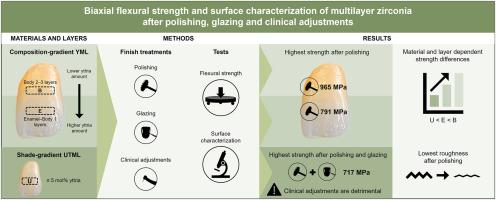
To evaluate how laboratory polishing and glazing and clinical adjustments, i.e., by grinding and polishing affect the biaxial flexural strength and surface characterization of multilayer zirconia.
Methods
Specimens of KATANA™ Zirconia YML, containing Enamel–Body 1 or Body 2–3 layers, and UTML were divided into 18 groups (n = 11) according to material/layer and finish treatment: laboratory polishing, glazing, or both, or followed by clinical adjustments. The surface roughness, surface structure and elemental composition were evaluated. Thermocyclic-mechanical cyclic loading and biaxial flexural strength test were performed. Three- and two-way ANOVA were used (α = 0.05).
Results
The yttrium amount decreased in the order UTML, YML Enamel–Body 1, and YML Body 2–3. Body 2–3 showed higher flexural strength than Enamel–Body 1 and UTML, in that order. Flexural strength after clinical adjustments was higher in Body 2–3 but lower in Enamel–Body 1 and UTML. Finish treatments had indistinguishable impact on Enamel–Body 1. Body 2–3 had higher strength after polishing, polishing and glazing, and glazing, in that order. UTML displayed the highest strength after polishing and glazing or glazing. The surface roughness was lowest after polishing regardless of material/layer.
Conclusions
Laboratory treatments and clinical adjustments of multilayer zirconia affect the flexural strength and surface roughness differently depending on the zirconia type. Composition-gradient zirconia should be polished, and shade-gradient zirconia (≥ 5 mol% yttria) should be polished and glazed. Clinical adjustments of zirconia with higher yttria content are detrimental for the flexural strength and should be performed with caution.
期刊介绍:
The Journal of the Mechanical Behavior of Biomedical Materials is concerned with the mechanical deformation, damage and failure under applied forces, of biological material (at the tissue, cellular and molecular levels) and of biomaterials, i.e. those materials which are designed to mimic or replace biological materials.
The primary focus of the journal is the synthesis of materials science, biology, and medical and dental science. Reports of fundamental scientific investigations are welcome, as are articles concerned with the practical application of materials in medical devices. Both experimental and theoretical work is of interest; theoretical papers will normally include comparison of predictions with experimental data, though we recognize that this may not always be appropriate. The journal also publishes technical notes concerned with emerging experimental or theoretical techniques, letters to the editor and, by invitation, review articles and papers describing existing techniques for the benefit of an interdisciplinary readership.



 京公网安备 11010802042870号
京ICP备2023020795号-1
京公网安备 11010802042870号
京ICP备2023020795号-1

 分享
分享
 求助内容:
求助内容: 应助结果提醒方式:
 扫码关注我们
