Aniket Pratapneni, Daniella Klebaner, Scott Gerard Soltys, Elham Rahimy, Iris Catrice Gibbs, Steven Daniel Chang, Gordon Li, Melanie Hayden Gephart, Anand Veeravagu, Gregory Arthur Szalkowski, Xuejun Gu, Lei Wang, Cynthia Chuang, Lianli Liu, Scott Jackson, Rong Lu, Jillian Adele Skerchak, Kelly Zhe Huang, Samantha Wong, Eleanor Brown, Erqi Liu Pollom
{"title":"Single- versus multi-fraction spine stereotactic radiosurgery (ALL-STAR) for patients with spinal metastases: a randomized phase III trial protocol.","authors":"Aniket Pratapneni, Daniella Klebaner, Scott Gerard Soltys, Elham Rahimy, Iris Catrice Gibbs, Steven Daniel Chang, Gordon Li, Melanie Hayden Gephart, Anand Veeravagu, Gregory Arthur Szalkowski, Xuejun Gu, Lei Wang, Cynthia Chuang, Lianli Liu, Scott Jackson, Rong Lu, Jillian Adele Skerchak, Kelly Zhe Huang, Samantha Wong, Eleanor Brown, Erqi Liu Pollom","doi":"10.1186/s12885-025-13655-6","DOIUrl":null,"url":null,"abstract":"<p><strong>Background: </strong>For patients with spine metastases, stereotactic radiosurgery (SRS) provides excellent local control and pain response. Despite increasing use of this treatment modality, there is no consensus on the optimal dose and fractionation of spine SRS for efficacy and toxicity. We have initiated a single-center phase III randomized trial that compares two dose regimens with similar biological equivalent dose (BED) to determine the isolated effect of SRS fractionation on local control.</p><p><strong>Methods: </strong>Patients with one to three cervical, thoracic, or lumbar spine metastases spanning no more than two contiguous vertebral levels in need of radiation will be eligible for enrollment. Patients will be assigned 1:1 to receive either 22 Gy in 1 fraction or 28 Gy in 2 fractions. Biased coin randomization will be used to randomly assign patients while balancing the following stratifying variables between the two treatment arms at baseline: gastrointestinal histology (yes/no), paraspinal tissue extension (yes/no), epidural compression (low-/high-grade), and number of sites treated (one to three). The primary endpoint is one-year local control, defined per Spine Response Assessment in Neuro-Oncology (SPINO) criteria. The secondary endpoints include patient-reported health-related quality of life (HRQOL), pain associated with the treated site, vertebral compression fracture (VCF), and two-year local control. Patients will be followed for these outcomes at one to two weeks, one month, three months, and six months after treatment, and every six months thereafter until 24 months after treatment. While on the study, patients will receive routine co-interventions as clinically indicated.</p><p><strong>Discussion: </strong>The studies published thus far comparing the single- and multi-fraction SRS are lacking long-term local control outcomes and are limited by selection bias as well as single-fraction arms with higher BED, which is correlated with improved local control. Our study will isolate the effect of fractionation by comparing one-year local control in patients treated with single- and multi-fraction SRS with equivalent BED. We anticipate that the results of this, as well as secondary endpoints such as pain response, adverse effects, and quality of life will provide much-needed guidance regarding optimal dose and fractionation for both maximizing local control and minimizing toxicity.</p><p><strong>Clinical trial information: </strong>NCT#06173401. Approved by Stanford Scientific Review Committee (study ID: BRN0060) on 9/12/2023 and Stanford Institutional Review Board (study ID: IRB-72248) on 11/14/2023.</p>","PeriodicalId":9131,"journal":{"name":"BMC Cancer","volume":"25 1","pages":"323"},"PeriodicalIF":3.4000,"publicationDate":"2025-02-21","publicationTypes":"Journal Article","fieldsOfStudy":null,"isOpenAccess":false,"openAccessPdf":"https://www.ncbi.nlm.nih.gov/pmc/articles/PMC11846292/pdf/","citationCount":"0","resultStr":null,"platform":"Semanticscholar","paperid":null,"PeriodicalName":"BMC Cancer","FirstCategoryId":"3","ListUrlMain":"https://doi.org/10.1186/s12885-025-13655-6","RegionNum":2,"RegionCategory":"医学","ArticlePicture":[],"TitleCN":null,"AbstractTextCN":null,"PMCID":null,"EPubDate":"","PubModel":"","JCR":"Q2","JCRName":"ONCOLOGY","Score":null,"Total":0}
引用次数: 0
Abstract
Background: For patients with spine metastases, stereotactic radiosurgery (SRS) provides excellent local control and pain response. Despite increasing use of this treatment modality, there is no consensus on the optimal dose and fractionation of spine SRS for efficacy and toxicity. We have initiated a single-center phase III randomized trial that compares two dose regimens with similar biological equivalent dose (BED) to determine the isolated effect of SRS fractionation on local control.
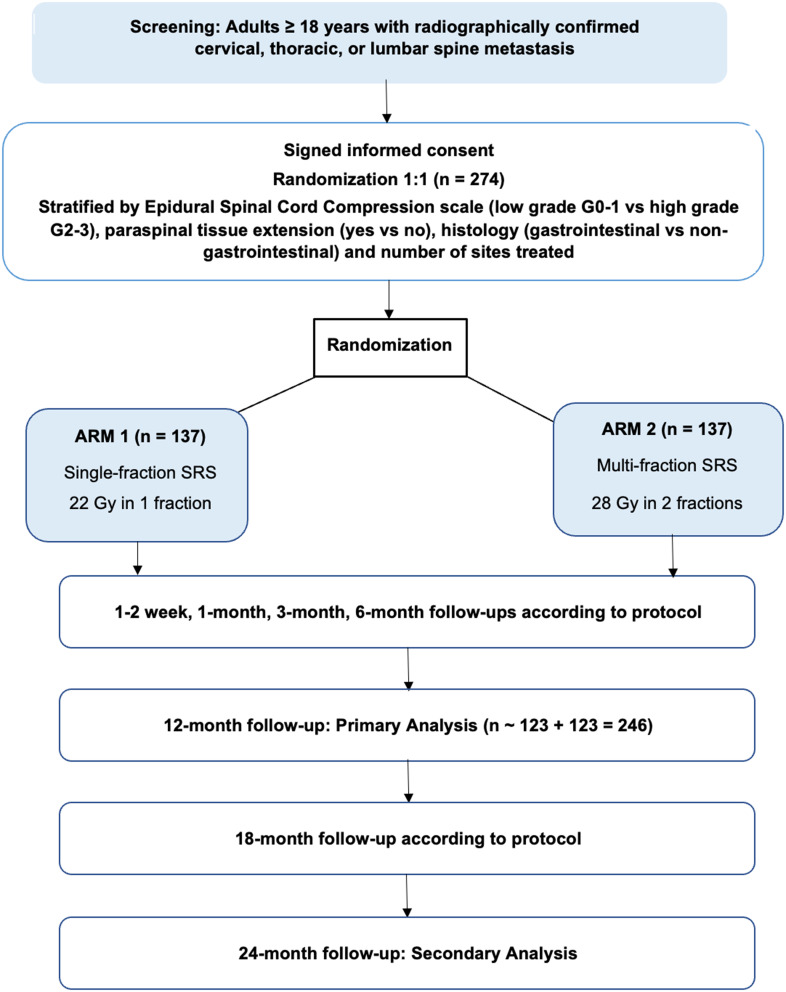
Methods: Patients with one to three cervical, thoracic, or lumbar spine metastases spanning no more than two contiguous vertebral levels in need of radiation will be eligible for enrollment. Patients will be assigned 1:1 to receive either 22 Gy in 1 fraction or 28 Gy in 2 fractions. Biased coin randomization will be used to randomly assign patients while balancing the following stratifying variables between the two treatment arms at baseline: gastrointestinal histology (yes/no), paraspinal tissue extension (yes/no), epidural compression (low-/high-grade), and number of sites treated (one to three). The primary endpoint is one-year local control, defined per Spine Response Assessment in Neuro-Oncology (SPINO) criteria. The secondary endpoints include patient-reported health-related quality of life (HRQOL), pain associated with the treated site, vertebral compression fracture (VCF), and two-year local control. Patients will be followed for these outcomes at one to two weeks, one month, three months, and six months after treatment, and every six months thereafter until 24 months after treatment. While on the study, patients will receive routine co-interventions as clinically indicated.
Discussion: The studies published thus far comparing the single- and multi-fraction SRS are lacking long-term local control outcomes and are limited by selection bias as well as single-fraction arms with higher BED, which is correlated with improved local control. Our study will isolate the effect of fractionation by comparing one-year local control in patients treated with single- and multi-fraction SRS with equivalent BED. We anticipate that the results of this, as well as secondary endpoints such as pain response, adverse effects, and quality of life will provide much-needed guidance regarding optimal dose and fractionation for both maximizing local control and minimizing toxicity.
Clinical trial information: NCT#06173401. Approved by Stanford Scientific Review Committee (study ID: BRN0060) on 9/12/2023 and Stanford Institutional Review Board (study ID: IRB-72248) on 11/14/2023.
期刊介绍:
BMC Cancer is an open access, peer-reviewed journal that considers articles on all aspects of cancer research, including the pathophysiology, prevention, diagnosis and treatment of cancers. The journal welcomes submissions concerning molecular and cellular biology, genetics, epidemiology, and clinical trials.





 京公网安备 11010802042870号
京ICP备2023020795号-1
京公网安备 11010802042870号
京ICP备2023020795号-1

 分享
分享
 求助内容:
求助内容: 应助结果提醒方式:
 扫码关注我们
