{"title":"Association between levothyroxine supplementation for hypothyroidism in late pregnancy and risk of prematurity: a population-based cohort study.","authors":"Maya Laham, Odile Sheehy, Anick Bérard","doi":"10.1186/s12916-025-03934-1","DOIUrl":null,"url":null,"abstract":"<p><strong>Background: </strong>Hypothyroidism in pregnancy is associated with obstetrical and fetal complications, such as prematurity. However, whether its management by levothyroxine affects the risk of prematurity is not yet clear.</p><p><strong>Methods: </strong>We conducted a cohort study within the Quebec Pregnancy Cohort including pregnancies with hypothyroidism from January 1, 1998, through December 31, 2015. In primary analyses, we considered levothyroxine exposure (yes/no), total duration, mean daily dose, and cumulative dose in the 2-months period before delivery (for preterm deliveries) or before 37th weeks' gestation (for term deliveries). Secondly, levothyroxine dosage before and after the beginning of the second trimester were compared, and pregnancies were categorized in increased or constant dosage groups. Lastly, levothyroxine was also defined as a time-varying daily exposure from the 14th weeks' gestation until delivery or 37th weeks' gestation, whichever came first. Prematurity was defined as giving birth before the 37th weeks' gestation. Term pregnancies were censored at 37th weeks' gestation because they were no longer at risk of prematurity afterwards. Generalized estimating equations and Cox-proportional hazard models, adjusted for potential confounders, were used to calculate adjusted relative risks (aRRs) and hazard ratios (aHRs), respectively.</p><p><strong>Results: </strong>A total of 9489 pregnant individuals with hypothyroidism were included. Among them, 6667 (70.3%) were exposed to levothyroxine in the 2-months time-window. Adjusting for potential confounders, no association was observed between levothyroxine exposure (aRR, 0.98; 95% CI, 0.81-1.20) and the risk of prematurity compared to non-exposed. Also, no association between levothyroxine duration (> 30 days: aRR, 0.99; 95% CI, 0.81-1.21), cumulative dose (> 7125 mcg: aRR, 0.97; 95% CI, 0.73-1.27) or mean daily dose (> 125 mcg/day: aRR, 0.95; 95% CI, 0.72-1.26) and the risk of prematurity was observed, compared to non-exposure. Finally, the risk of prematurity did not vary between increased or constant dosage groups (aRR, 0.84; 95% CI, 0.67-1.05). Similarly, time-varying exposure analysis did not show any association between levothyroxine exposure and prematurity risk (aHR, 0.95; 95% CI, 0.81-1.11).</p><p><strong>Conclusions: </strong>Levothyroxine supplementation in late pregnancy among individuals with hypothyroidism was not associated with prematurity risk. Our findings support the safe use of levothyroxine during gestation and might be useful for the current guidelines.</p>","PeriodicalId":9188,"journal":{"name":"BMC Medicine","volume":"23 1","pages":"105"},"PeriodicalIF":8.3000,"publicationDate":"2025-02-21","publicationTypes":"Journal Article","fieldsOfStudy":null,"isOpenAccess":false,"openAccessPdf":"https://www.ncbi.nlm.nih.gov/pmc/articles/PMC11846315/pdf/","citationCount":"0","resultStr":null,"platform":"Semanticscholar","paperid":null,"PeriodicalName":"BMC Medicine","FirstCategoryId":"3","ListUrlMain":"https://doi.org/10.1186/s12916-025-03934-1","RegionNum":1,"RegionCategory":"医学","ArticlePicture":[],"TitleCN":null,"AbstractTextCN":null,"PMCID":null,"EPubDate":"","PubModel":"","JCR":"Q1","JCRName":"MEDICINE, GENERAL & INTERNAL","Score":null,"Total":0}
引用次数: 0
Abstract
Background: Hypothyroidism in pregnancy is associated with obstetrical and fetal complications, such as prematurity. However, whether its management by levothyroxine affects the risk of prematurity is not yet clear.
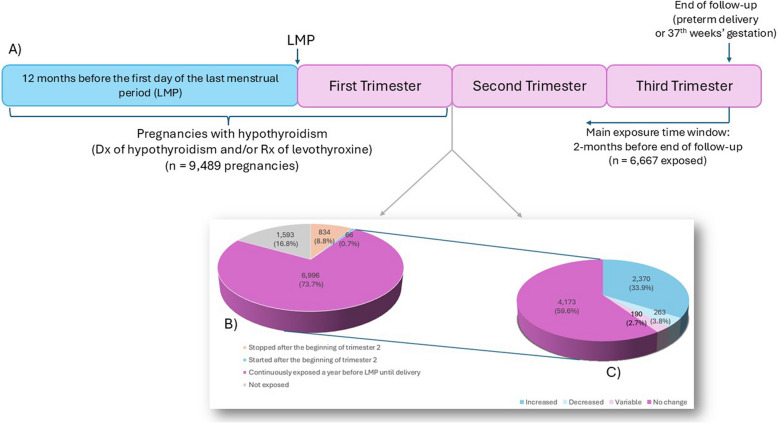
Methods: We conducted a cohort study within the Quebec Pregnancy Cohort including pregnancies with hypothyroidism from January 1, 1998, through December 31, 2015. In primary analyses, we considered levothyroxine exposure (yes/no), total duration, mean daily dose, and cumulative dose in the 2-months period before delivery (for preterm deliveries) or before 37th weeks' gestation (for term deliveries). Secondly, levothyroxine dosage before and after the beginning of the second trimester were compared, and pregnancies were categorized in increased or constant dosage groups. Lastly, levothyroxine was also defined as a time-varying daily exposure from the 14th weeks' gestation until delivery or 37th weeks' gestation, whichever came first. Prematurity was defined as giving birth before the 37th weeks' gestation. Term pregnancies were censored at 37th weeks' gestation because they were no longer at risk of prematurity afterwards. Generalized estimating equations and Cox-proportional hazard models, adjusted for potential confounders, were used to calculate adjusted relative risks (aRRs) and hazard ratios (aHRs), respectively.
Results: A total of 9489 pregnant individuals with hypothyroidism were included. Among them, 6667 (70.3%) were exposed to levothyroxine in the 2-months time-window. Adjusting for potential confounders, no association was observed between levothyroxine exposure (aRR, 0.98; 95% CI, 0.81-1.20) and the risk of prematurity compared to non-exposed. Also, no association between levothyroxine duration (> 30 days: aRR, 0.99; 95% CI, 0.81-1.21), cumulative dose (> 7125 mcg: aRR, 0.97; 95% CI, 0.73-1.27) or mean daily dose (> 125 mcg/day: aRR, 0.95; 95% CI, 0.72-1.26) and the risk of prematurity was observed, compared to non-exposure. Finally, the risk of prematurity did not vary between increased or constant dosage groups (aRR, 0.84; 95% CI, 0.67-1.05). Similarly, time-varying exposure analysis did not show any association between levothyroxine exposure and prematurity risk (aHR, 0.95; 95% CI, 0.81-1.11).
Conclusions: Levothyroxine supplementation in late pregnancy among individuals with hypothyroidism was not associated with prematurity risk. Our findings support the safe use of levothyroxine during gestation and might be useful for the current guidelines.
期刊介绍:
BMC Medicine is an open access, transparent peer-reviewed general medical journal. It is the flagship journal of the BMC series and publishes outstanding and influential research in various areas including clinical practice, translational medicine, medical and health advances, public health, global health, policy, and general topics of interest to the biomedical and sociomedical professional communities. In addition to research articles, the journal also publishes stimulating debates, reviews, unique forum articles, and concise tutorials. All articles published in BMC Medicine are included in various databases such as Biological Abstracts, BIOSIS, CAS, Citebase, Current contents, DOAJ, Embase, MEDLINE, PubMed, Science Citation Index Expanded, OAIster, SCImago, Scopus, SOCOLAR, and Zetoc.




 京公网安备 11010802042870号
京ICP备2023020795号-1
京公网安备 11010802042870号
京ICP备2023020795号-1

 分享
分享
 求助内容:
求助内容: 应助结果提醒方式:
 扫码关注我们
