Kedir Y Ahmed, Utpal K Mondal, M Mamun Huda, Setognal B Aychiluhm, Jamie Newman, Subash Thapa, Peter Gibbs, Shakeel Mahmood, Feleke H Astawesegn, Anayochukwu E Anyasodor, Allen G Ross
{"title":"Normal-weight central obesity and cardiometabolic disorders among Aboriginal and Torres Strait Islander Australians.","authors":"Kedir Y Ahmed, Utpal K Mondal, M Mamun Huda, Setognal B Aychiluhm, Jamie Newman, Subash Thapa, Peter Gibbs, Shakeel Mahmood, Feleke H Astawesegn, Anayochukwu E Anyasodor, Allen G Ross","doi":"10.1186/s12916-025-03942-1","DOIUrl":null,"url":null,"abstract":"<p><strong>Background: </strong>Cardiometabolic disorders are the leading cause of mortality and contribute substantially to the First Nations Health Gap in Australia. Central obesity is the major contributor to metabolic syndrome. We investigated factors associated with central obesity and how normal-weight central obesity is associated with cardiometabolic disorders among Aboriginal and Torres Strait Islander Australians (hereafter respectfully referred to as 'Indigenous Australians').</p><p><strong>Methods: </strong>This study used the 2018-2019 Australian Bureau of Statistics (ABS) National Aboriginal and Torres Strait Islander Health Survey dataset. A total of weighted 4864 Indigenous adults (18 + years) were included. Normal-weight central obesity refers to individuals with a normal body mass index (BMI) but with an elevated waist circumference (WC ≥ 102 cm for males and ≥ 88 cm for females). Main outcomes included self-reported type 2 diabetes, hypertension, high cholesterol and heart disease. Multi-level logistic regression models were used to examine the relationship between explanatory variables and outcomes.</p><p><strong>Results: </strong>The overall prevalence of central obesity was 46.2% (95% confidence interval [CI]: 42.8, 49.72) in males and 67.7% (95% CI: 64.90, 70.4) in females. Physical inactivity increased the risk of central obesity in males (odds ratio [OR] = 1.34; 95% CI: 1.09, 1.65), while daily consumption of soft drinks was associated with central obesity in females (OR = 1.35; 95% CI: 1.12, 1.62). Males living in very remote areas had a lower risk of central obesity, while females in very remote areas had a higher risk. Our findings also showed that females with normal-weight central obesity had a higher risk of hypertension (OR = 3.29; 95% CI: 1.95, 9.62) and higher total cholesterol (OR = 4.62; 95% CI: 2.22, 9.62). Similarly, males with normal-weight central obesity were associated with a higher risk of type 2 diabetes (OR = 4.13; 95% CI: 1.23, 13.94).</p><p><strong>Conclusions: </strong>This was the first study to report that approximately 12% of Indigenous Australians with normal BMI have central obesity. Relying solely on BMI to identify such high-risk individuals may be inadequate for early intervention. Public health initiatives targeting obesity should include individuals with a normal BMI and central obesity.</p>","PeriodicalId":9188,"journal":{"name":"BMC Medicine","volume":"23 1","pages":"106"},"PeriodicalIF":8.3000,"publicationDate":"2025-02-21","publicationTypes":"Journal Article","fieldsOfStudy":null,"isOpenAccess":false,"openAccessPdf":"https://www.ncbi.nlm.nih.gov/pmc/articles/PMC11846202/pdf/","citationCount":"0","resultStr":null,"platform":"Semanticscholar","paperid":null,"PeriodicalName":"BMC Medicine","FirstCategoryId":"3","ListUrlMain":"https://doi.org/10.1186/s12916-025-03942-1","RegionNum":1,"RegionCategory":"医学","ArticlePicture":[],"TitleCN":null,"AbstractTextCN":null,"PMCID":null,"EPubDate":"","PubModel":"","JCR":"Q1","JCRName":"MEDICINE, GENERAL & INTERNAL","Score":null,"Total":0}
引用次数: 0
Abstract
Background: Cardiometabolic disorders are the leading cause of mortality and contribute substantially to the First Nations Health Gap in Australia. Central obesity is the major contributor to metabolic syndrome. We investigated factors associated with central obesity and how normal-weight central obesity is associated with cardiometabolic disorders among Aboriginal and Torres Strait Islander Australians (hereafter respectfully referred to as 'Indigenous Australians').
Methods: This study used the 2018-2019 Australian Bureau of Statistics (ABS) National Aboriginal and Torres Strait Islander Health Survey dataset. A total of weighted 4864 Indigenous adults (18 + years) were included. Normal-weight central obesity refers to individuals with a normal body mass index (BMI) but with an elevated waist circumference (WC ≥ 102 cm for males and ≥ 88 cm for females). Main outcomes included self-reported type 2 diabetes, hypertension, high cholesterol and heart disease. Multi-level logistic regression models were used to examine the relationship between explanatory variables and outcomes.
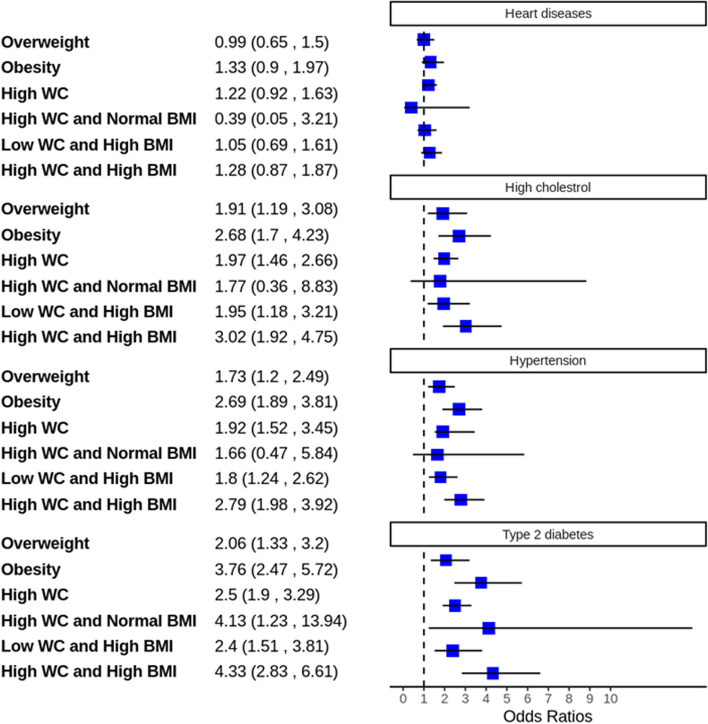
Results: The overall prevalence of central obesity was 46.2% (95% confidence interval [CI]: 42.8, 49.72) in males and 67.7% (95% CI: 64.90, 70.4) in females. Physical inactivity increased the risk of central obesity in males (odds ratio [OR] = 1.34; 95% CI: 1.09, 1.65), while daily consumption of soft drinks was associated with central obesity in females (OR = 1.35; 95% CI: 1.12, 1.62). Males living in very remote areas had a lower risk of central obesity, while females in very remote areas had a higher risk. Our findings also showed that females with normal-weight central obesity had a higher risk of hypertension (OR = 3.29; 95% CI: 1.95, 9.62) and higher total cholesterol (OR = 4.62; 95% CI: 2.22, 9.62). Similarly, males with normal-weight central obesity were associated with a higher risk of type 2 diabetes (OR = 4.13; 95% CI: 1.23, 13.94).
Conclusions: This was the first study to report that approximately 12% of Indigenous Australians with normal BMI have central obesity. Relying solely on BMI to identify such high-risk individuals may be inadequate for early intervention. Public health initiatives targeting obesity should include individuals with a normal BMI and central obesity.
期刊介绍:
BMC Medicine is an open access, transparent peer-reviewed general medical journal. It is the flagship journal of the BMC series and publishes outstanding and influential research in various areas including clinical practice, translational medicine, medical and health advances, public health, global health, policy, and general topics of interest to the biomedical and sociomedical professional communities. In addition to research articles, the journal also publishes stimulating debates, reviews, unique forum articles, and concise tutorials. All articles published in BMC Medicine are included in various databases such as Biological Abstracts, BIOSIS, CAS, Citebase, Current contents, DOAJ, Embase, MEDLINE, PubMed, Science Citation Index Expanded, OAIster, SCImago, Scopus, SOCOLAR, and Zetoc.




 京公网安备 11010802042870号
京ICP备2023020795号-1
京公网安备 11010802042870号
京ICP备2023020795号-1

 分享
分享
 求助内容:
求助内容: 应助结果提醒方式:
 扫码关注我们
