{"title":"Patient-physician communication of health and risk information in the management of cardiovascular diseases and diabetes: a systematic scoping review.","authors":"Aloysius Wei-Yan Chia, Winnie Li-Lian Teo, Sanchalika Acharyya, Yasmin Lynda Munro, Rinkoo Dalan","doi":"10.1186/s12916-025-03873-x","DOIUrl":null,"url":null,"abstract":"<p><strong>Background: </strong>The communication of health and risk information is an integral part of patient-physician interaction. Effective communication of risk information for cardiovascular diseases and diabetes has been shown to improve medication adherence, increase physical activity levels, and improve dietary control. Patients who understand their risk profile are better able to work towards modifying their lifestyle behaviours as part of a shared decision-making process with physicians. This scoping review examines the evidence on patient-physician risk communication strategies, approaches and interventions for CVDs and diabetes management in primary care and secondary outpatient settings.</p><p><strong>Methods: </strong>A comprehensive database search for quantitative and qualitative studies was conducted in PubMed, Embase, Web of Science, Scopus, CINAHL, PsycINFO, and Cochrane Library from 1st January 2000 to 3rd October 2023. Two reviewers independently performed the screening of articles. Studies that report on patient-physician risk communication processes were included. Data were extracted and analysed using descriptive summaries and narrative synthesis. Results are reported in accordance with PRISMA-ScR guidelines. Included articles were appraised for quality following JBI critical appraisal and MMAT tools.</p><p><strong>Results: </strong>A total of 8378 articles published between 1st Jan 2000 to 3rd October 2023 were screened. After a full-text review of 88 articles, a total of 30 articles, consisting of 15 qualitative, 14 quantitative and 1 mixed method studies were included. Common areas of inquiry among articles include: (1) understanding and recalling risk information, (2) strategies and approaches used by physicians to communicate risk, and (3) interventions to improve the communication of risk. Studies reveal how physicians use a range of strategies, approaches and interventions to discuss risk with patients. We present and discuss each theme narratively in detail.</p><p><strong>Conclusions: </strong>There is a critical need for further research into risk communication strategies for cardiovascular diseases (CVDs) and diabetes, with a focus on developing targeted approaches that enhance patients' understanding of their risk profiles. Evidence-based guidelines should assist healthcare professionals improve risk communication within clinical settings, with the goal of facilitating patient comprehension of health risks that can sustain lifestyle changes. Misalignment in communication may lead to dissatisfaction and confusion, which may impede the effective management of chronic conditions.</p>","PeriodicalId":9188,"journal":{"name":"BMC Medicine","volume":"23 1","pages":"96"},"PeriodicalIF":8.3000,"publicationDate":"2025-02-21","publicationTypes":"Journal Article","fieldsOfStudy":null,"isOpenAccess":false,"openAccessPdf":"https://www.ncbi.nlm.nih.gov/pmc/articles/PMC11846366/pdf/","citationCount":"0","resultStr":null,"platform":"Semanticscholar","paperid":null,"PeriodicalName":"BMC Medicine","FirstCategoryId":"3","ListUrlMain":"https://doi.org/10.1186/s12916-025-03873-x","RegionNum":1,"RegionCategory":"医学","ArticlePicture":[],"TitleCN":null,"AbstractTextCN":null,"PMCID":null,"EPubDate":"","PubModel":"","JCR":"Q1","JCRName":"MEDICINE, GENERAL & INTERNAL","Score":null,"Total":0}
引用次数: 0
Abstract
Background: The communication of health and risk information is an integral part of patient-physician interaction. Effective communication of risk information for cardiovascular diseases and diabetes has been shown to improve medication adherence, increase physical activity levels, and improve dietary control. Patients who understand their risk profile are better able to work towards modifying their lifestyle behaviours as part of a shared decision-making process with physicians. This scoping review examines the evidence on patient-physician risk communication strategies, approaches and interventions for CVDs and diabetes management in primary care and secondary outpatient settings.
Methods: A comprehensive database search for quantitative and qualitative studies was conducted in PubMed, Embase, Web of Science, Scopus, CINAHL, PsycINFO, and Cochrane Library from 1st January 2000 to 3rd October 2023. Two reviewers independently performed the screening of articles. Studies that report on patient-physician risk communication processes were included. Data were extracted and analysed using descriptive summaries and narrative synthesis. Results are reported in accordance with PRISMA-ScR guidelines. Included articles were appraised for quality following JBI critical appraisal and MMAT tools.
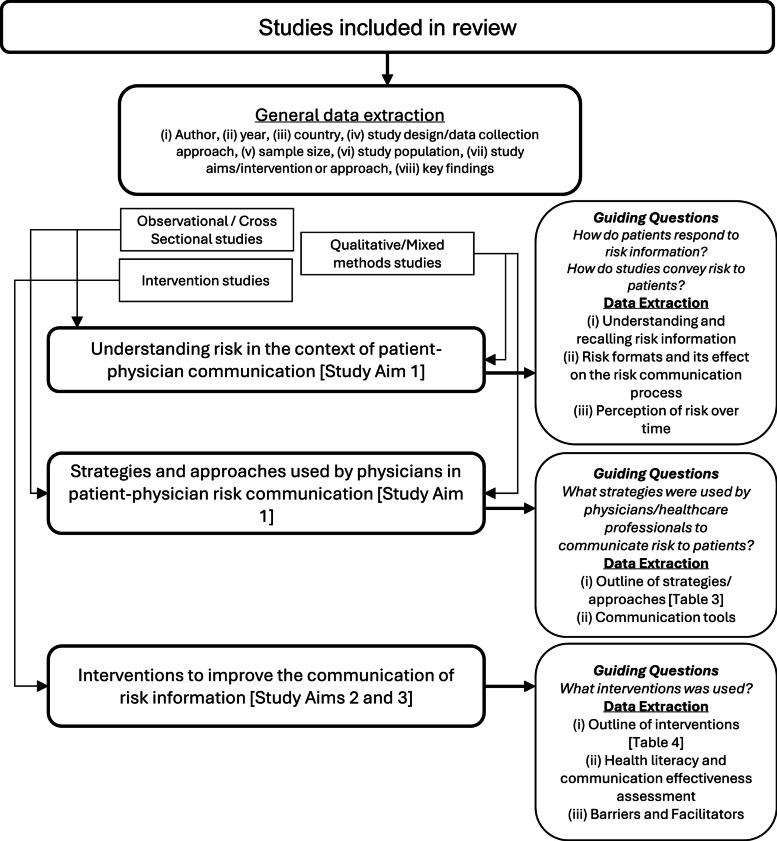
Results: A total of 8378 articles published between 1st Jan 2000 to 3rd October 2023 were screened. After a full-text review of 88 articles, a total of 30 articles, consisting of 15 qualitative, 14 quantitative and 1 mixed method studies were included. Common areas of inquiry among articles include: (1) understanding and recalling risk information, (2) strategies and approaches used by physicians to communicate risk, and (3) interventions to improve the communication of risk. Studies reveal how physicians use a range of strategies, approaches and interventions to discuss risk with patients. We present and discuss each theme narratively in detail.
Conclusions: There is a critical need for further research into risk communication strategies for cardiovascular diseases (CVDs) and diabetes, with a focus on developing targeted approaches that enhance patients' understanding of their risk profiles. Evidence-based guidelines should assist healthcare professionals improve risk communication within clinical settings, with the goal of facilitating patient comprehension of health risks that can sustain lifestyle changes. Misalignment in communication may lead to dissatisfaction and confusion, which may impede the effective management of chronic conditions.
背景:健康和风险信息的交流是医患互动的一个组成部分。心血管疾病和糖尿病风险信息的有效沟通已被证明可以改善药物依从性,增加身体活动水平,并改善饮食控制。了解自己的风险状况的患者能够更好地努力改变他们的生活方式行为,作为与医生共同决策过程的一部分。本综述研究了初级保健和二级门诊环境中心血管疾病和糖尿病管理的医患风险沟通策略、方法和干预措施的证据。方法:检索2000年1月1日至2023年10月3日PubMed、Embase、Web of Science、Scopus、CINAHL、PsycINFO、Cochrane Library等数据库进行定量和定性研究。两位审稿人独立地对文章进行了筛选。纳入了报告医患风险沟通过程的研究。数据提取和分析使用描述性总结和叙事综合。结果按照PRISMA-ScR指南报告。采用JBI关键评价和MMAT工具对纳入的文章进行质量评价。结果:共筛选了2000年1月1日至2023年10月3日发表的8378篇文献。全文综述88篇,共纳入30篇,其中定性研究15篇,定量研究14篇,混合方法研究1篇。文章中常见的调查领域包括:(1)理解和回顾风险信息,(2)医生沟通风险的策略和方法,(3)改善风险沟通的干预措施。研究揭示了医生如何使用一系列策略、方法和干预措施与患者讨论风险。我们详细叙述并讨论每个主题。结论:迫切需要进一步研究心血管疾病(cvd)和糖尿病的风险沟通策略,重点是开发有针对性的方法,提高患者对其风险概况的了解。循证指南应帮助医疗保健专业人员改善临床环境中的风险沟通,目标是促进患者理解可以维持生活方式改变的健康风险。沟通中的不协调可能会导致不满和混乱,这可能会阻碍慢性病的有效管理。
期刊介绍:
BMC Medicine is an open access, transparent peer-reviewed general medical journal. It is the flagship journal of the BMC series and publishes outstanding and influential research in various areas including clinical practice, translational medicine, medical and health advances, public health, global health, policy, and general topics of interest to the biomedical and sociomedical professional communities. In addition to research articles, the journal also publishes stimulating debates, reviews, unique forum articles, and concise tutorials. All articles published in BMC Medicine are included in various databases such as Biological Abstracts, BIOSIS, CAS, Citebase, Current contents, DOAJ, Embase, MEDLINE, PubMed, Science Citation Index Expanded, OAIster, SCImago, Scopus, SOCOLAR, and Zetoc.





 京公网安备 11010802042870号
京ICP备2023020795号-1
京公网安备 11010802042870号
京ICP备2023020795号-1

 分享
分享
 求助内容:
求助内容: 应助结果提醒方式:
 扫码关注我们
