{"title":"Broad-Spectrum Therapeutic Potentials of the Multifaceted Triterpene Lupeol and Its Derivatives","authors":"Anwar Parvez, Md. Anisur Rahman, Md. Mahfuzur Rahman, Afia Ibnath Shimki, Shakil Ahmmed, Fatema Akter Supti, Md. Hasibul Hasan, Mst. Sonia Akter Bristi, Siddique Akber Ansari, Muhammad Torequl Islam","doi":"10.1002/cbdv.202402286","DOIUrl":null,"url":null,"abstract":"<div>\n \n <p>Lupeol (LUP), a naturally occurring pentacyclic triterpene, is found in various fruits, vegetables, and medicinal plants and is evident to possess diverse pharmacological activities. This study aimed to consolidate its findings based on updated database reports. Findings suggest that LUP and some of its derivatives have promising biological roles, including anticancer effects. Notably, LUP induces apoptosis and cell cycle arrest in cancer cells while sparing normal cells, highlighting its selective cytotoxicity. By modifying pathways such as NF-κB and phosphatidyl inositol 3-kinase (PI3K)/Akt, LUP demonstrates anticancer activity, reducing LDL oxidation by 34.4% and causing cancer cells to undergo apoptosis while leaving healthy cells unaffected. Moreover, it has strong antioxidant and anti-inflammatory properties; thus, it may act against conditions like arthritis, asthma, and cardiovascular diseases. It has broad-spectrum antimicrobial activities and can be used as an alternative to conventional antibiotics. LUP and its nanoformulations (PEGylated liposomes) improved biopharmaceutical profiles in test systems. It also showed neuroprotective effects, particularly against Alzheimer's and Parkinson's diseases. Taken together, LUP has multi-target therapeutic approaches against various diseases and pathological conditions, advocating for its inclusion in future clinical trials.</p>\n </div>","PeriodicalId":9878,"journal":{"name":"Chemistry & Biodiversity","volume":"22 7","pages":""},"PeriodicalIF":2.5000,"publicationDate":"2025-02-21","publicationTypes":"Journal Article","fieldsOfStudy":null,"isOpenAccess":false,"openAccessPdf":"","citationCount":"0","resultStr":null,"platform":"Semanticscholar","paperid":null,"PeriodicalName":"Chemistry & Biodiversity","FirstCategoryId":"92","ListUrlMain":"https://onlinelibrary.wiley.com/doi/10.1002/cbdv.202402286","RegionNum":3,"RegionCategory":"化学","ArticlePicture":[],"TitleCN":null,"AbstractTextCN":null,"PMCID":null,"EPubDate":"","PubModel":"","JCR":"Q3","JCRName":"BIOCHEMISTRY & MOLECULAR BIOLOGY","Score":null,"Total":0}
引用次数: 0
Abstract
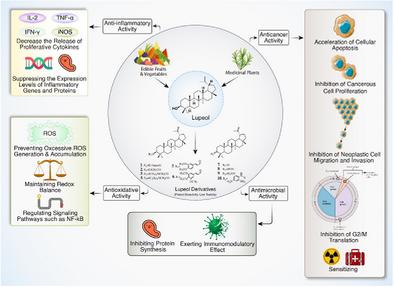
Lupeol (LUP), a naturally occurring pentacyclic triterpene, is found in various fruits, vegetables, and medicinal plants and is evident to possess diverse pharmacological activities. This study aimed to consolidate its findings based on updated database reports. Findings suggest that LUP and some of its derivatives have promising biological roles, including anticancer effects. Notably, LUP induces apoptosis and cell cycle arrest in cancer cells while sparing normal cells, highlighting its selective cytotoxicity. By modifying pathways such as NF-κB and phosphatidyl inositol 3-kinase (PI3K)/Akt, LUP demonstrates anticancer activity, reducing LDL oxidation by 34.4% and causing cancer cells to undergo apoptosis while leaving healthy cells unaffected. Moreover, it has strong antioxidant and anti-inflammatory properties; thus, it may act against conditions like arthritis, asthma, and cardiovascular diseases. It has broad-spectrum antimicrobial activities and can be used as an alternative to conventional antibiotics. LUP and its nanoformulations (PEGylated liposomes) improved biopharmaceutical profiles in test systems. It also showed neuroprotective effects, particularly against Alzheimer's and Parkinson's diseases. Taken together, LUP has multi-target therapeutic approaches against various diseases and pathological conditions, advocating for its inclusion in future clinical trials.
期刊介绍:
Chemistry & Biodiversity serves as a high-quality publishing forum covering a wide range of biorelevant topics for a truly international audience. This journal publishes both field-specific and interdisciplinary contributions on all aspects of biologically relevant chemistry research in the form of full-length original papers, short communications, invited reviews, and commentaries. It covers all research fields straddling the border between the chemical and biological sciences, with the ultimate goal of broadening our understanding of how nature works at a molecular level.
Since 2017, Chemistry & Biodiversity is published in an online-only format.



 京公网安备 11010802042870号
京ICP备2023020795号-1
京公网安备 11010802042870号
京ICP备2023020795号-1

 分享
分享
 求助内容:
求助内容: 应助结果提醒方式:
 扫码关注我们
