{"title":"Catalytic dwell oscillations complete the F<sub>1</sub>-ATPase mechanism.","authors":"Zain A Bukhari, Wayne D Frasch","doi":"10.1038/s42004-025-01443-z","DOIUrl":null,"url":null,"abstract":"<p><p>The F<sub>1</sub>-ATPase molecular motor rotates subunit-γ in 120° power strokes within its ring of three catalytic sites separated by catalytic dwells for ATP hydrolysis and Pi release. By monitoring rotary position of subunit-γ in E. coli F<sub>1</sub> every 5 μs, we resolved Stage-1 catalytic dwell oscillations that extend from -13° to 13° centered at 0° consistent with F<sub>1</sub> structures containing transition state inhibitors, which decay by a first order process consistent with ATP hydrolysis. During Stage-2, 80% of the oscillations extend from 3° and 25° centered at 14°, while 20% are centered at 33° and can extend to 27°-44° comparable to the ATP binding position. Remarkably, in Stage-3 subunit-γ returns to 0° to end the catalytic dwell, which keeps the start of power strokes in phase for consecutive rotational events. These newly observed states fit with F<sub>1</sub> structures that were inconsistent with the canonical mechanism, and indicate that catalytic dwell oscillations must persist until the correct occupancy of substrates and products occurs at all three catalytic sites. When that condition is met, F<sub>1</sub> can proceed to the next power stroke. Understanding the basis of these catalytic dwell oscillations completes the F<sub>1</sub>-ATPase rotary mechanism.</p>","PeriodicalId":10529,"journal":{"name":"Communications Chemistry","volume":"8 1","pages":"52"},"PeriodicalIF":6.2000,"publicationDate":"2025-02-21","publicationTypes":"Journal Article","fieldsOfStudy":null,"isOpenAccess":false,"openAccessPdf":"https://www.ncbi.nlm.nih.gov/pmc/articles/PMC11845608/pdf/","citationCount":"0","resultStr":null,"platform":"Semanticscholar","paperid":null,"PeriodicalName":"Communications Chemistry","FirstCategoryId":"92","ListUrlMain":"https://doi.org/10.1038/s42004-025-01443-z","RegionNum":2,"RegionCategory":"化学","ArticlePicture":[],"TitleCN":null,"AbstractTextCN":null,"PMCID":null,"EPubDate":"","PubModel":"","JCR":"Q1","JCRName":"CHEMISTRY, MULTIDISCIPLINARY","Score":null,"Total":0}
引用次数: 0
Abstract
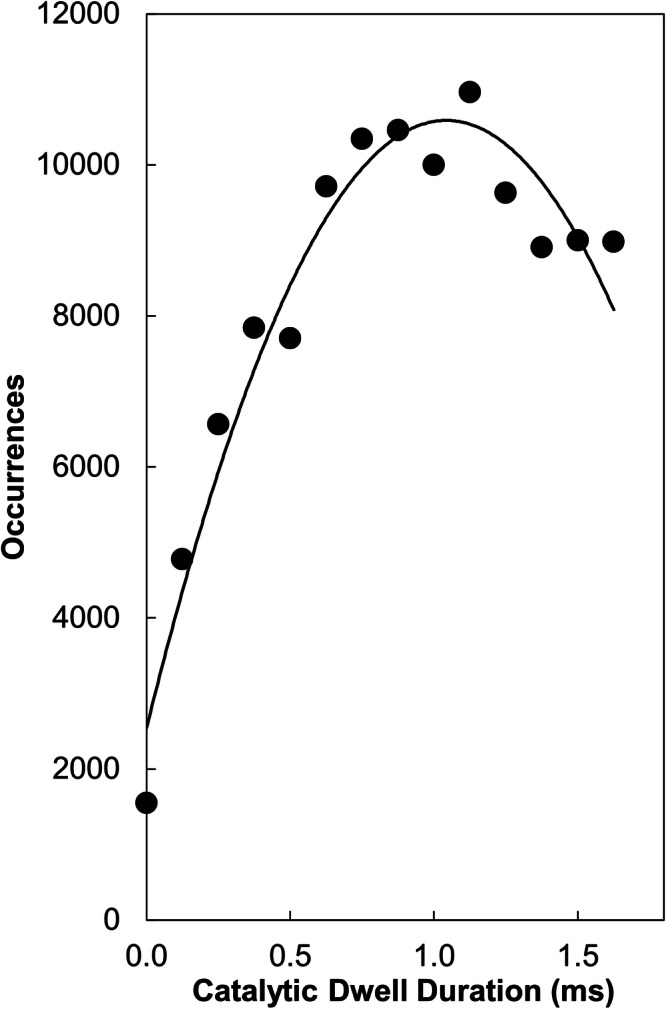
The F1-ATPase molecular motor rotates subunit-γ in 120° power strokes within its ring of three catalytic sites separated by catalytic dwells for ATP hydrolysis and Pi release. By monitoring rotary position of subunit-γ in E. coli F1 every 5 μs, we resolved Stage-1 catalytic dwell oscillations that extend from -13° to 13° centered at 0° consistent with F1 structures containing transition state inhibitors, which decay by a first order process consistent with ATP hydrolysis. During Stage-2, 80% of the oscillations extend from 3° and 25° centered at 14°, while 20% are centered at 33° and can extend to 27°-44° comparable to the ATP binding position. Remarkably, in Stage-3 subunit-γ returns to 0° to end the catalytic dwell, which keeps the start of power strokes in phase for consecutive rotational events. These newly observed states fit with F1 structures that were inconsistent with the canonical mechanism, and indicate that catalytic dwell oscillations must persist until the correct occupancy of substrates and products occurs at all three catalytic sites. When that condition is met, F1 can proceed to the next power stroke. Understanding the basis of these catalytic dwell oscillations completes the F1-ATPase rotary mechanism.
f1 -ATP酶分子马达在由催化孔分隔的三个催化位点组成的环内以120°功率冲程旋转亚基-γ,用于ATP水解和Pi释放。通过监测大肠杆菌F1中亚基-γ每5 μs的旋转位置,我们解决了从-13°到13°的阶段-1催化驻留振荡,该振荡以0°为中心,与含有过渡态抑制剂的F1结构一致,其衰变过程与ATP水解一致。在第二阶段,80%的振荡从3°和25°扩展到以14°为中心,而20%的振荡以33°为中心,可以扩展到与ATP结合位置相当的27°-44°。值得注意的是,在阶段3中,亚基-γ返回到0°以结束催化驻留,这使得连续旋转事件的功率冲程开始处于同一阶段。这些新观察到的状态符合与规范机制不一致的F1结构,并表明催化驻留振荡必须持续,直到底物和产物在所有三个催化位点都正确占据。当满足这个条件时,F1可以进行下一个动力冲程。了解这些催化驻留振荡的基础就完成了f1 - atp酶旋转机制的研究。
期刊介绍:
Communications Chemistry is an open access journal from Nature Research publishing high-quality research, reviews and commentary in all areas of the chemical sciences. Research papers published by the journal represent significant advances bringing new chemical insight to a specialized area of research. We also aim to provide a community forum for issues of importance to all chemists, regardless of sub-discipline.





 京公网安备 11010802042870号
京ICP备2023020795号-1
京公网安备 11010802042870号
京ICP备2023020795号-1

 分享
分享
 求助内容:
求助内容: 应助结果提醒方式:
 扫码关注我们
