Hooman Khanpoor, Ahad Alizadeh, Omid Khosravizadeh, Mohammad Amerzadeh, Sima Rafiei
{"title":"A mixed-methods model for healthcare system responsiveness to public health: insights from Iranian experts.","authors":"Hooman Khanpoor, Ahad Alizadeh, Omid Khosravizadeh, Mohammad Amerzadeh, Sima Rafiei","doi":"10.1186/s12961-025-01295-y","DOIUrl":null,"url":null,"abstract":"<p><strong>Background: </strong>Responsiveness is a critical dimension of public health, focussing on how health systems address the needs, preferences and expectations of the population. It plays a central role in improving and maintaining the population's health by ensuring timely, equitable and patient-centred healthcare services.</p><p><strong>Objective: </strong>In this study, we developed a mixed-methods model to assess healthcare system responsiveness from a public health perspective, integrating the insights of Iranian experts. The model identifies key factors such as intersectoral collaboration, health equity and community partnerships, which are essential for enhancing system responsiveness and ultimately improving health outcomes.</p><p><strong>Method: </strong>In this study, conducted in 2024, we developed a mixed-methods model for assessing healthcare system responsiveness from a public health perspective, integrating the insights of Iranian experts. R software version 3.2.4 and the lavaan package were used for statistical analysis, considering the significance level of 0.05.</p><p><strong>Results: </strong>On the basis of the literature review, the main components of health systems' responsiveness in the public health domain were extracted. The qualitative content analysis induced three different themes that affect health, which included payment mechanism (two subcategories of budget and incentive system), social determinants of health (three subcategories of intersectoral collaboration, community partnership and equity in health) and quality (three subcategories of timely provision of healthcare services, need-based service delivery and continuity of care). Finally, using structural equation modelling (SEM), a system of variables with causal relationships was developed. We found a statistically significant direct effect on intersectoral collaboration, health equity, payment mechanisms, timely delivery of services and need-based service provision. The strongest association was found for the payment system (β = 1.023, P ≤ 0.05). Model fit indices showed adequate fit.</p><p><strong>Conclusions: </strong>Our developed model underscores the need for a comprehensive approach to healthcare system responsiveness, particularly focussing on public health services as foundational strategies for achieving universal health coverage. The results of our study revealed that a well-structured payment system and incentive mechanisms are critical for motivating healthcare professionals to deliver high-quality, timely and need-based services, ensuring sustainability in care provision. Beyond financial incentives, our model highlights the importance of health equity, intersectoral collaboration and community partnerships, which were identified as key drivers of responsiveness in healthcare systems. The findings indicate that fostering these elements not only strengthens healthcare delivery, but also supports the adaptation of services to meet diverse population needs effectively. In addition, the study emphasizes the innovative role of intersectoral collaboration in enhancing primary healthcare, which requires commitment across healthcare and non-health sectors. Our model introduces the concept of integrating community participation and resource allocation strategies into the healthcare system, thereby enhancing responsiveness. These strategies are anticipated to improve key health outcomes, such as life expectancy and maternal and child health indicators, by establishing robust healthcare networks that are more attuned to the health needs of the population.</p>","PeriodicalId":12870,"journal":{"name":"Health Research Policy and Systems","volume":"23 1","pages":"24"},"PeriodicalIF":3.2000,"publicationDate":"2025-02-21","publicationTypes":"Journal Article","fieldsOfStudy":null,"isOpenAccess":false,"openAccessPdf":"https://www.ncbi.nlm.nih.gov/pmc/articles/PMC11844089/pdf/","citationCount":"0","resultStr":null,"platform":"Semanticscholar","paperid":null,"PeriodicalName":"Health Research Policy and Systems","FirstCategoryId":"3","ListUrlMain":"https://doi.org/10.1186/s12961-025-01295-y","RegionNum":2,"RegionCategory":"医学","ArticlePicture":[],"TitleCN":null,"AbstractTextCN":null,"PMCID":null,"EPubDate":"","PubModel":"","JCR":"Q1","JCRName":"HEALTH POLICY & SERVICES","Score":null,"Total":0}
引用次数: 0
Abstract
Background: Responsiveness is a critical dimension of public health, focussing on how health systems address the needs, preferences and expectations of the population. It plays a central role in improving and maintaining the population's health by ensuring timely, equitable and patient-centred healthcare services.
Objective: In this study, we developed a mixed-methods model to assess healthcare system responsiveness from a public health perspective, integrating the insights of Iranian experts. The model identifies key factors such as intersectoral collaboration, health equity and community partnerships, which are essential for enhancing system responsiveness and ultimately improving health outcomes.
Method: In this study, conducted in 2024, we developed a mixed-methods model for assessing healthcare system responsiveness from a public health perspective, integrating the insights of Iranian experts. R software version 3.2.4 and the lavaan package were used for statistical analysis, considering the significance level of 0.05.
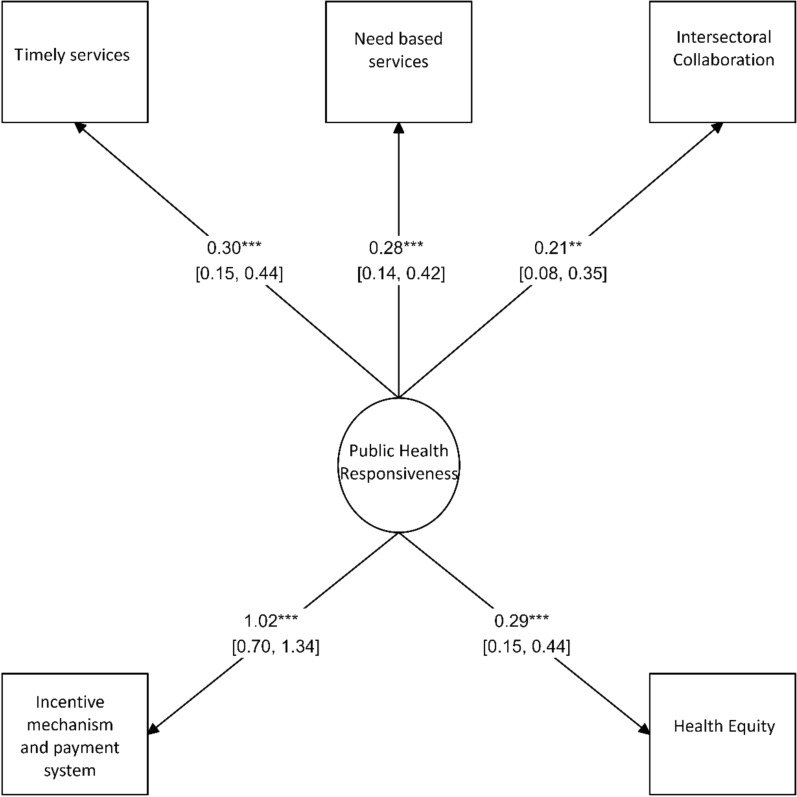
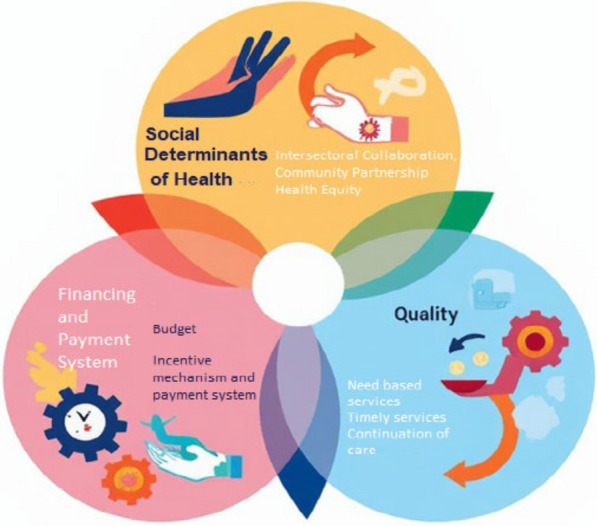
Results: On the basis of the literature review, the main components of health systems' responsiveness in the public health domain were extracted. The qualitative content analysis induced three different themes that affect health, which included payment mechanism (two subcategories of budget and incentive system), social determinants of health (three subcategories of intersectoral collaboration, community partnership and equity in health) and quality (three subcategories of timely provision of healthcare services, need-based service delivery and continuity of care). Finally, using structural equation modelling (SEM), a system of variables with causal relationships was developed. We found a statistically significant direct effect on intersectoral collaboration, health equity, payment mechanisms, timely delivery of services and need-based service provision. The strongest association was found for the payment system (β = 1.023, P ≤ 0.05). Model fit indices showed adequate fit.
Conclusions: Our developed model underscores the need for a comprehensive approach to healthcare system responsiveness, particularly focussing on public health services as foundational strategies for achieving universal health coverage. The results of our study revealed that a well-structured payment system and incentive mechanisms are critical for motivating healthcare professionals to deliver high-quality, timely and need-based services, ensuring sustainability in care provision. Beyond financial incentives, our model highlights the importance of health equity, intersectoral collaboration and community partnerships, which were identified as key drivers of responsiveness in healthcare systems. The findings indicate that fostering these elements not only strengthens healthcare delivery, but also supports the adaptation of services to meet diverse population needs effectively. In addition, the study emphasizes the innovative role of intersectoral collaboration in enhancing primary healthcare, which requires commitment across healthcare and non-health sectors. Our model introduces the concept of integrating community participation and resource allocation strategies into the healthcare system, thereby enhancing responsiveness. These strategies are anticipated to improve key health outcomes, such as life expectancy and maternal and child health indicators, by establishing robust healthcare networks that are more attuned to the health needs of the population.
期刊介绍:
Health Research Policy and Systems is an Open Access, peer-reviewed, online journal that aims to provide a platform for the global research community to share their views, findings, insights and successes. Health Research Policy and Systems considers manuscripts that investigate the role of evidence-based health policy and health research systems in ensuring the efficient utilization and application of knowledge to improve health and health equity, especially in developing countries. Research is the foundation for improvements in public health. The problem is that people involved in different areas of research, together with managers and administrators in charge of research entities, do not communicate sufficiently with each other.



 京公网安备 11010802042870号
京ICP备2023020795号-1
京公网安备 11010802042870号
京ICP备2023020795号-1

 分享
分享
 求助内容:
求助内容: 应助结果提醒方式:
 扫码关注我们
