Priyanka N. deSouza, Amanda Rees, Emilia Oscilowicz, Brendan Lawlor, William Obermann, Katherine Dickinson, Lisa M. McKenzie, Sheryl Magzamen, Shelly Miller, Michelle L. Bell
{"title":"Evaluating the environmental justice dimensions of odor in Denver, Colorado","authors":"Priyanka N. deSouza, Amanda Rees, Emilia Oscilowicz, Brendan Lawlor, William Obermann, Katherine Dickinson, Lisa M. McKenzie, Sheryl Magzamen, Shelly Miller, Michelle L. Bell","doi":"10.1038/s41370-025-00760-8","DOIUrl":null,"url":null,"abstract":"Odors are a documented environmental justice challenge in Denver, Colorado. Complaints are an important modality through which residents express their concerns. We investigated disparities in environmental justice related-variables, such as home and workplace census block groups (race/ethnicity, education levels, renter-occupied housing, median income and median home values, gentrification) by locations of odor complaints as well as that of potential malodorous facilities. We report key themes identified in complaints. We obtained odor complaints for 2014–2023 and the locations of facilities required to submit an odor management plan as of 2023 from the Denver Department of Public Health and Environment. We downloaded residential census block group-level socioeconomic data from the 2016–2020 American Community Survey and workplace-based socioeconomic data from the Longitudinal Employer-Household Dynamics dataset for 2020. We assessed exposure to potential malodorous facilities and complaints within each census block group. We investigated exposure disparities by comparing distributions of environmental justice-related variables based on whether a complaint has been made against a facility, and census block group-level odor intensity categories. We used unsupervised machine learning to identify themes from the odor complaints. Less privileged census block groups were more likely to contain a potential malodorous facility. Importantly, our study also reveals disparities in the location of facilities, not just in traditional residence/-based environmental justice-related variables, but in workplace/-based factors as well. Our work points to the need to broaden our understanding of the structural racism forces that shape disparities from residential-based forces such as segregation to others such as access to transportation that result in workplace disparities. We did not observe similar disparities for odor complaints. Specific facilities were mentioned repeatedly in the complaints received.","PeriodicalId":15684,"journal":{"name":"Journal of Exposure Science and Environmental Epidemiology","volume":"36 1","pages":"67-76"},"PeriodicalIF":4.7000,"publicationDate":"2025-02-22","publicationTypes":"Journal Article","fieldsOfStudy":null,"isOpenAccess":false,"openAccessPdf":"","citationCount":"0","resultStr":null,"platform":"Semanticscholar","paperid":null,"PeriodicalName":"Journal of Exposure Science and Environmental Epidemiology","FirstCategoryId":"3","ListUrlMain":"https://www.nature.com/articles/s41370-025-00760-8","RegionNum":3,"RegionCategory":"医学","ArticlePicture":[],"TitleCN":null,"AbstractTextCN":null,"PMCID":null,"EPubDate":"","PubModel":"","JCR":"Q2","JCRName":"ENVIRONMENTAL SCIENCES","Score":null,"Total":0}
引用次数: 0
Abstract
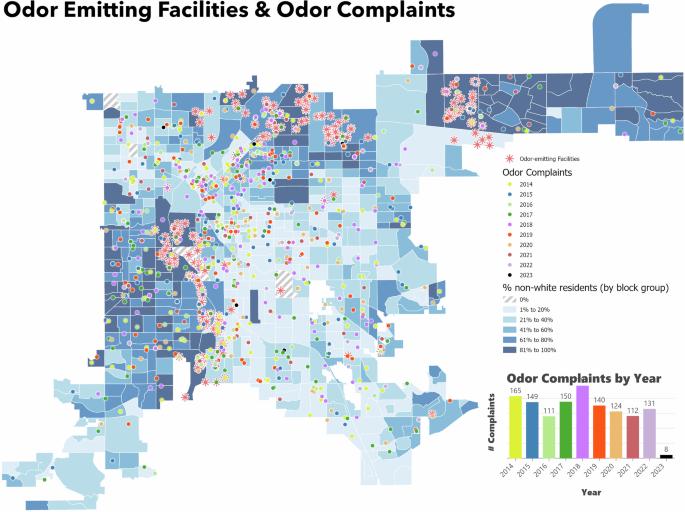
Odors are a documented environmental justice challenge in Denver, Colorado. Complaints are an important modality through which residents express their concerns. We investigated disparities in environmental justice related-variables, such as home and workplace census block groups (race/ethnicity, education levels, renter-occupied housing, median income and median home values, gentrification) by locations of odor complaints as well as that of potential malodorous facilities. We report key themes identified in complaints. We obtained odor complaints for 2014–2023 and the locations of facilities required to submit an odor management plan as of 2023 from the Denver Department of Public Health and Environment. We downloaded residential census block group-level socioeconomic data from the 2016–2020 American Community Survey and workplace-based socioeconomic data from the Longitudinal Employer-Household Dynamics dataset for 2020. We assessed exposure to potential malodorous facilities and complaints within each census block group. We investigated exposure disparities by comparing distributions of environmental justice-related variables based on whether a complaint has been made against a facility, and census block group-level odor intensity categories. We used unsupervised machine learning to identify themes from the odor complaints. Less privileged census block groups were more likely to contain a potential malodorous facility. Importantly, our study also reveals disparities in the location of facilities, not just in traditional residence/-based environmental justice-related variables, but in workplace/-based factors as well. Our work points to the need to broaden our understanding of the structural racism forces that shape disparities from residential-based forces such as segregation to others such as access to transportation that result in workplace disparities. We did not observe similar disparities for odor complaints. Specific facilities were mentioned repeatedly in the complaints received.
期刊介绍:
Journal of Exposure Science and Environmental Epidemiology (JESEE) aims to be the premier and authoritative source of information on advances in exposure science for professionals in a wide range of environmental and public health disciplines.
JESEE publishes original peer-reviewed research presenting significant advances in exposure science and exposure analysis, including development and application of the latest technologies for measuring exposures, and innovative computational approaches for translating novel data streams to characterize and predict exposures. The types of papers published in the research section of JESEE are original research articles, translation studies, and correspondence. Reported results should further understanding of the relationship between environmental exposure and human health, describe evaluated novel exposure science tools, or demonstrate potential of exposure science to enable decisions and actions that promote and protect human health.



 京公网安备 11010802042870号
京ICP备2023020795号-1
京公网安备 11010802042870号
京ICP备2023020795号-1

 分享
分享

 求助内容:
求助内容: 应助结果提醒方式:
 扫码关注我们
