Ruoxuan Wang, Jiao Fu, Jihui He, Xinxin Wang, Wenbo Xing, Xiaojing Liu, Juming Yao, Qingsong Ye, Yan He
{"title":"Apoptotic mesenchymal stem cells and their secreted apoptotic extracellular vesicles: therapeutic applications and mechanisms.","authors":"Ruoxuan Wang, Jiao Fu, Jihui He, Xinxin Wang, Wenbo Xing, Xiaojing Liu, Juming Yao, Qingsong Ye, Yan He","doi":"10.1186/s13287-025-04211-x","DOIUrl":null,"url":null,"abstract":"<p><p>Mesenchymal stem cells (MSCs), an accessible and less ethically controversial class of adult stem cells, have demonstrated significant efficacy in treating a wide range of diseases in both the preclinical and clinical phases. However, we do not yet have a clear understanding of the mechanisms by which MSCs exert their therapeutic effects in vivo. We found that the transplanted MSCs go an apoptotic fate within 24 h in vivo irrespective of the route of administration. Still, the short-term survival of MSCs do not affect their long-term therapeutic efficacy. An increasing number of studies have demonstrated that transplantation of apoptotic MSCs (ApoMSCs) show similar or even better efficacy than viable MSCs, including a variety of preclinical disease models such as inflammatory diseases, skin damage, bone damage, organ damage, etc. Although the exact mechanism has yet to be explored, recent studies have shown that transplanted MSCs undergo apoptosis in vivo and are phagocytosed by phagocytes, thereby exerting immunomodulatory effects. The apoptotic extracellular vesicles secreted by ApoMSCs (MSC-ApoEVs) play a significant role in promoting immunomodulation, endogenous stem cell regeneration, and angiogenesis due to their apoptotic properties and inheritance of molecular characteristics from their parental MSCs. On this basis, this review aims to deeply explore the therapeutic applications and mechanisms of ApoMSCs and their secretion of MSC-ApoEVs, as well as the challenges they face.</p>","PeriodicalId":21876,"journal":{"name":"Stem Cell Research & Therapy","volume":"16 1","pages":"78"},"PeriodicalIF":7.3000,"publicationDate":"2025-02-21","publicationTypes":"Journal Article","fieldsOfStudy":null,"isOpenAccess":false,"openAccessPdf":"https://www.ncbi.nlm.nih.gov/pmc/articles/PMC11846181/pdf/","citationCount":"0","resultStr":null,"platform":"Semanticscholar","paperid":null,"PeriodicalName":"Stem Cell Research & Therapy","FirstCategoryId":"3","ListUrlMain":"https://doi.org/10.1186/s13287-025-04211-x","RegionNum":2,"RegionCategory":"医学","ArticlePicture":[],"TitleCN":null,"AbstractTextCN":null,"PMCID":null,"EPubDate":"","PubModel":"","JCR":"Q1","JCRName":"CELL & TISSUE ENGINEERING","Score":null,"Total":0}
引用次数: 0
Abstract
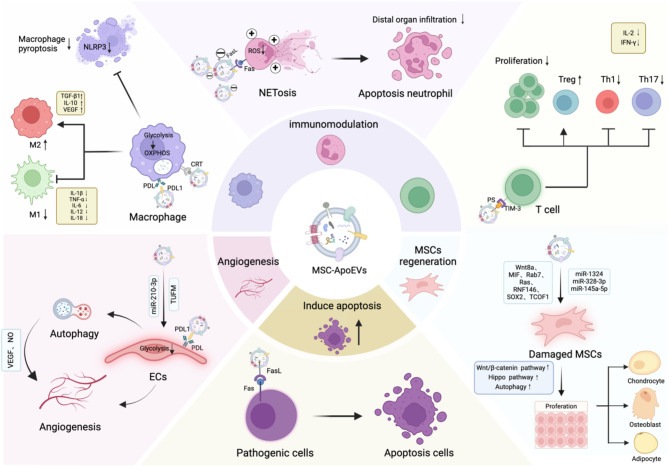
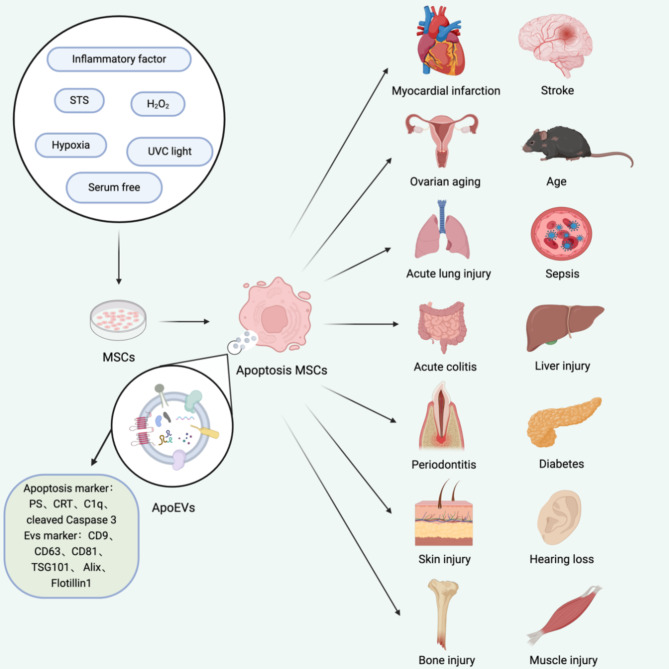
Mesenchymal stem cells (MSCs), an accessible and less ethically controversial class of adult stem cells, have demonstrated significant efficacy in treating a wide range of diseases in both the preclinical and clinical phases. However, we do not yet have a clear understanding of the mechanisms by which MSCs exert their therapeutic effects in vivo. We found that the transplanted MSCs go an apoptotic fate within 24 h in vivo irrespective of the route of administration. Still, the short-term survival of MSCs do not affect their long-term therapeutic efficacy. An increasing number of studies have demonstrated that transplantation of apoptotic MSCs (ApoMSCs) show similar or even better efficacy than viable MSCs, including a variety of preclinical disease models such as inflammatory diseases, skin damage, bone damage, organ damage, etc. Although the exact mechanism has yet to be explored, recent studies have shown that transplanted MSCs undergo apoptosis in vivo and are phagocytosed by phagocytes, thereby exerting immunomodulatory effects. The apoptotic extracellular vesicles secreted by ApoMSCs (MSC-ApoEVs) play a significant role in promoting immunomodulation, endogenous stem cell regeneration, and angiogenesis due to their apoptotic properties and inheritance of molecular characteristics from their parental MSCs. On this basis, this review aims to deeply explore the therapeutic applications and mechanisms of ApoMSCs and their secretion of MSC-ApoEVs, as well as the challenges they face.
期刊介绍:
Stem Cell Research & Therapy serves as a leading platform for translational research in stem cell therapies. This international, peer-reviewed journal publishes high-quality open-access research articles, with a focus on basic, translational, and clinical research in stem cell therapeutics and regenerative therapies. Coverage includes animal models and clinical trials. Additionally, the journal offers reviews, viewpoints, commentaries, and reports.




 京公网安备 11010802042870号
京ICP备2023020795号-1
京公网安备 11010802042870号
京ICP备2023020795号-1

 分享
分享
 求助内容:
求助内容: 应助结果提醒方式:
 扫码关注我们
