Clarisse Dibao-Dina, Lydia Nasri, Céline Dagot, Jean-Philippe Fouquet, Sophie Rideau, Vincent Dumas, Guillaume Neff, Véronique Payen, Delphine Rube-Millon, Marie Lemaile, Jacques-Alexis Nkodo, Vincent Camus, Bertrand Fougère, Bruno Giraudeau, Dominique Beauchamp, Laura Fruchard-Foucault, Cécile Renoux, Jean Robert
{"title":"Identifying the needs of natural caregivers caring for a person with dementia: a mixed method study.","authors":"Clarisse Dibao-Dina, Lydia Nasri, Céline Dagot, Jean-Philippe Fouquet, Sophie Rideau, Vincent Dumas, Guillaume Neff, Véronique Payen, Delphine Rube-Millon, Marie Lemaile, Jacques-Alexis Nkodo, Vincent Camus, Bertrand Fougère, Bruno Giraudeau, Dominique Beauchamp, Laura Fruchard-Foucault, Cécile Renoux, Jean Robert","doi":"10.1186/s12875-025-02724-1","DOIUrl":null,"url":null,"abstract":"<p><strong>Background: </strong>Many available interventions to reduce challenges of natural caregivers of people living with dementia have limited efficacy since they do not meet the caregiver's individual needs. This study aims to evaluate caregivers' needs with the future goal of developing a tailored, multicomponent intervention to ease caregiver challenges through appropriate caregiver-centred interventions.</p><p><strong>Methods: </strong>Mixed method study using a convergent design with quantitative and qualitative data collection and analysis performed at similar times. For the cross-sectional quantitative study, questionnaires were sent to natural adult caregivers of a person with dementia identified by local healthcare professionals and general practitioners exercising in a rural and an urban department. For the qualitative descriptive study, individual caregiver interviews and healthcare professional focus groups were conducted in two primary healthcare territories in both departments. Data about screening for caregiver challenges and any help provided to the caregiver were collected. Quantitative data were analysed using descriptive statistics and qualitative data underwent thematic analysis using the grounded theory approach. Quantitative and qualitative results were described using a narrative discussion approach, then results were combined on a theme-by-theme basis using the weaving approach enabling integrated analysis.</p><p><strong>Results: </strong>A total of 199 general practitioners and 67 caregivers participated in the quantitative study. In the qualitative study, 10 caregivers from the urban area and 12 caregivers from the rural area participated in the individual interviews, and 9 healthcare professionals participated in the focus groups. Our broad categories of caregiver needs were identified: awareness and early diagnosis, information and training, practical, coordinated support, and psychological support. The integrated analysis highlighted areas for improvement in meeting these needs, especially a better identification of the caregiver role, caregiver distress, better information about what the caregiver has to expect in terms of the disease's progression and daily management, ways to improve awareness in general population, acceptation of practical support and its coordination and adaptation.</p><p><strong>Conclusions: </strong>Identified needs were concordant with those in the literature. The mixed method used enabled expectations to be explored by analysing together the points of view of both patients and healthcare professionals in order to identify ways of improving their care.</p><p><strong>Trial registration: </strong>Not applicable.</p>","PeriodicalId":72428,"journal":{"name":"BMC primary care","volume":"26 1","pages":"48"},"PeriodicalIF":2.6000,"publicationDate":"2025-02-21","publicationTypes":"Journal Article","fieldsOfStudy":null,"isOpenAccess":false,"openAccessPdf":"https://www.ncbi.nlm.nih.gov/pmc/articles/PMC11846302/pdf/","citationCount":"0","resultStr":null,"platform":"Semanticscholar","paperid":null,"PeriodicalName":"BMC primary care","FirstCategoryId":"1085","ListUrlMain":"https://doi.org/10.1186/s12875-025-02724-1","RegionNum":0,"RegionCategory":null,"ArticlePicture":[],"TitleCN":null,"AbstractTextCN":null,"PMCID":null,"EPubDate":"","PubModel":"","JCR":"Q2","JCRName":"MEDICINE, GENERAL & INTERNAL","Score":null,"Total":0}
引用次数: 0
Abstract
Background: Many available interventions to reduce challenges of natural caregivers of people living with dementia have limited efficacy since they do not meet the caregiver's individual needs. This study aims to evaluate caregivers' needs with the future goal of developing a tailored, multicomponent intervention to ease caregiver challenges through appropriate caregiver-centred interventions.
Methods: Mixed method study using a convergent design with quantitative and qualitative data collection and analysis performed at similar times. For the cross-sectional quantitative study, questionnaires were sent to natural adult caregivers of a person with dementia identified by local healthcare professionals and general practitioners exercising in a rural and an urban department. For the qualitative descriptive study, individual caregiver interviews and healthcare professional focus groups were conducted in two primary healthcare territories in both departments. Data about screening for caregiver challenges and any help provided to the caregiver were collected. Quantitative data were analysed using descriptive statistics and qualitative data underwent thematic analysis using the grounded theory approach. Quantitative and qualitative results were described using a narrative discussion approach, then results were combined on a theme-by-theme basis using the weaving approach enabling integrated analysis.
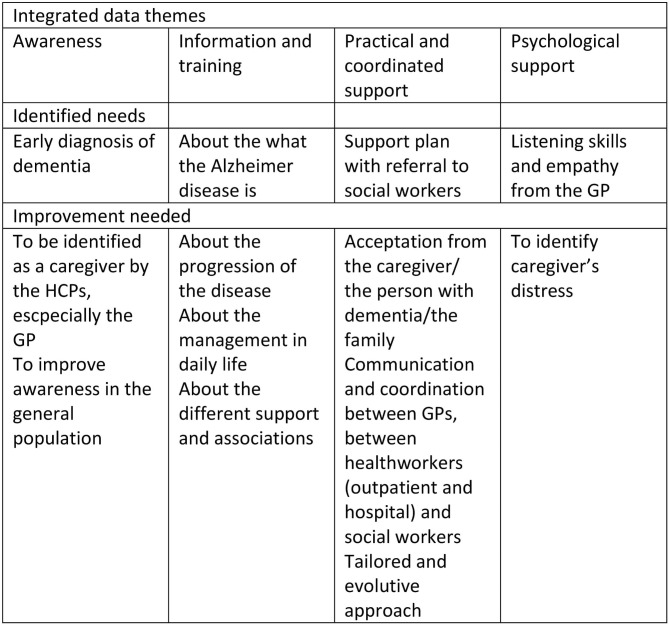
Results: A total of 199 general practitioners and 67 caregivers participated in the quantitative study. In the qualitative study, 10 caregivers from the urban area and 12 caregivers from the rural area participated in the individual interviews, and 9 healthcare professionals participated in the focus groups. Our broad categories of caregiver needs were identified: awareness and early diagnosis, information and training, practical, coordinated support, and psychological support. The integrated analysis highlighted areas for improvement in meeting these needs, especially a better identification of the caregiver role, caregiver distress, better information about what the caregiver has to expect in terms of the disease's progression and daily management, ways to improve awareness in general population, acceptation of practical support and its coordination and adaptation.
Conclusions: Identified needs were concordant with those in the literature. The mixed method used enabled expectations to be explored by analysing together the points of view of both patients and healthcare professionals in order to identify ways of improving their care.



 京公网安备 11010802042870号
京ICP备2023020795号-1
京公网安备 11010802042870号
京ICP备2023020795号-1

 分享
分享

 求助内容:
求助内容: 应助结果提醒方式:
 扫码关注我们
