Mostafa A. Al-Alusi, Samuel F. Friedman, Shinwan Kany, Joel T. Rämö, Daniel Pipilas, Pulkit Singh, Christopher Reeder, Shaan Khurshid, James P. Pirruccello, Mahnaz Maddah, Jennifer E. Ho, Patrick T. Ellinor
{"title":"A deep learning digital biomarker to detect hypertension and stratify cardiovascular risk from the electrocardiogram","authors":"Mostafa A. Al-Alusi, Samuel F. Friedman, Shinwan Kany, Joel T. Rämö, Daniel Pipilas, Pulkit Singh, Christopher Reeder, Shaan Khurshid, James P. Pirruccello, Mahnaz Maddah, Jennifer E. Ho, Patrick T. Ellinor","doi":"10.1038/s41746-025-01491-8","DOIUrl":null,"url":null,"abstract":"<p>Hypertension is a major risk factor for cardiovascular disease (CVD), yet blood pressure is measured intermittently and under suboptimal conditions. We developed a deep learning model to identify hypertension and stratify risk of CVD using 12-lead electrocardiogram waveforms. HTN-AI was trained to detect hypertension using 752,415 electrocardiograms from 103,405 adults at Massachusetts General Hospital. We externally validated HTN-AI and demonstrated associations between HTN-AI risk and incident CVD in 56,760 adults at Brigham and Women’s Hospital. HTN-AI accurately discriminated hypertension (internal and external validation AUROC 0.803 and 0.771, respectively). In Fine-Gray regression analyses model-predicted probability of hypertension was associated with mortality (hazard ratio per standard deviation: 1.47 [1.36-1.60], <i>p</i> < 0.001), HF (2.26 [1.90-2.69], <i>p</i> < 0.001), MI (1.87 [1.69-2.07], <i>p</i> < 0.001), stroke (1.30 [1.18-1.44], <i>p</i> < 0.001), and aortic dissection or rupture (1.69 [1.22-2.35], <i>p</i> < 0.001) after adjustment for demographics and risk factors. HTN-AI may facilitate diagnosis of hypertension and serve as a digital biomarker of hypertension-associated CVD.</p>","PeriodicalId":19349,"journal":{"name":"NPJ Digital Medicine","volume":"18 1","pages":""},"PeriodicalIF":15.1000,"publicationDate":"2025-02-22","publicationTypes":"Journal Article","fieldsOfStudy":null,"isOpenAccess":false,"openAccessPdf":"","citationCount":"0","resultStr":null,"platform":"Semanticscholar","paperid":null,"PeriodicalName":"NPJ Digital Medicine","FirstCategoryId":"3","ListUrlMain":"https://doi.org/10.1038/s41746-025-01491-8","RegionNum":1,"RegionCategory":"医学","ArticlePicture":[],"TitleCN":null,"AbstractTextCN":null,"PMCID":null,"EPubDate":"","PubModel":"","JCR":"Q1","JCRName":"HEALTH CARE SCIENCES & SERVICES","Score":null,"Total":0}
引用次数: 0
Abstract
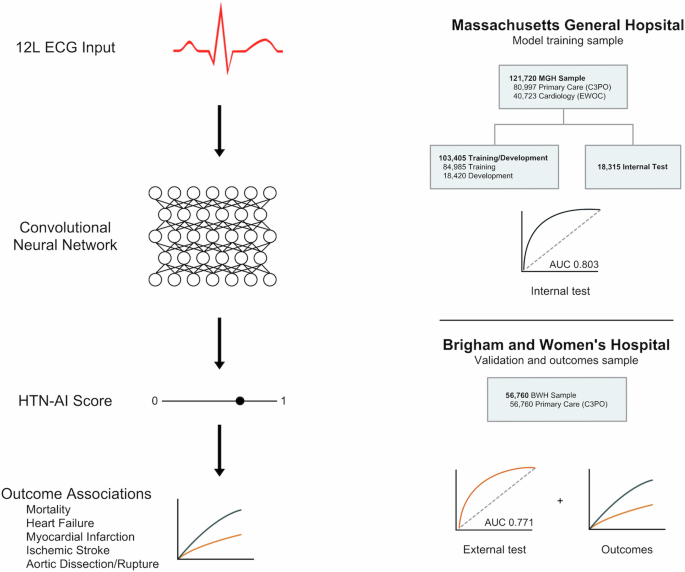
Hypertension is a major risk factor for cardiovascular disease (CVD), yet blood pressure is measured intermittently and under suboptimal conditions. We developed a deep learning model to identify hypertension and stratify risk of CVD using 12-lead electrocardiogram waveforms. HTN-AI was trained to detect hypertension using 752,415 electrocardiograms from 103,405 adults at Massachusetts General Hospital. We externally validated HTN-AI and demonstrated associations between HTN-AI risk and incident CVD in 56,760 adults at Brigham and Women’s Hospital. HTN-AI accurately discriminated hypertension (internal and external validation AUROC 0.803 and 0.771, respectively). In Fine-Gray regression analyses model-predicted probability of hypertension was associated with mortality (hazard ratio per standard deviation: 1.47 [1.36-1.60], p < 0.001), HF (2.26 [1.90-2.69], p < 0.001), MI (1.87 [1.69-2.07], p < 0.001), stroke (1.30 [1.18-1.44], p < 0.001), and aortic dissection or rupture (1.69 [1.22-2.35], p < 0.001) after adjustment for demographics and risk factors. HTN-AI may facilitate diagnosis of hypertension and serve as a digital biomarker of hypertension-associated CVD.
期刊介绍:
npj Digital Medicine is an online open-access journal that focuses on publishing peer-reviewed research in the field of digital medicine. The journal covers various aspects of digital medicine, including the application and implementation of digital and mobile technologies in clinical settings, virtual healthcare, and the use of artificial intelligence and informatics.
The primary goal of the journal is to support innovation and the advancement of healthcare through the integration of new digital and mobile technologies. When determining if a manuscript is suitable for publication, the journal considers four important criteria: novelty, clinical relevance, scientific rigor, and digital innovation.




 京公网安备 11010802042870号
京ICP备2023020795号-1
京公网安备 11010802042870号
京ICP备2023020795号-1

 分享
分享
 求助内容:
求助内容: 应助结果提醒方式:
 扫码关注我们
