{"title":"Prediction of service life of friction damage of WC coating on hot roll descaling rolls based on modified Archchard theory","authors":"Kailiang Qiu , Lianghai Feng , Li Zhang , Zhenshan Zhang , Yongjun Feng , Zhiwen Xie","doi":"10.1016/j.engfailanal.2025.109442","DOIUrl":null,"url":null,"abstract":"<div><div>The friction damage data of hot rolling descaling rollers is limited by small sample size and challenges in data collection, significantly impacting the evaluation of the surface cladding coating’s service performance and life. To effectively assess the impact of Ni-based WC45 coating on the friction damage and service life of descaling rollers, a prediction method based on a modified Archard theory was proposed. By integrating experiments with finite element simulations, the friction characteristics and service life of the Ni-based WC45 coating were investigated. The results indicate that the primary mode of friction damage in the Ni-based WC45 coating is abrasive wear. While increasing operating temperatures exacerbate friction damage, they simultaneously reduce the friction coefficient. WC particles within the coating are deposited between the surface and transition layers, contributing to its superior wear resistance. The wear depth profile of the coating follows a “low-high-low” pattern and asymptotically approaches zero. The accuracy of the wear depth prediction model for the Ni-based WC45 coating, developed using the modified Archard theory, exceeds 90%. Compared to other forms of service damage, friction damage has a negligible effect on service life, and the Ni-based WC45 coating demonstrates excellent friction damage protection. These findings provide a theoretical foundation for optimizing the performance of the Ni-based WC45 coating for descaling rollers and offer a reliable basis for the precise maintenance of hot rolling descaling rollers.</div></div>","PeriodicalId":11677,"journal":{"name":"Engineering Failure Analysis","volume":"173 ","pages":"Article 109442"},"PeriodicalIF":5.7000,"publicationDate":"2025-02-21","publicationTypes":"Journal Article","fieldsOfStudy":null,"isOpenAccess":false,"openAccessPdf":"","citationCount":"0","resultStr":null,"platform":"Semanticscholar","paperid":null,"PeriodicalName":"Engineering Failure Analysis","FirstCategoryId":"5","ListUrlMain":"https://www.sciencedirect.com/science/article/pii/S1350630725001839","RegionNum":2,"RegionCategory":"工程技术","ArticlePicture":[],"TitleCN":null,"AbstractTextCN":null,"PMCID":null,"EPubDate":"","PubModel":"","JCR":"Q1","JCRName":"ENGINEERING, MECHANICAL","Score":null,"Total":0}
引用次数: 0
Abstract
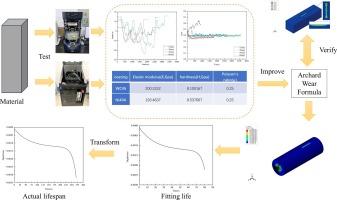
The friction damage data of hot rolling descaling rollers is limited by small sample size and challenges in data collection, significantly impacting the evaluation of the surface cladding coating’s service performance and life. To effectively assess the impact of Ni-based WC45 coating on the friction damage and service life of descaling rollers, a prediction method based on a modified Archard theory was proposed. By integrating experiments with finite element simulations, the friction characteristics and service life of the Ni-based WC45 coating were investigated. The results indicate that the primary mode of friction damage in the Ni-based WC45 coating is abrasive wear. While increasing operating temperatures exacerbate friction damage, they simultaneously reduce the friction coefficient. WC particles within the coating are deposited between the surface and transition layers, contributing to its superior wear resistance. The wear depth profile of the coating follows a “low-high-low” pattern and asymptotically approaches zero. The accuracy of the wear depth prediction model for the Ni-based WC45 coating, developed using the modified Archard theory, exceeds 90%. Compared to other forms of service damage, friction damage has a negligible effect on service life, and the Ni-based WC45 coating demonstrates excellent friction damage protection. These findings provide a theoretical foundation for optimizing the performance of the Ni-based WC45 coating for descaling rollers and offer a reliable basis for the precise maintenance of hot rolling descaling rollers.
期刊介绍:
Engineering Failure Analysis publishes research papers describing the analysis of engineering failures and related studies.
Papers relating to the structure, properties and behaviour of engineering materials are encouraged, particularly those which also involve the detailed application of materials parameters to problems in engineering structures, components and design. In addition to the area of materials engineering, the interacting fields of mechanical, manufacturing, aeronautical, civil, chemical, corrosion and design engineering are considered relevant. Activity should be directed at analysing engineering failures and carrying out research to help reduce the incidences of failures and to extend the operating horizons of engineering materials.
Emphasis is placed on the mechanical properties of materials and their behaviour when influenced by structure, process and environment. Metallic, polymeric, ceramic and natural materials are all included and the application of these materials to real engineering situations should be emphasised. The use of a case-study based approach is also encouraged.
Engineering Failure Analysis provides essential reference material and critical feedback into the design process thereby contributing to the prevention of engineering failures in the future. All submissions will be subject to peer review from leading experts in the field.



 京公网安备 11010802042870号
京ICP备2023020795号-1
京公网安备 11010802042870号
京ICP备2023020795号-1

 分享
分享
 求助内容:
求助内容: 应助结果提醒方式:
 扫码关注我们
