Yue Zhang , Wei Sun , Rui-shuang Zhang , Yan Feng , Bin Dai , Jichang Liu
{"title":"Electrochemical hydrogenation of nitrogen to ammonia under ambient conditions in a suspended dual-catalyst system†","authors":"Yue Zhang , Wei Sun , Rui-shuang Zhang , Yan Feng , Bin Dai , Jichang Liu","doi":"10.1039/d4gc05276e","DOIUrl":null,"url":null,"abstract":"<div><div>Electrocatalytic hydrogenation provides a sustainable method and green route to convert atmospheric nitrogen N<sub>2</sub> into ammonia NH<sub>3</sub> under mild conditions but is still challenged with the issues of low working current density and low faradaic efficiency. Herein, a suspended electrocatalytic dual-catalyst system was designed to realize the nitrogen hydrogenation into ammonia with high faradaic efficiency and high working current density, which is often thought to be rather difficult in aqueous electrolysis. The electrochemical system uses a soluble polyoxometalate of silicotungstic acid as an electron captor and a suspended noble-metal catalyst Ru/TiO<sub>2</sub> as the nitrogen fixation catalyst, so that the catalyst particles can be detached from the electrode, which is quite different from common electrochemical systems. Because the nitrogen fixation catalyst is free from the electrode, no current flows through the catalyst and even a non-conductive catalyst can be used, so that the suspended electrochemical system can provide a rather large opportunity and maneuverability for enhancing the nitrogen fixation process.</div></div>","PeriodicalId":78,"journal":{"name":"Green Chemistry","volume":"27 9","pages":"Pages 2404-2416"},"PeriodicalIF":9.2000,"publicationDate":"2025-01-31","publicationTypes":"Journal Article","fieldsOfStudy":null,"isOpenAccess":false,"openAccessPdf":"","citationCount":"0","resultStr":null,"platform":"Semanticscholar","paperid":null,"PeriodicalName":"Green Chemistry","FirstCategoryId":"92","ListUrlMain":"https://www.sciencedirect.com/org/science/article/pii/S1463926225000792","RegionNum":1,"RegionCategory":"化学","ArticlePicture":[],"TitleCN":null,"AbstractTextCN":null,"PMCID":null,"EPubDate":"2025/1/10 0:00:00","PubModel":"Epub","JCR":"Q1","JCRName":"CHEMISTRY, MULTIDISCIPLINARY","Score":null,"Total":0}
引用次数: 0
Abstract
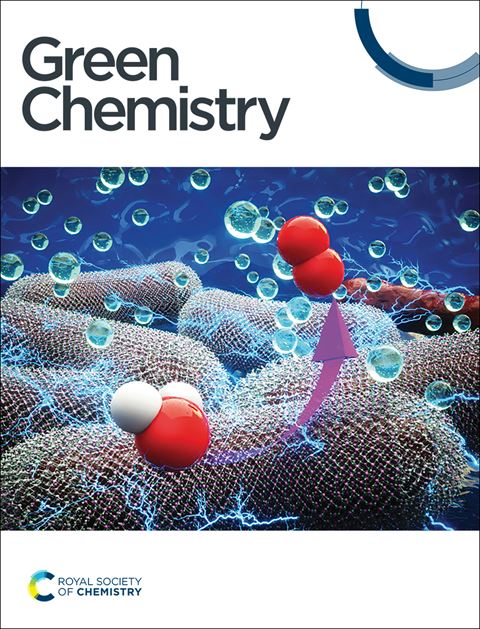
Electrocatalytic hydrogenation provides a sustainable method and green route to convert atmospheric nitrogen N2 into ammonia NH3 under mild conditions but is still challenged with the issues of low working current density and low faradaic efficiency. Herein, a suspended electrocatalytic dual-catalyst system was designed to realize the nitrogen hydrogenation into ammonia with high faradaic efficiency and high working current density, which is often thought to be rather difficult in aqueous electrolysis. The electrochemical system uses a soluble polyoxometalate of silicotungstic acid as an electron captor and a suspended noble-metal catalyst Ru/TiO2 as the nitrogen fixation catalyst, so that the catalyst particles can be detached from the electrode, which is quite different from common electrochemical systems. Because the nitrogen fixation catalyst is free from the electrode, no current flows through the catalyst and even a non-conductive catalyst can be used, so that the suspended electrochemical system can provide a rather large opportunity and maneuverability for enhancing the nitrogen fixation process.
期刊介绍:
Green Chemistry is a journal that provides a unique forum for the publication of innovative research on the development of alternative green and sustainable technologies. The scope of Green Chemistry is based on the definition proposed by Anastas and Warner (Green Chemistry: Theory and Practice, P T Anastas and J C Warner, Oxford University Press, Oxford, 1998), which defines green chemistry as the utilisation of a set of principles that reduces or eliminates the use or generation of hazardous substances in the design, manufacture and application of chemical products. Green Chemistry aims to reduce the environmental impact of the chemical enterprise by developing a technology base that is inherently non-toxic to living things and the environment. The journal welcomes submissions on all aspects of research relating to this endeavor and publishes original and significant cutting-edge research that is likely to be of wide general appeal. For a work to be published, it must present a significant advance in green chemistry, including a comparison with existing methods and a demonstration of advantages over those methods.





 京公网安备 11010802042870号
京ICP备2023020795号-1
京公网安备 11010802042870号
京ICP备2023020795号-1

 分享
分享
 求助内容:
求助内容: 应助结果提醒方式:
 扫码关注我们
