{"title":"Metagenomic Studies on Microbiomes Capable of Degrading the Decabromodiphenyl Ether in River Sediments","authors":"Yi-Yun Lao, Shu-Chi Chang","doi":"10.1007/s11270-025-07793-7","DOIUrl":null,"url":null,"abstract":"<div><p>Sediment contamination is a prevailing global environmental problem. Sediments in the lower sections of rivers are often contaminated by persistent organic pollutants (POPs). Among the POPs, polybrominated diphenyl ethers (PBDEs) raised deep concerns because of their multiple toxicities and endocrine-disrupting effects. Decabromodiphenyl ether (BDE-209) usually occupies more than 90% of the total PBDE concentration in sediments and is not easy to clean up. We have successfully developed the <i>in situ</i> phase inversion emulsification and biological reductive dehalogenation (ISPIE/BiRD) to remediate weathered polychlorinated biphenyls (PCBs) and hexachlorobenzene (HCB) in river sediments. Still, it has yet to be applied to BDE-209-contaminated sediments. Thus, in this study, we tested ISPIE/BiRD’s applicability on the sediments contaminated by BDE-209 in batch and column experiments and analyzed their metagenomic profiles. In the batch experiment, the best-performing group, Group 3, removed 56.5% of BDE-209 in 70 days. In the column study, ISPIE removed 22% and 15% of BDE-209 in the weathered and fresh groups, respectively. In addition, the best performance group for subsequent BiRD removal is the natural recovery group of weathered BDE-209 (WNR), with a total removal of 56.0%. According to the DNA sequencing data, more species and higher diversity in the batch experiment tend to perform better. The predominant bacteria in the column experiment differed from those in the batch experiment but showed similar removal functions. <i>Rectinema cohabitans</i> is the only species positively correlated with the removals in batch and column studies. The results suggested that ISPIE/BiRD is feasible for the remediation of BDE-209-contaminated sediment.</p></div>","PeriodicalId":808,"journal":{"name":"Water, Air, & Soil Pollution","volume":"236 3","pages":""},"PeriodicalIF":3.0000,"publicationDate":"2025-02-24","publicationTypes":"Journal Article","fieldsOfStudy":null,"isOpenAccess":false,"openAccessPdf":"","citationCount":"0","resultStr":null,"platform":"Semanticscholar","paperid":null,"PeriodicalName":"Water, Air, & Soil Pollution","FirstCategoryId":"6","ListUrlMain":"https://link.springer.com/article/10.1007/s11270-025-07793-7","RegionNum":4,"RegionCategory":"环境科学与生态学","ArticlePicture":[],"TitleCN":null,"AbstractTextCN":null,"PMCID":null,"EPubDate":"","PubModel":"","JCR":"Q2","JCRName":"ENVIRONMENTAL SCIENCES","Score":null,"Total":0}
引用次数: 0
Abstract
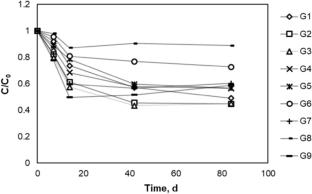
Sediment contamination is a prevailing global environmental problem. Sediments in the lower sections of rivers are often contaminated by persistent organic pollutants (POPs). Among the POPs, polybrominated diphenyl ethers (PBDEs) raised deep concerns because of their multiple toxicities and endocrine-disrupting effects. Decabromodiphenyl ether (BDE-209) usually occupies more than 90% of the total PBDE concentration in sediments and is not easy to clean up. We have successfully developed the in situ phase inversion emulsification and biological reductive dehalogenation (ISPIE/BiRD) to remediate weathered polychlorinated biphenyls (PCBs) and hexachlorobenzene (HCB) in river sediments. Still, it has yet to be applied to BDE-209-contaminated sediments. Thus, in this study, we tested ISPIE/BiRD’s applicability on the sediments contaminated by BDE-209 in batch and column experiments and analyzed their metagenomic profiles. In the batch experiment, the best-performing group, Group 3, removed 56.5% of BDE-209 in 70 days. In the column study, ISPIE removed 22% and 15% of BDE-209 in the weathered and fresh groups, respectively. In addition, the best performance group for subsequent BiRD removal is the natural recovery group of weathered BDE-209 (WNR), with a total removal of 56.0%. According to the DNA sequencing data, more species and higher diversity in the batch experiment tend to perform better. The predominant bacteria in the column experiment differed from those in the batch experiment but showed similar removal functions. Rectinema cohabitans is the only species positively correlated with the removals in batch and column studies. The results suggested that ISPIE/BiRD is feasible for the remediation of BDE-209-contaminated sediment.
期刊介绍:
Water, Air, & Soil Pollution is an international, interdisciplinary journal on all aspects of pollution and solutions to pollution in the biosphere. This includes chemical, physical and biological processes affecting flora, fauna, water, air and soil in relation to environmental pollution. Because of its scope, the subject areas are diverse and include all aspects of pollution sources, transport, deposition, accumulation, acid precipitation, atmospheric pollution, metals, aquatic pollution including marine pollution and ground water, waste water, pesticides, soil pollution, sewage, sediment pollution, forestry pollution, effects of pollutants on humans, vegetation, fish, aquatic species, micro-organisms, and animals, environmental and molecular toxicology applied to pollution research, biosensors, global and climate change, ecological implications of pollution and pollution models. Water, Air, & Soil Pollution also publishes manuscripts on novel methods used in the study of environmental pollutants, environmental toxicology, environmental biology, novel environmental engineering related to pollution, biodiversity as influenced by pollution, novel environmental biotechnology as applied to pollution (e.g. bioremediation), environmental modelling and biorestoration of polluted environments.
Articles should not be submitted that are of local interest only and do not advance international knowledge in environmental pollution and solutions to pollution. Articles that simply replicate known knowledge or techniques while researching a local pollution problem will normally be rejected without review. Submitted articles must have up-to-date references, employ the correct experimental replication and statistical analysis, where needed and contain a significant contribution to new knowledge. The publishing and editorial team sincerely appreciate your cooperation.
Water, Air, & Soil Pollution publishes research papers; review articles; mini-reviews; and book reviews.



 京公网安备 11010802042870号
京ICP备2023020795号-1
京公网安备 11010802042870号
京ICP备2023020795号-1

 分享
分享
 求助内容:
求助内容: 应助结果提醒方式:
 扫码关注我们
