Xiaoqiang Zhao, Xiao He, Yide Gao, Song Liang, Guangyu Wen, Bo Wang, Kun Gong, Wenhui Feng, Denghui Ji
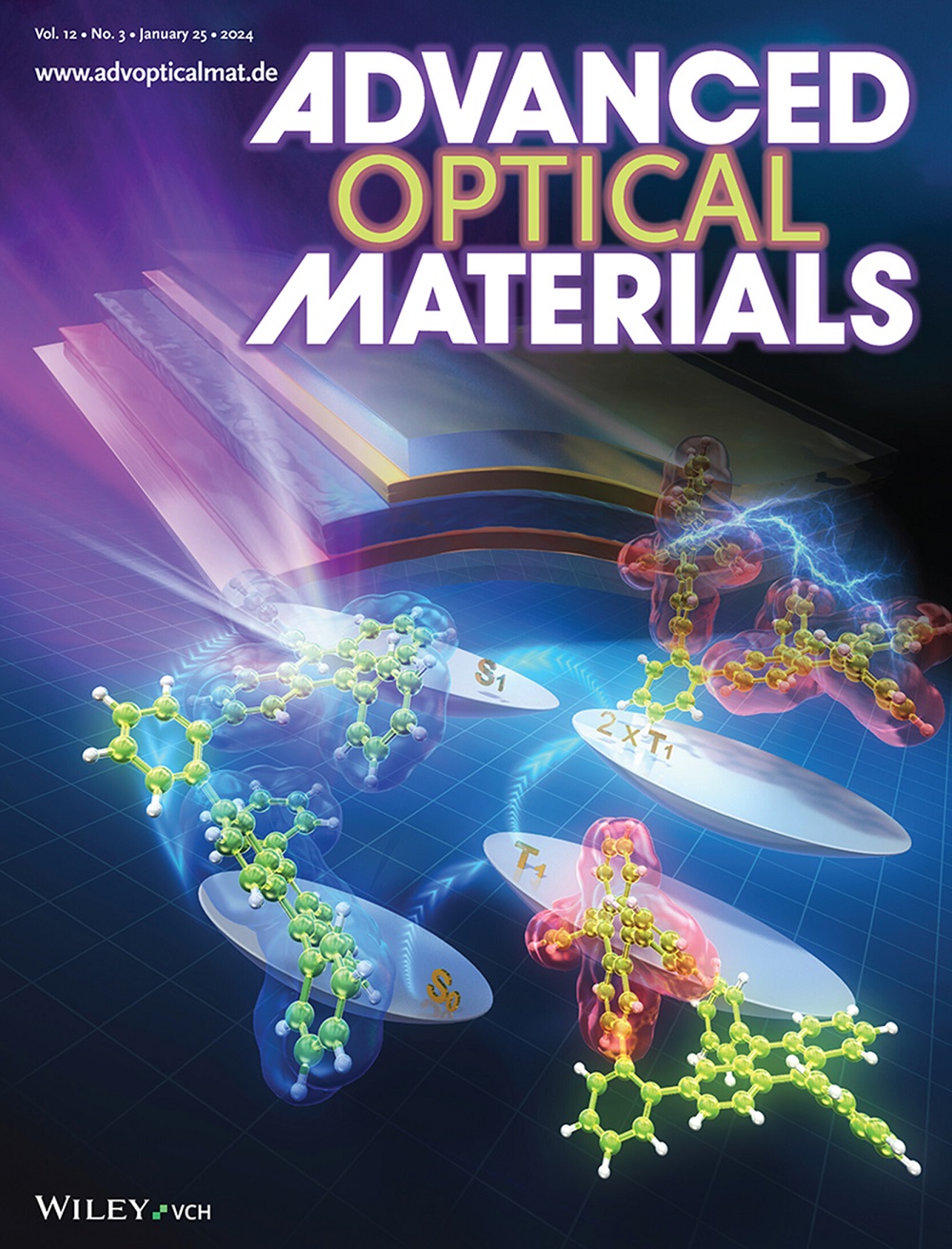
{"title":"Achieving Efficient Blue Room-Temperature Phosphorescence Through Self-Doping of Similar Structures and Polymer Assistance","authors":"Xiaoqiang Zhao, Xiao He, Yide Gao, Song Liang, Guangyu Wen, Bo Wang, Kun Gong, Wenhui Feng, Denghui Ji","doi":"10.1002/adom.202402452","DOIUrl":null,"url":null,"abstract":"<p>Blue is one of the three primary colors, and it is a crucial element in the regulation and application of organic room-temperature phosphorescence (ORTP). However, the considerable Stokes shift of small organic molecules presents a challenge for creating blue afterglow materials. To address this, host-guest-doped materials are prepared by selecting compounds with similar structures for self-doping. This method effectively regulated blue organic long-lasting phosphorescence. Additionally, the persistent-RTP and organic long-persistent luminescence (LPL) properties can be further enhanced by incorporating a rigid or flexible polymer network, creating a dense environment between the host and guest. Remarkably, the phosphorescence lifetime and afterglow duration of polymer-assisted doped materials are ≈5 times greater than those of host-guest doped crystal materials. Apart from its high efficiency, environmental friendliness, and easy synthesis, this blue ORTP material boasts high thermal stability and flexibility. Furthermore, this blue material demonstrates considerable potential in applications such as information encryption and anti-counterfeiting across various media, including paper, cotton thread, and leaves.</p>","PeriodicalId":116,"journal":{"name":"Advanced Optical Materials","volume":"13 6","pages":""},"PeriodicalIF":7.2000,"publicationDate":"2025-01-28","publicationTypes":"Journal Article","fieldsOfStudy":null,"isOpenAccess":false,"openAccessPdf":"","citationCount":"0","resultStr":null,"platform":"Semanticscholar","paperid":null,"PeriodicalName":"Advanced Optical Materials","FirstCategoryId":"88","ListUrlMain":"https://advanced.onlinelibrary.wiley.com/doi/10.1002/adom.202402452","RegionNum":2,"RegionCategory":"材料科学","ArticlePicture":[],"TitleCN":null,"AbstractTextCN":null,"PMCID":null,"EPubDate":"","PubModel":"","JCR":"Q1","JCRName":"MATERIALS SCIENCE, MULTIDISCIPLINARY","Score":null,"Total":0}
引用次数: 0
Abstract
Blue is one of the three primary colors, and it is a crucial element in the regulation and application of organic room-temperature phosphorescence (ORTP). However, the considerable Stokes shift of small organic molecules presents a challenge for creating blue afterglow materials. To address this, host-guest-doped materials are prepared by selecting compounds with similar structures for self-doping. This method effectively regulated blue organic long-lasting phosphorescence. Additionally, the persistent-RTP and organic long-persistent luminescence (LPL) properties can be further enhanced by incorporating a rigid or flexible polymer network, creating a dense environment between the host and guest. Remarkably, the phosphorescence lifetime and afterglow duration of polymer-assisted doped materials are ≈5 times greater than those of host-guest doped crystal materials. Apart from its high efficiency, environmental friendliness, and easy synthesis, this blue ORTP material boasts high thermal stability and flexibility. Furthermore, this blue material demonstrates considerable potential in applications such as information encryption and anti-counterfeiting across various media, including paper, cotton thread, and leaves.
期刊介绍:
Advanced Optical Materials, part of the esteemed Advanced portfolio, is a unique materials science journal concentrating on all facets of light-matter interactions. For over a decade, it has been the preferred optical materials journal for significant discoveries in photonics, plasmonics, metamaterials, and more. The Advanced portfolio from Wiley is a collection of globally respected, high-impact journals that disseminate the best science from established and emerging researchers, aiding them in fulfilling their mission and amplifying the reach of their scientific discoveries.





 京公网安备 11010802042870号
京ICP备2023020795号-1
京公网安备 11010802042870号
京ICP备2023020795号-1

 分享
分享
 求助内容:
求助内容: 应助结果提醒方式:
 扫码关注我们
