{"title":"Understanding the Role of MicroRNAs in Congenital Tooth Agenesis: A Multi-omics Integration","authors":"Prashant Ranjan, Chandra Devi, Neha Verma, Rajesh Bansal, Vinay Kumar Srivastava, Parimal Das","doi":"10.1007/s10528-025-11064-9","DOIUrl":null,"url":null,"abstract":"<div><p>This study employs a comprehensive multi-omics approach to investigate the regulatory roles of specific microRNAs (miRNAs) in Congenital Tooth Agenesis (CTA). A total of 58 miRNAs associated with tooth diseases, cancer, and bone development were initially identified through a literature review and analyzed using bioinformatics. Based on target prediction and network analysis, eight miRNAs with strong connectivity and common target genes were shortlisted for further investigation. Blood samples from 10 CTA patients and 5 healthy controls were analyzed for miRNA expression using stem-loop RT-PCR. Four miRNAs—hsa-miR-218-5p, hsa-miR-15b-5p, hsa-miR-200b-3p, and hsa-let-7a-3p—were identified as significantly differentially expressed, marking their first reported involvement in CTA. Notably, hsa-miR-218-5p and hsa-let-7a-3p emerged as novel regulators with no prior associations with CTA or tooth development. To address the limitations of a small sample size, a multi-omics strategy was employed to validate these findings, integrating miRNA expression data with whole exome sequencing (WES), gene expression panels, and metabolomic profiling. The analysis confirmed the association of these four miRNAs with CTA and highlighted their involvement in critical biological pathways such as Wnt signaling, FGF signaling, and PI3 kinase pathways, which are essential for cellular proliferation, differentiation, and tissue morphogenesis. Importantly, the identification of these miRNAs in blood samples, rather than traditional dental tissues, highlights a minimally invasive approach that could aid in the early detection, therapeutic targeting, and personalized management of dental anomalies.</p><h3>Graphical Abstract</h3>\n<div><figure><div><div><picture><source><img></source></picture></div></div></figure></div></div>","PeriodicalId":482,"journal":{"name":"Biochemical Genetics","volume":"64 1","pages":"865 - 894"},"PeriodicalIF":1.6000,"publicationDate":"2025-02-22","publicationTypes":"Journal Article","fieldsOfStudy":null,"isOpenAccess":false,"openAccessPdf":"","citationCount":"0","resultStr":null,"platform":"Semanticscholar","paperid":null,"PeriodicalName":"Biochemical Genetics","FirstCategoryId":"99","ListUrlMain":"https://link.springer.com/article/10.1007/s10528-025-11064-9","RegionNum":4,"RegionCategory":"生物学","ArticlePicture":[],"TitleCN":null,"AbstractTextCN":null,"PMCID":null,"EPubDate":"","PubModel":"","JCR":"Q4","JCRName":"BIOCHEMISTRY & MOLECULAR BIOLOGY","Score":null,"Total":0}
引用次数: 0
Abstract
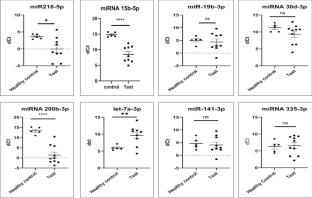
This study employs a comprehensive multi-omics approach to investigate the regulatory roles of specific microRNAs (miRNAs) in Congenital Tooth Agenesis (CTA). A total of 58 miRNAs associated with tooth diseases, cancer, and bone development were initially identified through a literature review and analyzed using bioinformatics. Based on target prediction and network analysis, eight miRNAs with strong connectivity and common target genes were shortlisted for further investigation. Blood samples from 10 CTA patients and 5 healthy controls were analyzed for miRNA expression using stem-loop RT-PCR. Four miRNAs—hsa-miR-218-5p, hsa-miR-15b-5p, hsa-miR-200b-3p, and hsa-let-7a-3p—were identified as significantly differentially expressed, marking their first reported involvement in CTA. Notably, hsa-miR-218-5p and hsa-let-7a-3p emerged as novel regulators with no prior associations with CTA or tooth development. To address the limitations of a small sample size, a multi-omics strategy was employed to validate these findings, integrating miRNA expression data with whole exome sequencing (WES), gene expression panels, and metabolomic profiling. The analysis confirmed the association of these four miRNAs with CTA and highlighted their involvement in critical biological pathways such as Wnt signaling, FGF signaling, and PI3 kinase pathways, which are essential for cellular proliferation, differentiation, and tissue morphogenesis. Importantly, the identification of these miRNAs in blood samples, rather than traditional dental tissues, highlights a minimally invasive approach that could aid in the early detection, therapeutic targeting, and personalized management of dental anomalies.
本研究采用综合多组学方法研究了特定microRNAs (miRNAs)在先天性牙齿发育(CTA)中的调节作用。通过文献综述和生物信息学分析,共鉴定出58种与牙齿疾病、癌症和骨骼发育相关的mirna。基于靶标预测和网络分析,筛选出8个具有较强连通性和共同靶基因的mirna进行进一步研究。采用茎环RT-PCR分析10例CTA患者和5例健康对照者的血液样本中miRNA的表达。四个mirna -hsa- mir -218-5p、hsa-miR-15b-5p、hsa-miR-200b-3p和hsa-let-7a-3p被鉴定为显著差异表达,这标志着它们首次被报道参与CTA。值得注意的是,hsa-miR-218-5p和hsa-let-7a-3p作为新的调节因子出现,与CTA或牙齿发育无关。为了解决小样本量的局限性,采用多组学策略来验证这些发现,将miRNA表达数据与全外显子组测序(WES)、基因表达面板和代谢组学分析相结合。分析证实了这四种mirna与CTA的关联,并强调了它们参与关键的生物学途径,如Wnt信号传导、FGF信号传导和PI3激酶途径,这些途径对细胞增殖、分化和组织形态发生至关重要。重要的是,在血液样本中识别这些mirna,而不是在传统的牙齿组织中,强调了一种微创方法,可以帮助早期发现、治疗靶向和个性化处理牙齿异常。
期刊介绍:
Biochemical Genetics welcomes original manuscripts that address and test clear scientific hypotheses, are directed to a broad scientific audience, and clearly contribute to the advancement of the field through the use of sound sampling or experimental design, reliable analytical methodologies and robust statistical analyses.
Although studies focusing on particular regions and target organisms are welcome, it is not the journal’s goal to publish essentially descriptive studies that provide results with narrow applicability, or are based on very small samples or pseudoreplication.
Rather, Biochemical Genetics welcomes review articles that go beyond summarizing previous publications and create added value through the systematic analysis and critique of the current state of knowledge or by conducting meta-analyses.
Methodological articles are also within the scope of Biological Genetics, particularly when new laboratory techniques or computational approaches are fully described and thoroughly compared with the existing benchmark methods.
Biochemical Genetics welcomes articles on the following topics: Genomics; Proteomics; Population genetics; Phylogenetics; Metagenomics; Microbial genetics; Genetics and evolution of wild and cultivated plants; Animal genetics and evolution; Human genetics and evolution; Genetic disorders; Genetic markers of diseases; Gene technology and therapy; Experimental and analytical methods; Statistical and computational methods.



 京公网安备 11010802042870号
京ICP备2023020795号-1
京公网安备 11010802042870号
京ICP备2023020795号-1

 分享
分享
 求助内容:
求助内容: 应助结果提醒方式:
 扫码关注我们
