{"title":"The impact of misspecified covariate models on inclusion and omission bias when using fixed effects and full random effects models.","authors":"Joakim Nyberg, E Niclas Jonsson","doi":"10.1007/s10928-025-09964-9","DOIUrl":null,"url":null,"abstract":"<p><p>Identification of covariates that can explain sources of variability among individuals in pharmacometric models is key, as it can lead to patient-subgrouping or patient-specific dosing strategies. Common recommendations propose to limit the covariate-parameters relationships to be tested to those that are scientifically plausible, a process called covariate \"scope reduction\". We investigated the possible impact of scope reduction on model parameters estimated with misspecified models in terms of omission bias (when a relevant covariate is not included in a model) and inclusion bias (when a non-relevant covariate is included). One-hundred datasets were simulated with a rich-sampling design using 8 variations of a one-compartment model with first-order absorption, having clearance (CL), volume of distribution (V), and absorption rate constant (Ka) as parameters, and body weight (WT) as covariate. Parameters were estimated using 14 models that included the covariate using fixed-effects (FEM) and 2 full random-effects models (FREM), with combinations of covariate-parameter relationships and IIV correlations. Estimated parameters were compared to the parameter values used for simulations in terms of accuracy (bias) and precision. Results showed that, in misspecified FEMs, covariate coefficients and IIV parameters were sensitive to omission bias. Conversely, misspecified covariate models did not introduce inclusion bias since the impact of a non-relevant covariate was estimated, as expected, to values close to zero, and in these cases FREM performed better than FEM. In conclusion, while inclusion bias does not seem to be an issue in misspecified models, the risk of introducing omission bias in parameter estimates should be kept in mind when considering covariate scope reduction when covariate models are implemented using fixed effects.</p>","PeriodicalId":16851,"journal":{"name":"Journal of Pharmacokinetics and Pharmacodynamics","volume":"52 2","pages":"18"},"PeriodicalIF":2.8000,"publicationDate":"2025-02-22","publicationTypes":"Journal Article","fieldsOfStudy":null,"isOpenAccess":false,"openAccessPdf":"https://www.ncbi.nlm.nih.gov/pmc/articles/PMC11846770/pdf/","citationCount":"0","resultStr":null,"platform":"Semanticscholar","paperid":null,"PeriodicalName":"Journal of Pharmacokinetics and Pharmacodynamics","FirstCategoryId":"3","ListUrlMain":"https://doi.org/10.1007/s10928-025-09964-9","RegionNum":4,"RegionCategory":"医学","ArticlePicture":[],"TitleCN":null,"AbstractTextCN":null,"PMCID":null,"EPubDate":"","PubModel":"","JCR":"Q3","JCRName":"PHARMACOLOGY & PHARMACY","Score":null,"Total":0}
引用次数: 0
Abstract
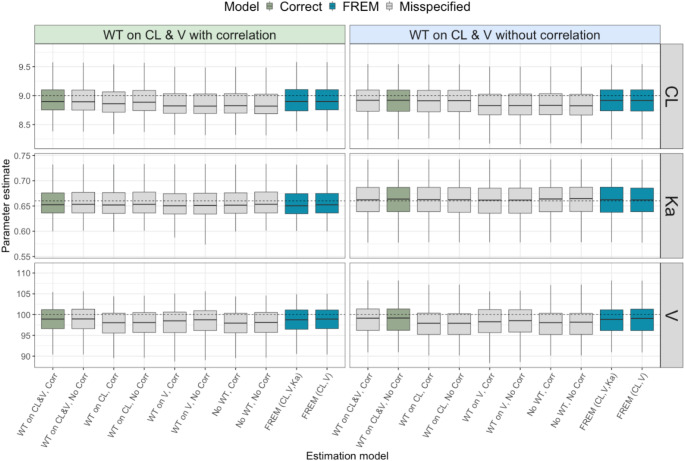
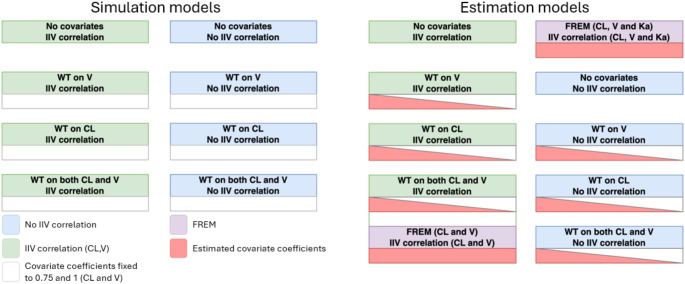
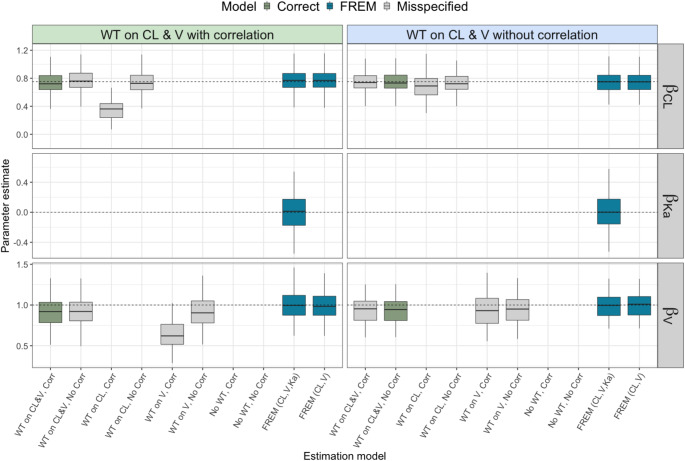
Identification of covariates that can explain sources of variability among individuals in pharmacometric models is key, as it can lead to patient-subgrouping or patient-specific dosing strategies. Common recommendations propose to limit the covariate-parameters relationships to be tested to those that are scientifically plausible, a process called covariate "scope reduction". We investigated the possible impact of scope reduction on model parameters estimated with misspecified models in terms of omission bias (when a relevant covariate is not included in a model) and inclusion bias (when a non-relevant covariate is included). One-hundred datasets were simulated with a rich-sampling design using 8 variations of a one-compartment model with first-order absorption, having clearance (CL), volume of distribution (V), and absorption rate constant (Ka) as parameters, and body weight (WT) as covariate. Parameters were estimated using 14 models that included the covariate using fixed-effects (FEM) and 2 full random-effects models (FREM), with combinations of covariate-parameter relationships and IIV correlations. Estimated parameters were compared to the parameter values used for simulations in terms of accuracy (bias) and precision. Results showed that, in misspecified FEMs, covariate coefficients and IIV parameters were sensitive to omission bias. Conversely, misspecified covariate models did not introduce inclusion bias since the impact of a non-relevant covariate was estimated, as expected, to values close to zero, and in these cases FREM performed better than FEM. In conclusion, while inclusion bias does not seem to be an issue in misspecified models, the risk of introducing omission bias in parameter estimates should be kept in mind when considering covariate scope reduction when covariate models are implemented using fixed effects.
期刊介绍:
Broadly speaking, the Journal of Pharmacokinetics and Pharmacodynamics covers the area of pharmacometrics. The journal is devoted to illustrating the importance of pharmacokinetics, pharmacodynamics, and pharmacometrics in drug development, clinical care, and the understanding of drug action. The journal publishes on a variety of topics related to pharmacometrics, including, but not limited to, clinical, experimental, and theoretical papers examining the kinetics of drug disposition and effects of drug action in humans, animals, in vitro, or in silico; modeling and simulation methodology, including optimal design; precision medicine; systems pharmacology; and mathematical pharmacology (including computational biology, bioengineering, and biophysics related to pharmacology, pharmacokinetics, orpharmacodynamics). Clinical papers that include population pharmacokinetic-pharmacodynamic relationships are welcome. The journal actively invites and promotes up-and-coming areas of pharmacometric research, such as real-world evidence, quality of life analyses, and artificial intelligence. The Journal of Pharmacokinetics and Pharmacodynamics is an official journal of the International Society of Pharmacometrics.



 京公网安备 11010802042870号
京ICP备2023020795号-1
京公网安备 11010802042870号
京ICP备2023020795号-1

 分享
分享
 求助内容:
求助内容: 应助结果提醒方式:
 扫码关注我们
