{"title":"Effectiveness of perioperative remimazolam in preventing postoperative delirium: a systematic review and meta-analysis.","authors":"Mingzhen Wang, Jinhui Liu, Wenjie Liu, Xin Zhang, Gaofeng Zhang, Lixin Sun, Yanlin Bi, Hong Wang, Rui Dong","doi":"10.1186/s40001-025-02383-z","DOIUrl":null,"url":null,"abstract":"<p><strong>Background: </strong>To compare the POD rates in patients undergoing non-cardiac surgery who received remimazolam perioperatively versus placebo or other sedatives.</p><p><strong>Methods: </strong>We systematically searched four major databases (Cochrane Central Register of Controlled Trials, Web of Science, Embase, and PubMed) for relevant randomized controlled trials (RCTs) up to July 11, 2024. Literature quality evaluation was used the bias risk table in Review Manager 5.4. The primary outcome of interest was POD, and secondary outcomes were the hypotension risk, bradycardia and, nausea and vomiting.</p><p><strong>Results: </strong>Across 11 trials involving 1985 participants, we recorded 309 cases of POD during follow-up. In trials where the control group received saline, remimazolam decrease the risk of POD significantly by 70% (RR 0.30, 95% CI [0.19, 0.46]; p < 0.00001). Statistical analysis did not show significant difference in the risk of POD between the remimazolam group and the groups receiving either dexmedetomidine (RR 1.23 [0.64, 2.37]; p = 0.53) or propofol (RR 0.83 [0.60, 1.16]; p = 0.28). Regarding adverse events, remimazolam significantly reduces the morbidity of hypotension compared to dexmedetomidine (RR 0.25 [0.10, 0.65]; p = 0.004) and propofol (RR 0.45 [0.33, 0.60]; p < 0.00001). In addition, there were no significant differences in the incidence of bradycardia (RR 0.85; 95% CI [0.34-2.12], p = 0.72) and nausea and vomiting (RR 1.06; 95% CI [0.74-1.51], p = 0.77) between remimazolam and the control group.</p><p><strong>Conclusions: </strong>During the perioperative period, using remimazolam can lower POD risk after surgery for patients who had non-cardiac surgery, but remimazolam does not work better than dexmedetomidine or propofol. Compared with the dexmedetomidine and propofol, remimazolam also has apparent advantages in preventing intraoperative hypotension.</p>","PeriodicalId":11949,"journal":{"name":"European Journal of Medical Research","volume":"30 1","pages":"122"},"PeriodicalIF":3.4000,"publicationDate":"2025-02-21","publicationTypes":"Journal Article","fieldsOfStudy":null,"isOpenAccess":false,"openAccessPdf":"https://www.ncbi.nlm.nih.gov/pmc/articles/PMC11843786/pdf/","citationCount":"0","resultStr":null,"platform":"Semanticscholar","paperid":null,"PeriodicalName":"European Journal of Medical Research","FirstCategoryId":"3","ListUrlMain":"https://doi.org/10.1186/s40001-025-02383-z","RegionNum":3,"RegionCategory":"医学","ArticlePicture":[],"TitleCN":null,"AbstractTextCN":null,"PMCID":null,"EPubDate":"","PubModel":"","JCR":"Q2","JCRName":"MEDICINE, RESEARCH & EXPERIMENTAL","Score":null,"Total":0}
引用次数: 0
Abstract
Background: To compare the POD rates in patients undergoing non-cardiac surgery who received remimazolam perioperatively versus placebo or other sedatives.
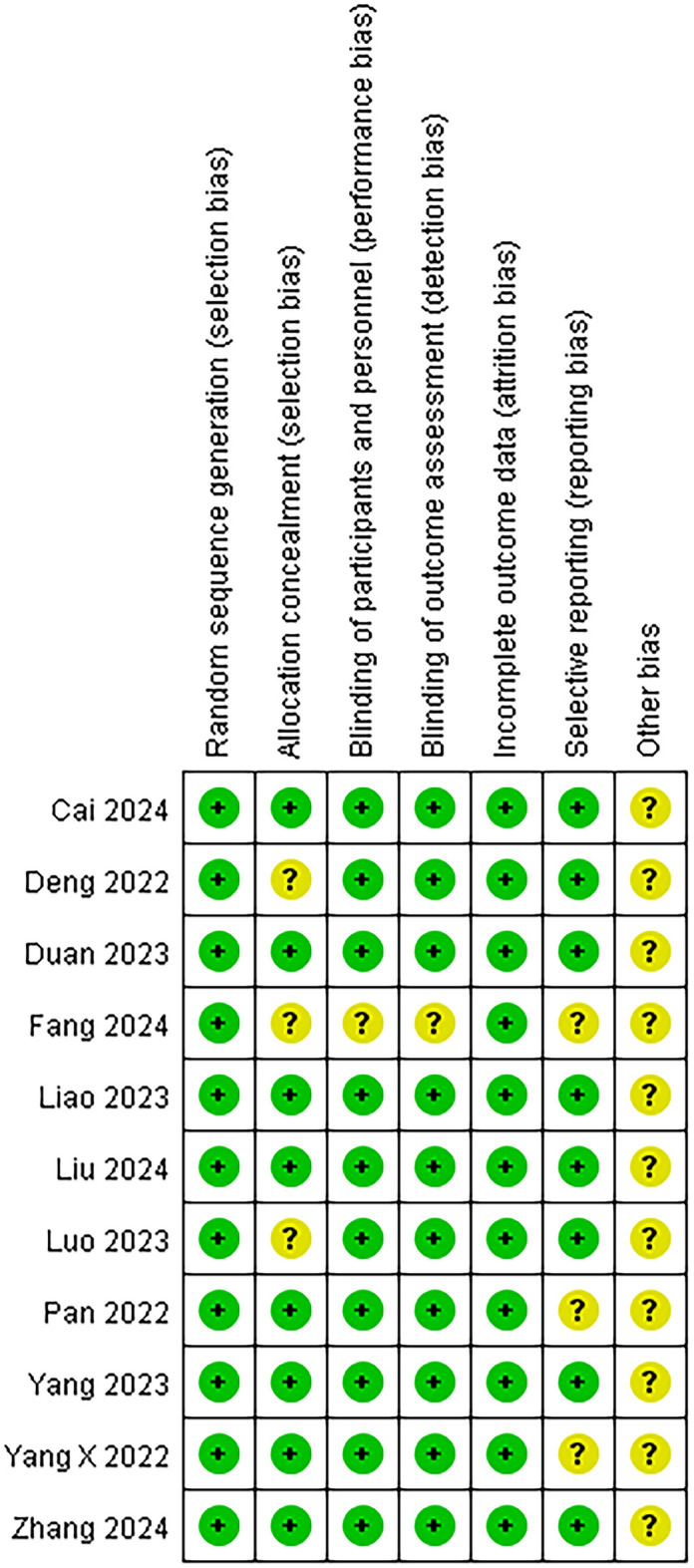
Methods: We systematically searched four major databases (Cochrane Central Register of Controlled Trials, Web of Science, Embase, and PubMed) for relevant randomized controlled trials (RCTs) up to July 11, 2024. Literature quality evaluation was used the bias risk table in Review Manager 5.4. The primary outcome of interest was POD, and secondary outcomes were the hypotension risk, bradycardia and, nausea and vomiting.
Results: Across 11 trials involving 1985 participants, we recorded 309 cases of POD during follow-up. In trials where the control group received saline, remimazolam decrease the risk of POD significantly by 70% (RR 0.30, 95% CI [0.19, 0.46]; p < 0.00001). Statistical analysis did not show significant difference in the risk of POD between the remimazolam group and the groups receiving either dexmedetomidine (RR 1.23 [0.64, 2.37]; p = 0.53) or propofol (RR 0.83 [0.60, 1.16]; p = 0.28). Regarding adverse events, remimazolam significantly reduces the morbidity of hypotension compared to dexmedetomidine (RR 0.25 [0.10, 0.65]; p = 0.004) and propofol (RR 0.45 [0.33, 0.60]; p < 0.00001). In addition, there were no significant differences in the incidence of bradycardia (RR 0.85; 95% CI [0.34-2.12], p = 0.72) and nausea and vomiting (RR 1.06; 95% CI [0.74-1.51], p = 0.77) between remimazolam and the control group.
Conclusions: During the perioperative period, using remimazolam can lower POD risk after surgery for patients who had non-cardiac surgery, but remimazolam does not work better than dexmedetomidine or propofol. Compared with the dexmedetomidine and propofol, remimazolam also has apparent advantages in preventing intraoperative hypotension.
背景:比较非心脏手术患者围手术期接受雷马唑仑与安慰剂或其他镇静剂的POD率。方法:我们系统地检索了四个主要数据库(Cochrane Central Register of Controlled Trials, Web of Science, Embase和PubMed),检索截至2024年7月11日的相关随机对照试验(RCTs)。文献质量评价采用Review Manager 5.4中的偏倚风险表。主要结局是POD,次要结局是低血压风险、心动过缓、恶心和呕吐。结果:在涉及1985名参与者的11项试验中,我们在随访期间记录了309例POD病例。在对照组接受生理盐水治疗的试验中,雷马唑仑显著降低了70%的POD风险(RR 0.30, 95% CI [0.19, 0.46];p结论:非心脏手术患者围手术期使用雷马唑仑可降低术后POD风险,但效果并不优于右美托咪定或异丙酚。与右美托咪定和异丙酚相比,雷马唑仑在预防术中低血压方面也有明显的优势。
期刊介绍:
European Journal of Medical Research publishes translational and clinical research of international interest across all medical disciplines, enabling clinicians and other researchers to learn about developments and innovations within these disciplines and across the boundaries between disciplines. The journal publishes high quality research and reviews and aims to ensure that the results of all well-conducted research are published, regardless of their outcome.





 京公网安备 11010802042870号
京ICP备2023020795号-1
京公网安备 11010802042870号
京ICP备2023020795号-1

 分享
分享
 求助内容:
求助内容: 应助结果提醒方式:
 扫码关注我们
