Núria Amigó, Esmeralda Castelblanco, Josep Julve, Neus Martínez-Micaelo, Núria Alonso, Marta Hernández, Josep Ribalta, Montse Guardiola, Pere Torán-Monserrat, Victor Lopez-Lifante, Cecilia Herrero-Alonso, Ingrid Arteaga, Emilio Ortega, Josep Franch-Nadal, Didac Mauricio
{"title":"Advanced serum lipoprotein and glycoprotein profiling for cardiovascular event prediction in type 2 diabetes mellitus: the LIPOCAT study.","authors":"Núria Amigó, Esmeralda Castelblanco, Josep Julve, Neus Martínez-Micaelo, Núria Alonso, Marta Hernández, Josep Ribalta, Montse Guardiola, Pere Torán-Monserrat, Victor Lopez-Lifante, Cecilia Herrero-Alonso, Ingrid Arteaga, Emilio Ortega, Josep Franch-Nadal, Didac Mauricio","doi":"10.1186/s12933-025-02636-5","DOIUrl":null,"url":null,"abstract":"<p><strong>Background: </strong>Traditional risk factors cannot accurately predict cardiovascular events (CVE) in type 2 diabetes (T2D). The LIPOCAT study aimed to prospectively evaluate the clinical utility of advanced lipoprotein characteristics and glycoproteins to predict future cardiovascular events (CVE) in a large cohort of subjects with type 2 diabetes mellitus (T2D).</p><p><strong>Methods: </strong>From four different Spanish prospective cohorts, a total of 933 T2D subjects were selected to form the LIPOCAT study. Advanced 1H-Nuclear Magnetic Resonance (1H-NMR) analysis included lipoprotein (Liposcale®) and glycoprotein (Glycoscale) profiling. Random forest classification models and Area Under the Receiver Operating Characteristics (AUROC) analysis were used to assess the differential contribution of advanced variables in predicting CVE. Validation was performed using an external cohort.</p><p><strong>Results: </strong>Out of 933 T2D subjects, 104 reported a CVE during follow-up. Analysis of Liposcale®/Glycoscale uncovered elevations in the circulating VLDL-cholesterol(C), remnant IDL-triglycerides (TG) and LDL-TG in subjects with CVE, along with glycoproteins (Glyc) A and B. Moreover, the incorporation of advanced Liposcale® variables to a base model constructed with traditional risk factors significantly improved the prediction of CVE, as evidenced by 1.5-fold increase in the C statistic (AUROC), reaching AUROC values of 0.756. In the independent validation cohort, similar improvements in AUROC values were observed by adding the advanced variables to the traditional models.</p><p><strong>Conclusions: </strong>Advanced 1H-NMR analysis revealed previously hidden lipoprotein and glycoprotein characteristics associated with CVE in T2D subjects.</p>","PeriodicalId":9374,"journal":{"name":"Cardiovascular Diabetology","volume":"24 1","pages":"88"},"PeriodicalIF":10.6000,"publicationDate":"2025-02-21","publicationTypes":"Journal Article","fieldsOfStudy":null,"isOpenAccess":false,"openAccessPdf":"https://www.ncbi.nlm.nih.gov/pmc/articles/PMC11846359/pdf/","citationCount":"0","resultStr":null,"platform":"Semanticscholar","paperid":null,"PeriodicalName":"Cardiovascular Diabetology","FirstCategoryId":"3","ListUrlMain":"https://doi.org/10.1186/s12933-025-02636-5","RegionNum":1,"RegionCategory":"医学","ArticlePicture":[],"TitleCN":null,"AbstractTextCN":null,"PMCID":null,"EPubDate":"","PubModel":"","JCR":"Q1","JCRName":"CARDIAC & CARDIOVASCULAR SYSTEMS","Score":null,"Total":0}
引用次数: 0
Abstract
Background: Traditional risk factors cannot accurately predict cardiovascular events (CVE) in type 2 diabetes (T2D). The LIPOCAT study aimed to prospectively evaluate the clinical utility of advanced lipoprotein characteristics and glycoproteins to predict future cardiovascular events (CVE) in a large cohort of subjects with type 2 diabetes mellitus (T2D).
Methods: From four different Spanish prospective cohorts, a total of 933 T2D subjects were selected to form the LIPOCAT study. Advanced 1H-Nuclear Magnetic Resonance (1H-NMR) analysis included lipoprotein (Liposcale®) and glycoprotein (Glycoscale) profiling. Random forest classification models and Area Under the Receiver Operating Characteristics (AUROC) analysis were used to assess the differential contribution of advanced variables in predicting CVE. Validation was performed using an external cohort.
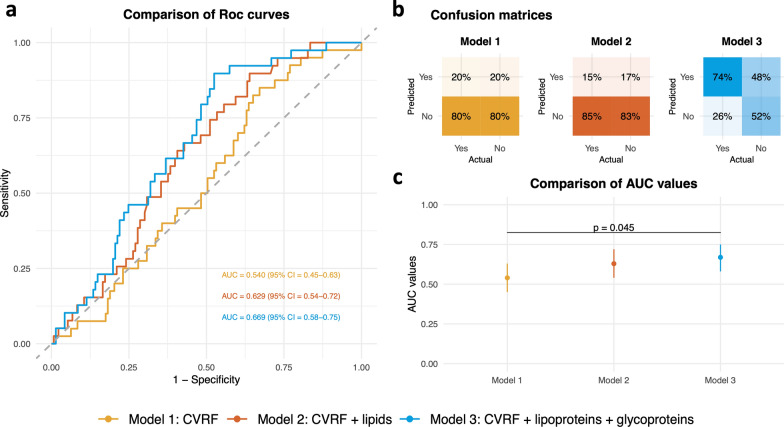
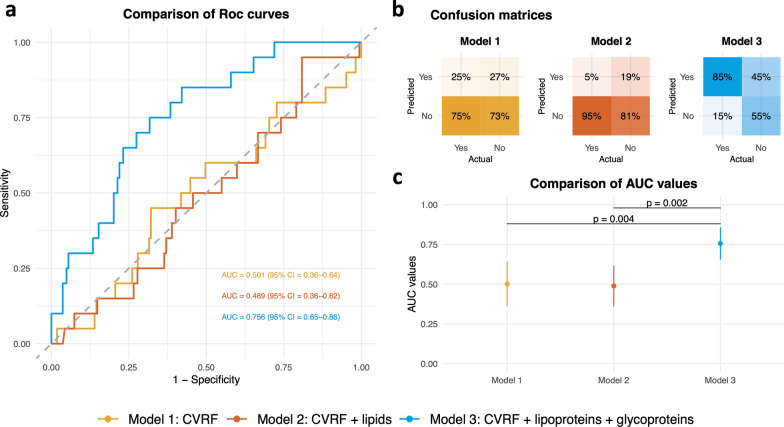
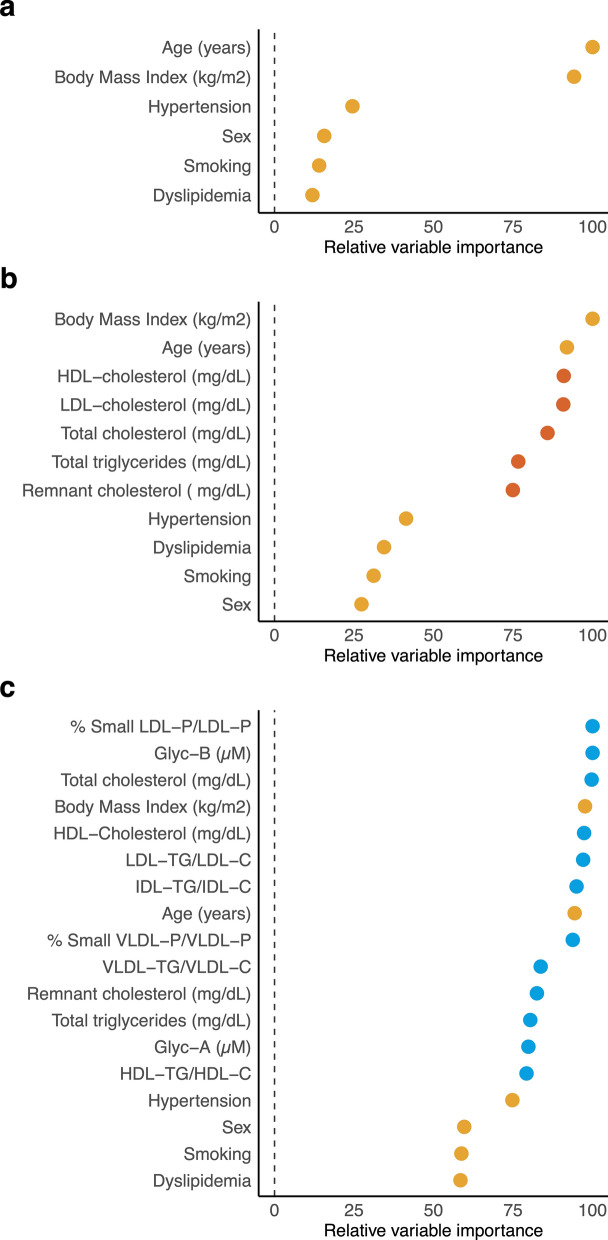
Results: Out of 933 T2D subjects, 104 reported a CVE during follow-up. Analysis of Liposcale®/Glycoscale uncovered elevations in the circulating VLDL-cholesterol(C), remnant IDL-triglycerides (TG) and LDL-TG in subjects with CVE, along with glycoproteins (Glyc) A and B. Moreover, the incorporation of advanced Liposcale® variables to a base model constructed with traditional risk factors significantly improved the prediction of CVE, as evidenced by 1.5-fold increase in the C statistic (AUROC), reaching AUROC values of 0.756. In the independent validation cohort, similar improvements in AUROC values were observed by adding the advanced variables to the traditional models.
Conclusions: Advanced 1H-NMR analysis revealed previously hidden lipoprotein and glycoprotein characteristics associated with CVE in T2D subjects.
期刊介绍:
Cardiovascular Diabetology is a journal that welcomes manuscripts exploring various aspects of the relationship between diabetes, cardiovascular health, and the metabolic syndrome. We invite submissions related to clinical studies, genetic investigations, experimental research, pharmacological studies, epidemiological analyses, and molecular biology research in this field.



 京公网安备 11010802042870号
京ICP备2023020795号-1
京公网安备 11010802042870号
京ICP备2023020795号-1

 分享
分享
 求助内容:
求助内容: 应助结果提醒方式:
 扫码关注我们
