{"title":"Molecular detection of Anaplasma phagocytophilum in field-collected Haemaphysalis larvae in the Republic of Korea.","authors":"KyuSung Ahn, Badriah Alkathiri, Seung-Hun Lee, Haeseung Lee, Dongmi Kwak, Yun Sang Cho, Hyang-Sim Lee, SoYoun Youn, Mi-Sun Yoo, Jaemyung Kim, SungShik Shin","doi":"10.1186/s13071-024-06649-z","DOIUrl":null,"url":null,"abstract":"<p><strong>Background: </strong>Anaplasma spp., zoonotic tick-borne pathogens affecting livestock, companion animals, and humans, exhibits 15-18% seropositivity among hunting dogs in the Republic of Korea (South Korea). The dominant tick species in South Korea, Haemaphysalis longicornis, can transmit these pathogens to both humans and animals. Given the limited understanding of transovarial transmission of Anaplasma spp., our study aimed to assess the prevalence of questing larval ticks containing Anaplasma DNA. Additionally, we aimed to gather data for establishing a nationwide forecasting and alert system on seasonal variation of tick developmental stages and tick-borne zoonotic pathogens.</p><p><strong>Methods: </strong>From March to October 2021 and again from March to October 2022, we collected a total of 36,912 unfed, questing ticks of Haemaphysalis spp. from 149 sites in South Korea. Ticks were collected from herbaceous vegetation using the flagging method using a white flannel cloth. After species identification, one-third of collected ticks underwent analysis for Anaplasma DNA. Nymph ticks were pooled in groups of 1-10 and larvae in groups of 1-50, while adults were examined individually. Nested polymerase chain reaction (PCR) was performed to detect the genus Anaplasma by amplifying the 16S rRNA gene, followed by sequencing for species identification and phylogenetic analysis.</p><p><strong>Results: </strong>Of the 36,912 questing ticks collected, 13,082 (35.4%) were identified as nymphs and adults of H. longicornis and 3850 (10.4%) as those of Haemaphysalis flava. The morphologically indistinguishable larval stage of Haemaphysalis spp. predominated, with 19,980 (54.1%) collected primarily from July to October. From the 939 tick pools, 24 pools (2.6%) tested positive for Anaplasma, with the larval stage exhibiting the highest number of positive pools (16, 1.7%). Phylogenetic analysis revealed that 21 of the 24 Anaplasma-positive pools contained A. phagocytophilum-specific genes, with 1 identified as Anaplasma sp. and the remaining 2 as A. bovis.</p><p><strong>Conclusions: </strong>Our study provides evidence of transovarial transmission of A. phagocytophilum in Haemaphysalis spp. larvae under field conditions, showing that the bacteria are transmitted from mother ticks to unengorged, questing larvae. Additionally, our findings contribute significant data for establishing a nationwide forecasting and alert system on seasonal variation of tick developmental stages and tick-borne zoonotic pathogens.</p>","PeriodicalId":19793,"journal":{"name":"Parasites & Vectors","volume":"18 1","pages":"67"},"PeriodicalIF":3.5000,"publicationDate":"2025-02-21","publicationTypes":"Journal Article","fieldsOfStudy":null,"isOpenAccess":false,"openAccessPdf":"https://www.ncbi.nlm.nih.gov/pmc/articles/PMC11846178/pdf/","citationCount":"0","resultStr":null,"platform":"Semanticscholar","paperid":null,"PeriodicalName":"Parasites & Vectors","FirstCategoryId":"3","ListUrlMain":"https://doi.org/10.1186/s13071-024-06649-z","RegionNum":2,"RegionCategory":"医学","ArticlePicture":[],"TitleCN":null,"AbstractTextCN":null,"PMCID":null,"EPubDate":"","PubModel":"","JCR":"Q1","JCRName":"PARASITOLOGY","Score":null,"Total":0}
引用次数: 0
Abstract
Background: Anaplasma spp., zoonotic tick-borne pathogens affecting livestock, companion animals, and humans, exhibits 15-18% seropositivity among hunting dogs in the Republic of Korea (South Korea). The dominant tick species in South Korea, Haemaphysalis longicornis, can transmit these pathogens to both humans and animals. Given the limited understanding of transovarial transmission of Anaplasma spp., our study aimed to assess the prevalence of questing larval ticks containing Anaplasma DNA. Additionally, we aimed to gather data for establishing a nationwide forecasting and alert system on seasonal variation of tick developmental stages and tick-borne zoonotic pathogens.
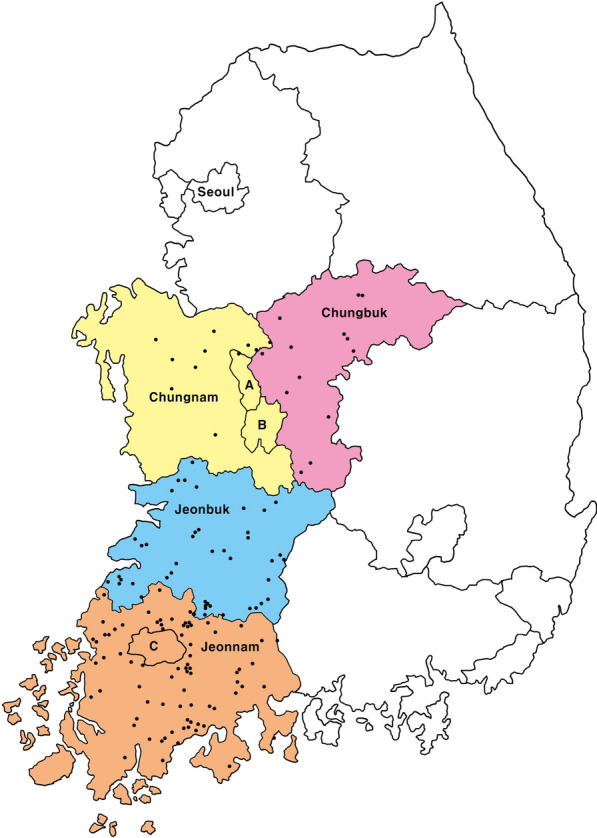
Methods: From March to October 2021 and again from March to October 2022, we collected a total of 36,912 unfed, questing ticks of Haemaphysalis spp. from 149 sites in South Korea. Ticks were collected from herbaceous vegetation using the flagging method using a white flannel cloth. After species identification, one-third of collected ticks underwent analysis for Anaplasma DNA. Nymph ticks were pooled in groups of 1-10 and larvae in groups of 1-50, while adults were examined individually. Nested polymerase chain reaction (PCR) was performed to detect the genus Anaplasma by amplifying the 16S rRNA gene, followed by sequencing for species identification and phylogenetic analysis.
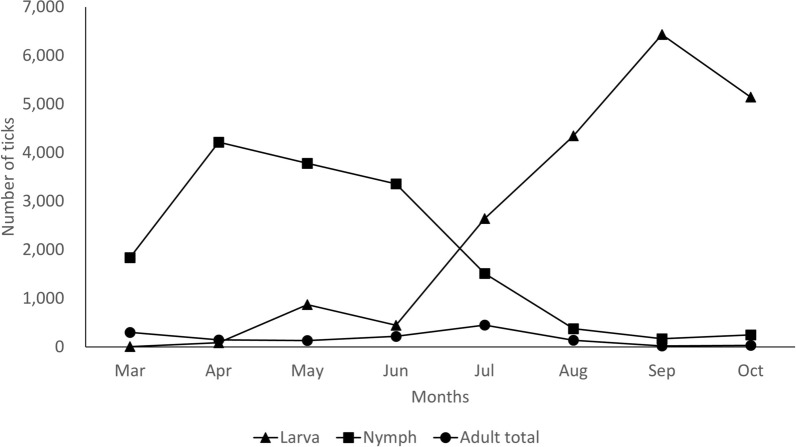
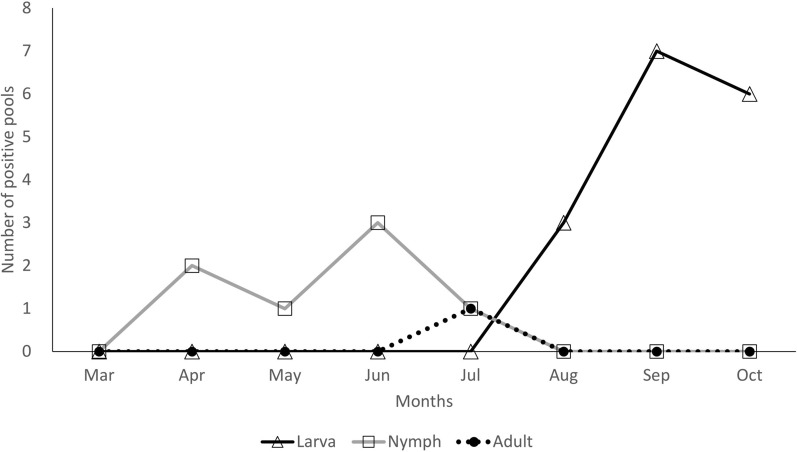
Results: Of the 36,912 questing ticks collected, 13,082 (35.4%) were identified as nymphs and adults of H. longicornis and 3850 (10.4%) as those of Haemaphysalis flava. The morphologically indistinguishable larval stage of Haemaphysalis spp. predominated, with 19,980 (54.1%) collected primarily from July to October. From the 939 tick pools, 24 pools (2.6%) tested positive for Anaplasma, with the larval stage exhibiting the highest number of positive pools (16, 1.7%). Phylogenetic analysis revealed that 21 of the 24 Anaplasma-positive pools contained A. phagocytophilum-specific genes, with 1 identified as Anaplasma sp. and the remaining 2 as A. bovis.
Conclusions: Our study provides evidence of transovarial transmission of A. phagocytophilum in Haemaphysalis spp. larvae under field conditions, showing that the bacteria are transmitted from mother ticks to unengorged, questing larvae. Additionally, our findings contribute significant data for establishing a nationwide forecasting and alert system on seasonal variation of tick developmental stages and tick-borne zoonotic pathogens.
期刊介绍:
Parasites & Vectors is an open access, peer-reviewed online journal dealing with the biology of parasites, parasitic diseases, intermediate hosts, vectors and vector-borne pathogens. Manuscripts published in this journal will be available to all worldwide, with no barriers to access, immediately following acceptance. However, authors retain the copyright of their material and may use it, or distribute it, as they wish.
Manuscripts on all aspects of the basic and applied biology of parasites, intermediate hosts, vectors and vector-borne pathogens will be considered. In addition to the traditional and well-established areas of science in these fields, we also aim to provide a vehicle for publication of the rapidly developing resources and technology in parasite, intermediate host and vector genomics and their impacts on biological research. We are able to publish large datasets and extensive results, frequently associated with genomic and post-genomic technologies, which are not readily accommodated in traditional journals. Manuscripts addressing broader issues, for example economics, social sciences and global climate change in relation to parasites, vectors and disease control, are also welcomed.



 京公网安备 11010802042870号
京ICP备2023020795号-1
京公网安备 11010802042870号
京ICP备2023020795号-1

 分享
分享
 求助内容:
求助内容: 应助结果提醒方式:
 扫码关注我们
