{"title":"A Dual-Targeted Molecule for Disease-Activatable Proteolysis Targeting Chimeras and Targeted Radionuclide Therapy of Cancer","authors":"Yuan Zhang, Wei Gu, Wan Chen, Jieli Zhu, Longfei Fan, Liwen Zhang, Liangyou Zhao, Qingqing Miao","doi":"10.1021/jacs.4c18398","DOIUrl":null,"url":null,"abstract":"Proteolysis targeting chimeras (PROTACs) represent a cutting-edge approach for targeted protein degradation in cancer therapy, yet they face challenges such as poor pharmacokinetics and specificity issues, leading to undesirable off-target effects and limited antitumor potency. To address these issues, we introduce dual-targeted unimolecular theranostic probes (e.g., radioactive <sup>177</sup>Lu-P-A and its cold counterpart <sup>nat</sup>Lu-P-A) for disease-activatable PROTACs in combination with targeted radionuclide therapy (TRT) against prostate cancer with high specificity and effectiveness. The probes achieve a cathepsin B (CTSB)-activatable pro-PROTAC moiety for precise degradation of bromodomain-containing protein 4 (BRD4) and a prostate-specific membrane antigen (PSMA)-targeted <sup>177</sup>Lu-based TRT. Owing to the favorable pharmacokinetics and PSMA-mediated excellent targeting efficiency, the probe possesses high tumor imaging specificity and accumulation capacity of therapeutic units for highly effective PROTACs and TRT. In contrast, the free PROTACs unit (e.g., ARV-771) shows no observable therapeutic effect due to its poor targeting ability. Importantly, the BRD4 proteolysis by PROTAC activation can downregulate radiosensitivity-associated RAD51AP1 expression, synergistically enhancing the TRT effect and promoting apoptosis after combined therapy compared to individual treatment regimes. Additionally, the probe demonstrates high renal clearance, underscoring its biosafety for potential clinical translation. This study presents a potential approach for precise PROTACs combined with TRT for effective tumor therapy.","PeriodicalId":49,"journal":{"name":"Journal of the American Chemical Society","volume":"31 1","pages":""},"PeriodicalIF":15.6000,"publicationDate":"2025-02-24","publicationTypes":"Journal Article","fieldsOfStudy":null,"isOpenAccess":false,"openAccessPdf":"","citationCount":"0","resultStr":null,"platform":"Semanticscholar","paperid":null,"PeriodicalName":"Journal of the American Chemical Society","FirstCategoryId":"92","ListUrlMain":"https://doi.org/10.1021/jacs.4c18398","RegionNum":1,"RegionCategory":"化学","ArticlePicture":[],"TitleCN":null,"AbstractTextCN":null,"PMCID":null,"EPubDate":"","PubModel":"","JCR":"Q1","JCRName":"CHEMISTRY, MULTIDISCIPLINARY","Score":null,"Total":0}
引用次数: 0
Abstract
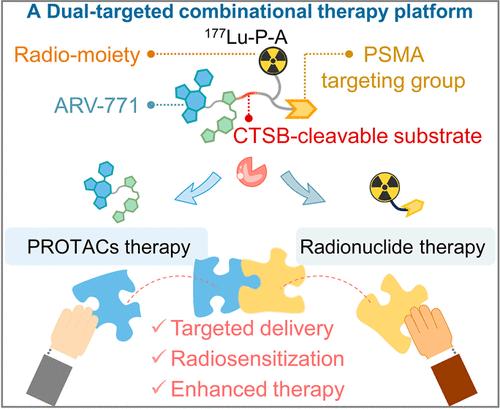
Proteolysis targeting chimeras (PROTACs) represent a cutting-edge approach for targeted protein degradation in cancer therapy, yet they face challenges such as poor pharmacokinetics and specificity issues, leading to undesirable off-target effects and limited antitumor potency. To address these issues, we introduce dual-targeted unimolecular theranostic probes (e.g., radioactive 177Lu-P-A and its cold counterpart natLu-P-A) for disease-activatable PROTACs in combination with targeted radionuclide therapy (TRT) against prostate cancer with high specificity and effectiveness. The probes achieve a cathepsin B (CTSB)-activatable pro-PROTAC moiety for precise degradation of bromodomain-containing protein 4 (BRD4) and a prostate-specific membrane antigen (PSMA)-targeted 177Lu-based TRT. Owing to the favorable pharmacokinetics and PSMA-mediated excellent targeting efficiency, the probe possesses high tumor imaging specificity and accumulation capacity of therapeutic units for highly effective PROTACs and TRT. In contrast, the free PROTACs unit (e.g., ARV-771) shows no observable therapeutic effect due to its poor targeting ability. Importantly, the BRD4 proteolysis by PROTAC activation can downregulate radiosensitivity-associated RAD51AP1 expression, synergistically enhancing the TRT effect and promoting apoptosis after combined therapy compared to individual treatment regimes. Additionally, the probe demonstrates high renal clearance, underscoring its biosafety for potential clinical translation. This study presents a potential approach for precise PROTACs combined with TRT for effective tumor therapy.
期刊介绍:
The flagship journal of the American Chemical Society, known as the Journal of the American Chemical Society (JACS), has been a prestigious publication since its establishment in 1879. It holds a preeminent position in the field of chemistry and related interdisciplinary sciences. JACS is committed to disseminating cutting-edge research papers, covering a wide range of topics, and encompasses approximately 19,000 pages of Articles, Communications, and Perspectives annually. With a weekly publication frequency, JACS plays a vital role in advancing the field of chemistry by providing essential research.



 京公网安备 11010802042870号
京ICP备2023020795号-1
京公网安备 11010802042870号
京ICP备2023020795号-1

 分享
分享
 求助内容:
求助内容: 应助结果提醒方式:
 扫码关注我们
