Xu Cheng, Beibei Sun, Tingting Wei, Jiemin Dong, Xin Cao, Jiaxin Zhang, Yanhua Zhang, Tao Wang, Yanhui Liu, Feng Zhong, Ming Liang and Jianfeng Li
{"title":"The effect of lithium content on the discharge and electrochemical performance of Mg–Li–Zn–Y alloys for primary Mg–air batteries†","authors":"Xu Cheng, Beibei Sun, Tingting Wei, Jiemin Dong, Xin Cao, Jiaxin Zhang, Yanhua Zhang, Tao Wang, Yanhui Liu, Feng Zhong, Ming Liang and Jianfeng Li","doi":"10.1039/D4TA08376H","DOIUrl":null,"url":null,"abstract":"<p >In this work, the microstructure, corrosion resistance, and discharge performance of two hot-extruded Mg alloys with different lithium contents were thoroughly investigated. The electrochemical performance of the Mg anode is closely related to its microstructure. The Mg–11Li–6Zn–2Y (ML11) alloy, primarily composed of a singular β-Li phase and smaller, fewer W phases, enables uniform discharge reactions in magnesium–air batteries (Mg–air batteries), thereby significantly suppressing the “chunk effect”. Moreover, the Li<small><sub>2</sub></small>CO<small><sub>3</sub></small> film formed in the discharge products helps inhibit the hydrogen evolution side reaction. In contrast, the Mg–8Li–6Zn–2Y (ML8) alloy is mainly composed of α-Mg and β-Li phases, with larger and more numerous W phases, resulting in inferior discharge performance. Battery tests indicate that the ML11 anode has a discharge voltage of 1.211 V, an anode utilization rate of 62.6%, and a high specific energy density of 1727 mW h g<small><sup>−1</sup></small> at a current density of 20 mA cm<small><sup>−2</sup></small>. This study provides a new perspective for the development of anode materials for Mg–air batteries.</p>","PeriodicalId":82,"journal":{"name":"Journal of Materials Chemistry A","volume":" 12","pages":" 8642-8653"},"PeriodicalIF":9.5000,"publicationDate":"2025-02-24","publicationTypes":"Journal Article","fieldsOfStudy":null,"isOpenAccess":false,"openAccessPdf":"","citationCount":"0","resultStr":null,"platform":"Semanticscholar","paperid":null,"PeriodicalName":"Journal of Materials Chemistry A","FirstCategoryId":"88","ListUrlMain":"https://pubs.rsc.org/en/content/articlelanding/2025/ta/d4ta08376h","RegionNum":2,"RegionCategory":"材料科学","ArticlePicture":[],"TitleCN":null,"AbstractTextCN":null,"PMCID":null,"EPubDate":"","PubModel":"","JCR":"Q1","JCRName":"CHEMISTRY, PHYSICAL","Score":null,"Total":0}
引用次数: 0
Abstract
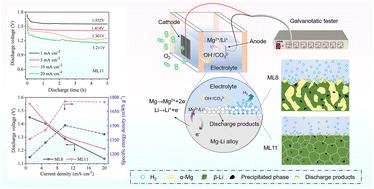
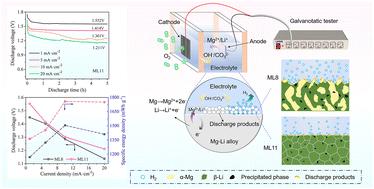
In this work, the microstructure, corrosion resistance, and discharge performance of two hot-extruded Mg alloys with different lithium contents were thoroughly investigated. The electrochemical performance of the Mg anode is closely related to its microstructure. The Mg–11Li–6Zn–2Y (ML11) alloy, primarily composed of a singular β-Li phase and smaller, fewer W phases, enables uniform discharge reactions in magnesium–air batteries (Mg–air batteries), thereby significantly suppressing the “chunk effect”. Moreover, the Li2CO3 film formed in the discharge products helps inhibit the hydrogen evolution side reaction. In contrast, the Mg–8Li–6Zn–2Y (ML8) alloy is mainly composed of α-Mg and β-Li phases, with larger and more numerous W phases, resulting in inferior discharge performance. Battery tests indicate that the ML11 anode has a discharge voltage of 1.211 V, an anode utilization rate of 62.6%, and a high specific energy density of 1727 mW h g−1 at a current density of 20 mA cm−2. This study provides a new perspective for the development of anode materials for Mg–air batteries.
研究了两种不同锂含量的热挤压镁合金的显微组织、耐蚀性和放电性能。镁阳极的电化学性能与其微观结构密切相关。Mg-11Li-6Zn-2Y (ML11)合金主要由单一的β-Li相和更少的W相组成,可以实现镁-空气电池(mg -空气电池)的均匀放电反应,从而显著抑制“块效应”。此外,放电产物中形成的Li2CO3膜有助于抑制析氢副反应。相反,Mg-8Li-6Zn-2Y (ML8)合金主要由α-Mg和β-Li相组成,W相较大且数量较多,导致放电性能较差。电池测试表明,在电流密度为20 mA cm - 2时,ML11阳极的放电电压为1.211 V,阳极利用率为62.6%,比能密度高达1727 mW h g - 1。本研究为镁空气电池负极材料的开发提供了新的思路。
期刊介绍:
The Journal of Materials Chemistry A, B & C covers a wide range of high-quality studies in the field of materials chemistry, with each section focusing on specific applications of the materials studied. Journal of Materials Chemistry A emphasizes applications in energy and sustainability, including topics such as artificial photosynthesis, batteries, and fuel cells. Journal of Materials Chemistry B focuses on applications in biology and medicine, while Journal of Materials Chemistry C covers applications in optical, magnetic, and electronic devices. Example topic areas within the scope of Journal of Materials Chemistry A include catalysis, green/sustainable materials, sensors, and water treatment, among others.



 京公网安备 11010802042870号
京ICP备2023020795号-1
京公网安备 11010802042870号
京ICP备2023020795号-1

 分享
分享
 求助内容:
求助内容: 应助结果提醒方式:
 扫码关注我们
