Manjiang Xing , Chi Gong , Gyu-Hyen Moon , Xiaohong Ge
{"title":"Digital economy, dual innovation capability and enterprise labor productivity","authors":"Manjiang Xing , Chi Gong , Gyu-Hyen Moon , Xiaohong Ge","doi":"10.1016/j.irfa.2025.104005","DOIUrl":null,"url":null,"abstract":"<div><div>While digital economy development has emerged as a crucial driver of enterprise performance, existing research offers limited insights into how firms' innovation capabilities shape their ability to translate digital advancement into productivity gains. This gap is particularly significant given the varying success rates of digital transformation initiatives across enterprises. Drawing on organizational ambidexterity theory and utilizing panel data from Chinese listed companies (2010−2022), this study investigates how dual innovation capability moderates the relationship between digital economy development and enterprise labor productivity. Through comprehensive econometric analysis incorporating instrumental variables and multiple robustness checks, we find that digital economy development significantly enhances enterprise labor productivity, with this effect strengthened by both exploitative and exploratory innovation capabilities. Our heterogeneity analysis reveals that these relationships vary meaningfully across industry factor intensities and firm life cycle stages, with technology-intensive industries and growth-stage firms demonstrating superior ability to leverage digital resources. The findings extend digital transformation theory by illuminating the critical role of innovation capabilities in maximizing productivity gains from digital advancement, while offering practical insights for enterprises pursuing digital transformation strategies.</div></div>","PeriodicalId":48226,"journal":{"name":"International Review of Financial Analysis","volume":"101 ","pages":"Article 104005"},"PeriodicalIF":9.8000,"publicationDate":"2025-02-17","publicationTypes":"Journal Article","fieldsOfStudy":null,"isOpenAccess":false,"openAccessPdf":"","citationCount":"0","resultStr":null,"platform":"Semanticscholar","paperid":null,"PeriodicalName":"International Review of Financial Analysis","FirstCategoryId":"96","ListUrlMain":"https://www.sciencedirect.com/science/article/pii/S1057521925000924","RegionNum":1,"RegionCategory":"经济学","ArticlePicture":[],"TitleCN":null,"AbstractTextCN":null,"PMCID":null,"EPubDate":"","PubModel":"","JCR":"Q1","JCRName":"BUSINESS, FINANCE","Score":null,"Total":0}
引用次数: 0
Abstract
While digital economy development has emerged as a crucial driver of enterprise performance, existing research offers limited insights into how firms' innovation capabilities shape their ability to translate digital advancement into productivity gains. This gap is particularly significant given the varying success rates of digital transformation initiatives across enterprises. Drawing on organizational ambidexterity theory and utilizing panel data from Chinese listed companies (2010−2022), this study investigates how dual innovation capability moderates the relationship between digital economy development and enterprise labor productivity. Through comprehensive econometric analysis incorporating instrumental variables and multiple robustness checks, we find that digital economy development significantly enhances enterprise labor productivity, with this effect strengthened by both exploitative and exploratory innovation capabilities. Our heterogeneity analysis reveals that these relationships vary meaningfully across industry factor intensities and firm life cycle stages, with technology-intensive industries and growth-stage firms demonstrating superior ability to leverage digital resources. The findings extend digital transformation theory by illuminating the critical role of innovation capabilities in maximizing productivity gains from digital advancement, while offering practical insights for enterprises pursuing digital transformation strategies.
期刊介绍:
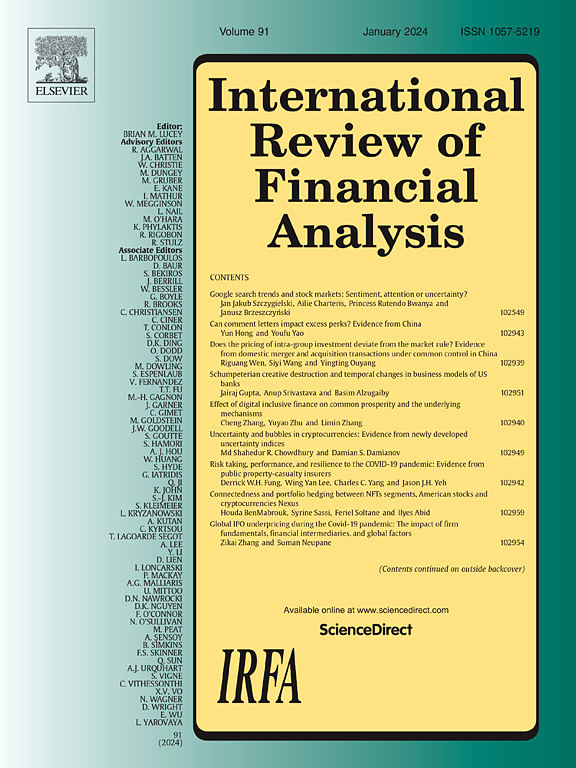
The International Review of Financial Analysis (IRFA) is an impartial refereed journal designed to serve as a platform for high-quality financial research. It welcomes a diverse range of financial research topics and maintains an unbiased selection process. While not limited to U.S.-centric subjects, IRFA, as its title suggests, is open to valuable research contributions from around the world.



 京公网安备 11010802042870号
京ICP备2023020795号-1
京公网安备 11010802042870号
京ICP备2023020795号-1

 分享
分享
 求助内容:
求助内容: 应助结果提醒方式:
 扫码关注我们
