Cas9 Mouse Model of Skull Base Meningioma Driven by Combinational Gene Inactivation in Meningeal Cells

IF 5 1区 医学 Q1 NEUROSCIENCES CNS Neuroscience & Therapeutics Pub Date : 2025-02-25 DOI:10.1111/cns.70287
Hailiang Tang, Feng Xu, Dan Sun, Lingyang Hua, Ji Xiong, Ming Xu, Jian Xu, Ping Zhong
{"title":"Cas9 Mouse Model of Skull Base Meningioma Driven by Combinational Gene Inactivation in Meningeal Cells","authors":"Hailiang Tang,&nbsp;Feng Xu,&nbsp;Dan Sun,&nbsp;Lingyang Hua,&nbsp;Ji Xiong,&nbsp;Ming Xu,&nbsp;Jian Xu,&nbsp;Ping Zhong","doi":"10.1111/cns.70287","DOIUrl":null,"url":null,"abstract":"<div>\n \n \n <section>\n \n <h3> Introduction</h3>\n \n <p>Neurofibromatosis type 2 (<i>Nf2</i>) gene inactivation is common in sporadic and <i>Nf2</i>-related meningioma. There is currently scant literature describing the development of an intracranial meningioma model in animals. Given the role of <i>Nf2</i> and other gene inactivation in meningeal cells, we used Cas9 mice here as the background host to establish a new animal model of skull base meningioma in this study.</p>\n </section>\n \n <section>\n \n <h3> Aims</h3>\n \n <p>Cas9 transgenic mice were purchased from Jackson Laboratory and raised in our institution. Subsequently, meningeal cells were obtained from the Cas9 transgenic mice, cultured in medium, and passaged in vitro. We then prepared lentivirus vector pLentiCre/gRNA, which could express the elements blocking the function of four genes: <i>Nf2, P15</i><sup><i>Ink4b</i></sup>, <i>P16</i><sup><i>Ink4a</i></sup><i>,</i> and <i>P19</i><sup><i>Arf</i></sup>. We infected the meningeal cells with the lentivirus vector pLentiCre/gRNA and tested the expression of these four genes in those infected meningeal cells. Next, adeno-associated virus vector pAAVCre/gRNA was injected in vivo into the skull base meningeal cells of the neonate Cas9 transgenic mice. These mice were observed once a week and killed 10 months later for brain inspection and pathological analysis.</p>\n </section>\n \n <section>\n \n <h3> Results</h3>\n \n <p>Twenty Cas9 transgenic mice were successfully bred. Five mice were killed so that meningeal cells could be extracted, cultured, and infected with the lentivirus vector pLentiCre/gRNA for 72 h in vitro. The gene function test showed that <i>Nf2, P15</i><sup><i>Ink4b</i></sup>, <i>P16</i><sup><i>Ink4a</i></sup><i>,</i> and <i>P19</i><sup><i>Arf</i></sup> were all blocked in the infected meningeal cells, which indicated that the lentivirus vector pLentiCre/gRNA could effectively block the expression of the four genes in targeted cells. Then pAAVCre/gRNA was injected into the skull base meningeal cells of 15 mice in vivo, and nine mice were observed for 10 months so that the intracranial tumor growth could be assessed. Among these nine mice, pathological analysis showed that six mice had benign meningioma subtypes similar to human meningioma, one mouse had atypical meningioma, one mouse had malignant meningioma, and one mouse had sarcoma.</p>\n </section>\n \n <section>\n \n <h3> Conclusions</h3>\n \n <p>The Cas9 mouse model of skull base meningioma generated with the <i>Nf2</i> genetic defect and the combinational loss of <i>P15</i><sup><i>Ink4b</i></sup>, <i>P16</i><sup><i>Ink4a</i></sup>, and <i>P19</i><sup><i>Arf</i></sup> could provide a new tool for investigating the pathogenesis of meningioma and the development of chemical interventions for this disease.</p>\n </section>\n </div>","PeriodicalId":154,"journal":{"name":"CNS Neuroscience & Therapeutics","volume":"31 2","pages":""},"PeriodicalIF":5.0000,"publicationDate":"2025-02-25","publicationTypes":"Journal Article","fieldsOfStudy":null,"isOpenAccess":false,"openAccessPdf":"https://onlinelibrary.wiley.com/doi/epdf/10.1111/cns.70287","citationCount":"0","resultStr":null,"platform":"Semanticscholar","paperid":null,"PeriodicalName":"CNS Neuroscience & Therapeutics","FirstCategoryId":"3","ListUrlMain":"https://onlinelibrary.wiley.com/doi/10.1111/cns.70287","RegionNum":1,"RegionCategory":"医学","ArticlePicture":[],"TitleCN":null,"AbstractTextCN":null,"PMCID":null,"EPubDate":"","PubModel":"","JCR":"Q1","JCRName":"NEUROSCIENCES","Score":null,"Total":0}
引用次数: 0

Abstract

Introduction

Neurofibromatosis type 2 (Nf2) gene inactivation is common in sporadic and Nf2-related meningioma. There is currently scant literature describing the development of an intracranial meningioma model in animals. Given the role of Nf2 and other gene inactivation in meningeal cells, we used Cas9 mice here as the background host to establish a new animal model of skull base meningioma in this study.

Aims

Cas9 transgenic mice were purchased from Jackson Laboratory and raised in our institution. Subsequently, meningeal cells were obtained from the Cas9 transgenic mice, cultured in medium, and passaged in vitro. We then prepared lentivirus vector pLentiCre/gRNA, which could express the elements blocking the function of four genes: Nf2, P15Ink4b, P16Ink4a, and P19Arf. We infected the meningeal cells with the lentivirus vector pLentiCre/gRNA and tested the expression of these four genes in those infected meningeal cells. Next, adeno-associated virus vector pAAVCre/gRNA was injected in vivo into the skull base meningeal cells of the neonate Cas9 transgenic mice. These mice were observed once a week and killed 10 months later for brain inspection and pathological analysis.

Results

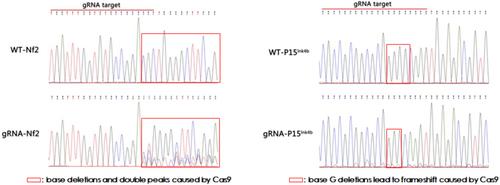
Twenty Cas9 transgenic mice were successfully bred. Five mice were killed so that meningeal cells could be extracted, cultured, and infected with the lentivirus vector pLentiCre/gRNA for 72 h in vitro. The gene function test showed that Nf2, P15Ink4b, P16Ink4a, and P19Arf were all blocked in the infected meningeal cells, which indicated that the lentivirus vector pLentiCre/gRNA could effectively block the expression of the four genes in targeted cells. Then pAAVCre/gRNA was injected into the skull base meningeal cells of 15 mice in vivo, and nine mice were observed for 10 months so that the intracranial tumor growth could be assessed. Among these nine mice, pathological analysis showed that six mice had benign meningioma subtypes similar to human meningioma, one mouse had atypical meningioma, one mouse had malignant meningioma, and one mouse had sarcoma.

Conclusions

The Cas9 mouse model of skull base meningioma generated with the Nf2 genetic defect and the combinational loss of P15Ink4b, P16Ink4a, and P19Arf could provide a new tool for investigating the pathogenesis of meningioma and the development of chemical interventions for this disease.
Abstract Image

查看原文
分享 分享
微信好友 朋友圈 QQ好友 复制链接
本刊更多论文
脑膜细胞组合基因失活驱动的Cas9小鼠颅底脑膜瘤模型
2型神经纤维瘤病(Nf2)基因失活在散发性和Nf2相关脑膜瘤中很常见。目前,描述颅内脑膜瘤动物模型发展的文献很少。考虑到Nf2等基因失活在脑膜细胞中的作用,本研究以Cas9小鼠为背景宿主,建立新的颅底脑膜瘤动物模型。目的Cas9转基因小鼠购自Jackson实验室,在我院饲养。随后,从Cas9转基因小鼠中获得脑膜细胞,在培养基中培养,并在体外传代。然后,我们制备了慢病毒载体pLentiCre/gRNA,该载体可以表达阻断Nf2、P15Ink4b、P16Ink4a和P19Arf四个基因功能的元件。我们用慢病毒载体pLentiCre/gRNA感染脑膜细胞,检测这四个基因在感染的脑膜细胞中的表达。接下来,将腺相关病毒载体pAAVCre/gRNA体内注射到新生Cas9转基因小鼠的颅底脑膜细胞中。每周观察1次,10个月后处死,进行脑部检查和病理分析。结果成功培育了20只Cas9转基因小鼠。杀死5只小鼠,提取脑膜细胞,培养后用慢病毒载体pLentiCre/gRNA体外感染72 h。基因功能检测显示,Nf2、P15Ink4b、P16Ink4a和P19Arf在感染的脑膜细胞中均被阻断,表明慢病毒载体pLentiCre/gRNA能有效阻断这4个基因在靶细胞中的表达。然后将pAAVCre/gRNA注射到15只小鼠的颅底脑膜细胞中,观察9只小鼠10个月,评估颅内肿瘤的生长情况。在这9只小鼠中,病理分析显示6只小鼠为与人脑膜瘤相似的良性脑膜瘤亚型,1只小鼠为非典型脑膜瘤,1只小鼠为恶性脑膜瘤,1只小鼠为肉瘤。结论Nf2基因缺陷和P15Ink4b、P16Ink4a、P19Arf基因组合缺失导致的颅底脑膜瘤Cas9小鼠模型可为脑膜瘤发病机制的研究和化学干预手段的开发提供新的工具。
本文章由计算机程序翻译,如有差异,请以英文原文为准。
求助全文
约1分钟内获得全文 去求助
来源期刊
CNS Neuroscience & Therapeutics
CNS Neuroscience & Therapeutics 医学-神经科学
CiteScore
7.30
自引率
12.70%
发文量
240
审稿时长
2 months
期刊介绍: CNS Neuroscience & Therapeutics provides a medium for rapid publication of original clinical, experimental, and translational research papers, timely reviews and reports of novel findings of therapeutic relevance to the central nervous system, as well as papers related to clinical pharmacology, drug development and novel methodologies for drug evaluation. The journal focuses on neurological and psychiatric diseases such as stroke, Parkinson’s disease, Alzheimer’s disease, depression, schizophrenia, epilepsy, and drug abuse.
期刊最新文献
Rapamycin Reduces Amyloid-β Plaques and Improves Behavioral Performance in a Sex-Dependent Manner in Mouse Models of Amyloidosis. MCC-135 Exerts Antiepileptic and Neuroprotective Effects by Downregulating NCX1 Expression to Decrease Intracellular Calcium Overload in the Hippocampus. Restricting Synaptotagmin-3 Internalization Mitigates Cerebral Ischemia/Reperfusion Injury by Curtailed Neuronal Apoptosis and Microglial Re-Programming. Glymphatic System Dysfunction in Central Nervous System Diseases. SMPD1 as a Potential Prognostic Biomarker in Glioma Is Associated With an Immunosuppressive Microenvironment.
×
引用
GB/T 7714-2015
复制
MLA
复制
APA
复制
导出至
BibTeX EndNote RefMan NoteFirst NoteExpress
×
×
提示
您的信息不完整,为了账户安全,请先补充。
现在去补充
×
提示
您因"违规操作"
具体请查看互助需知
我知道了
×
提示
现在去查看 取消
×
提示
确定
0
微信
客服QQ
Book学术公众号 扫码关注我们
反馈
×
意见反馈
请填写您的意见或建议
请填写您的手机或邮箱
已复制链接
已复制链接
快去分享给好友吧!
我知道了
×
扫码分享
扫码分享
Book学术官方微信
Book学术文献互助
Book学术文献互助群
群 号:604180095
Book学术
文献互助 智能选刊 最新文献 互助须知 联系我们:info@booksci.cn
Book学术提供免费学术资源搜索服务,方便国内外学者检索中英文文献。致力于提供最便捷和优质的服务体验。
Copyright © 2023 Book学术 All rights reserved.
ghs 京公网安备 11010802042870号 京ICP备2023020795号-1





