Weifeng Qin, Kathrina D. Castillo, Hongye Li, Thi Kim Cuc Nguyen, Daniel L. Kiss, John P. Cooke, Anahita Mojiri
{"title":"Circular RNA Telomerase Reverses Endothelial Senescence in Progeria","authors":"Weifeng Qin, Kathrina D. Castillo, Hongye Li, Thi Kim Cuc Nguyen, Daniel L. Kiss, John P. Cooke, Anahita Mojiri","doi":"10.1111/acel.70021","DOIUrl":null,"url":null,"abstract":"<p>Telomeres shorten with each cell division, acting as a chronometer of cell age. The enzyme telomerase, primarily active in stem cells, reverses telomere erosion. We have previously observed that transient transfection with human TERT mRNA extends telomeres and mitigates hallmarks of senescence in replicatively aged human cells or those affected by Hutchinson–Gilford progeroid syndrome (HGPS). However, due to its short half-life, mRNA requires frequent administration. In this study, we hypothesized that TERT circular (circ) RNA would extend the duration of telomerase expression and be more effective at reversing hallmarks of senescence in endothelial cells derived from HGPS patients. We observe that a single transfection of TERT circRNA is more effective than mRNA in the extension of telomere length, as determined by quantitative fluorescence in situ hybridization. Furthermore, TERT circRNA reduced the number of β-gal positive cells by three-fold and normalized nuclear morphology in HGPS endothelial cells (HGPS-ECs). Moreover, TERT circRNA substantially reduced senescent markers, inflammatory markers, and DNA damage markers, including Progerin, p16, p21, IL-1B, IL-6, IL-8, MCP1, and γH2AX. Additionally, it restored NO production, enhanced cell proliferation, promoted angiogenesis, improved LDL uptake, reduced mitochondrial ROS, and normalized mitochondrial membrane potential more effectively. Our data suggest that TERT circRNA is superior to linear TERT mRNA in reversing processes involved in senescence.</p>","PeriodicalId":55543,"journal":{"name":"Aging Cell","volume":"24 6","pages":""},"PeriodicalIF":7.1000,"publicationDate":"2025-02-23","publicationTypes":"Journal Article","fieldsOfStudy":null,"isOpenAccess":false,"openAccessPdf":"https://onlinelibrary.wiley.com/doi/epdf/10.1111/acel.70021","citationCount":"0","resultStr":null,"platform":"Semanticscholar","paperid":null,"PeriodicalName":"Aging Cell","FirstCategoryId":"99","ListUrlMain":"https://onlinelibrary.wiley.com/doi/10.1111/acel.70021","RegionNum":1,"RegionCategory":"医学","ArticlePicture":[],"TitleCN":null,"AbstractTextCN":null,"PMCID":null,"EPubDate":"","PubModel":"","JCR":"Q1","JCRName":"Biochemistry, Genetics and Molecular Biology","Score":null,"Total":0}
引用次数: 0
Abstract
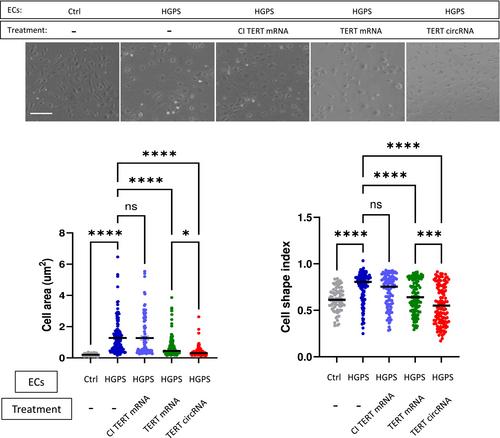
Telomeres shorten with each cell division, acting as a chronometer of cell age. The enzyme telomerase, primarily active in stem cells, reverses telomere erosion. We have previously observed that transient transfection with human TERT mRNA extends telomeres and mitigates hallmarks of senescence in replicatively aged human cells or those affected by Hutchinson–Gilford progeroid syndrome (HGPS). However, due to its short half-life, mRNA requires frequent administration. In this study, we hypothesized that TERT circular (circ) RNA would extend the duration of telomerase expression and be more effective at reversing hallmarks of senescence in endothelial cells derived from HGPS patients. We observe that a single transfection of TERT circRNA is more effective than mRNA in the extension of telomere length, as determined by quantitative fluorescence in situ hybridization. Furthermore, TERT circRNA reduced the number of β-gal positive cells by three-fold and normalized nuclear morphology in HGPS endothelial cells (HGPS-ECs). Moreover, TERT circRNA substantially reduced senescent markers, inflammatory markers, and DNA damage markers, including Progerin, p16, p21, IL-1B, IL-6, IL-8, MCP1, and γH2AX. Additionally, it restored NO production, enhanced cell proliferation, promoted angiogenesis, improved LDL uptake, reduced mitochondrial ROS, and normalized mitochondrial membrane potential more effectively. Our data suggest that TERT circRNA is superior to linear TERT mRNA in reversing processes involved in senescence.
期刊介绍:
Aging Cell, an Open Access journal, delves into fundamental aspects of aging biology. It comprehensively explores geroscience, emphasizing research on the mechanisms underlying the aging process and the connections between aging and age-related diseases.



 京公网安备 11010802042870号
京ICP备2023020795号-1
京公网安备 11010802042870号
京ICP备2023020795号-1

 分享
分享
 求助内容:
求助内容: 应助结果提醒方式:
 扫码关注我们
