Jingjing Wu, Zhaokai Liu, Yongrui Yang, Kun Zhang, Yumeng Wang, Lutong Guo, Mengmeng Guo, Yang Wang, Yali Qiao, Yanlin Song
{"title":"Regulating Precursor Viscosity with Inert Solvent Additives for Efficient Blade-Coated Perovskite Solar Cells","authors":"Jingjing Wu, Zhaokai Liu, Yongrui Yang, Kun Zhang, Yumeng Wang, Lutong Guo, Mengmeng Guo, Yang Wang, Yali Qiao, Yanlin Song","doi":"10.1002/smtd.202500129","DOIUrl":null,"url":null,"abstract":"<p>Metal halide perovskite solar cells (PSCs) are emerging as promising candidates for next-generation photovoltaics aimed at green energy production. However, during solution-processed film deposition, the distinct rheological behaviors of blade coating, compared to spin coating, result in less controlled crystallization, leading to inferior film quality and limiting the power conversion efficiency (PCE) of blade-coated photovoltaics. In this work, ethylene glycol (EG) is introduced as an inert co-solvent in perovskite precursor solutions to achieve high-quality perovskite films via blade coating. The high viscosity of EG facilitates the deposition of thick perovskite films ranging from 400 to 2000 nm, while its low vapor pressure effectively suppresses premature nucleation before vacuum flashing, leading to films with enhanced morphology. As a result, the blade-coated PSCs achieve an impressive champion PCE of 24.10% and retain 89% of their initial efficiency after 600 h of continuous operation.</p>","PeriodicalId":229,"journal":{"name":"Small Methods","volume":"9 8","pages":""},"PeriodicalIF":9.1000,"publicationDate":"2025-02-24","publicationTypes":"Journal Article","fieldsOfStudy":null,"isOpenAccess":false,"openAccessPdf":"","citationCount":"0","resultStr":null,"platform":"Semanticscholar","paperid":null,"PeriodicalName":"Small Methods","FirstCategoryId":"88","ListUrlMain":"https://onlinelibrary.wiley.com/doi/10.1002/smtd.202500129","RegionNum":2,"RegionCategory":"材料科学","ArticlePicture":[],"TitleCN":null,"AbstractTextCN":null,"PMCID":null,"EPubDate":"","PubModel":"","JCR":"Q1","JCRName":"CHEMISTRY, PHYSICAL","Score":null,"Total":0}
引用次数: 0
Abstract
Metal halide perovskite solar cells (PSCs) are emerging as promising candidates for next-generation photovoltaics aimed at green energy production. However, during solution-processed film deposition, the distinct rheological behaviors of blade coating, compared to spin coating, result in less controlled crystallization, leading to inferior film quality and limiting the power conversion efficiency (PCE) of blade-coated photovoltaics. In this work, ethylene glycol (EG) is introduced as an inert co-solvent in perovskite precursor solutions to achieve high-quality perovskite films via blade coating. The high viscosity of EG facilitates the deposition of thick perovskite films ranging from 400 to 2000 nm, while its low vapor pressure effectively suppresses premature nucleation before vacuum flashing, leading to films with enhanced morphology. As a result, the blade-coated PSCs achieve an impressive champion PCE of 24.10% and retain 89% of their initial efficiency after 600 h of continuous operation.
Small MethodsMaterials Science-General Materials Science
CiteScore
17.40
自引率
1.60%
发文量
347
期刊介绍:
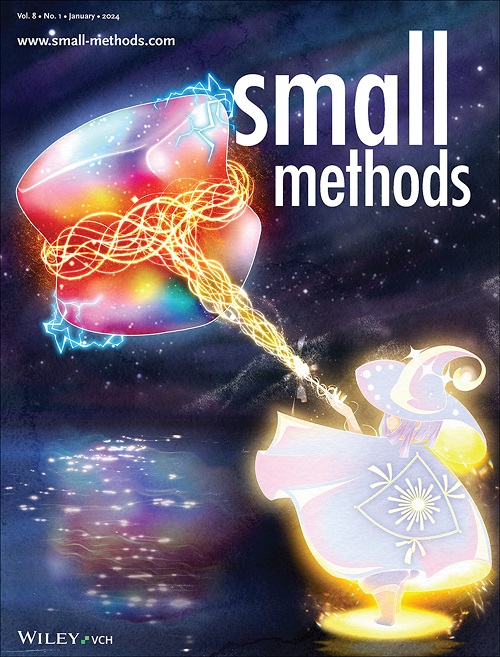
Small Methods is a multidisciplinary journal that publishes groundbreaking research on methods relevant to nano- and microscale research. It welcomes contributions from the fields of materials science, biomedical science, chemistry, and physics, showcasing the latest advancements in experimental techniques.
With a notable 2022 Impact Factor of 12.4 (Journal Citation Reports, Clarivate Analytics, 2023), Small Methods is recognized for its significant impact on the scientific community.
The online ISSN for Small Methods is 2366-9608.




 京公网安备 11010802042870号
京ICP备2023020795号-1
京公网安备 11010802042870号
京ICP备2023020795号-1

 分享
分享
 求助内容:
求助内容: 应助结果提醒方式:
 扫码关注我们
