{"title":"Network pharmacology unveils the intricate molecular landscape of Chrysin in breast cancer therapeutics.","authors":"Jianping Ma, PinYi Liu, Lili Pan","doi":"10.1007/s12672-025-01951-3","DOIUrl":null,"url":null,"abstract":"<p><p>Chrysin is one of the natural flavonoid compounds Sourced from various plant source, mainly in propolis and honey, demonstrates effective Cancer-suppressing properties, particularly in Breast cancer (BC). However, the specific molecular mechanisms underlying its efficacy in breast cancer treatment have remained elusive. This study employed network pharmacology combined with a molecular docking approach to uncover the intricate details of Chrysin's impact on breast cancer. Utilizing databases such as GeneCards, and disgenet, Pharmmapper, ctd database, Chrysin and potential breast cancer targets were meticulously curated. Through a strategic process of mapping and screening, core targets essential for Chrysin's efficacy in breast cancer treatment were identified. Further refinement through Venn diagram analysis, considering 1350 breast cancer target genes and 433 Chrysin-related targets, identified 140 intersection targets. Subsequent construction of protein-protein interaction networks of 140 intersecting using the STRING and Cytoscape software highlighted these ten targets as core candidates. Functional annotation and pathway analysis, performed using the ShinyGO database, unveiled that the key targets were significantly associated with the Prostate cancer pathways and IL17 signaling pathways. Molecular docking results underscored Chrysin's effective binding to these ten key targets, forming stable protein-ligand complexes. Molecular docking analyses were then conducted to evaluate the impact of Chrysin in the key targets, revealing TP53, JUN, HIF1A, ALB, CASP3, STAT3, BCL2, TNF, AKT1, and IL6 as pivotal players. In summary, this investigation provides valuable revelations into the essential targets and molecular processes through which Chrysin exerts its anti-breast cancer effects. These findings not only enhance our understanding of Chrysin's pharmacological actions in breast cancer but also lay a theoretical groundwork for future investigations into the therapeutic mechanisms of Chrysin in this context.</p>","PeriodicalId":11148,"journal":{"name":"Discover. Oncology","volume":"16 1","pages":"228"},"PeriodicalIF":2.9000,"publicationDate":"2025-02-23","publicationTypes":"Journal Article","fieldsOfStudy":null,"isOpenAccess":false,"openAccessPdf":"https://www.ncbi.nlm.nih.gov/pmc/articles/PMC11847756/pdf/","citationCount":"0","resultStr":null,"platform":"Semanticscholar","paperid":null,"PeriodicalName":"Discover. Oncology","FirstCategoryId":"3","ListUrlMain":"https://doi.org/10.1007/s12672-025-01951-3","RegionNum":4,"RegionCategory":"医学","ArticlePicture":[],"TitleCN":null,"AbstractTextCN":null,"PMCID":null,"EPubDate":"","PubModel":"","JCR":"Q3","JCRName":"ENDOCRINOLOGY & METABOLISM","Score":null,"Total":0}
引用次数: 0
Abstract
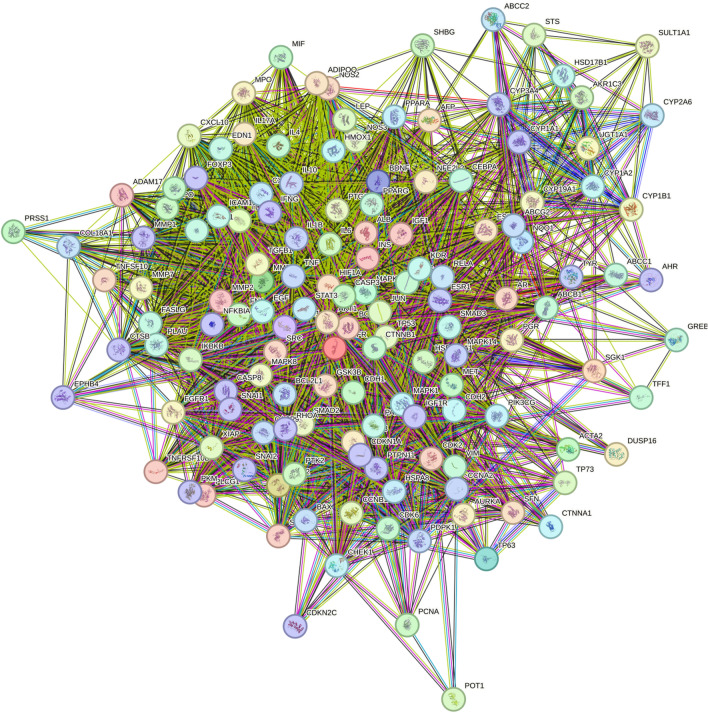
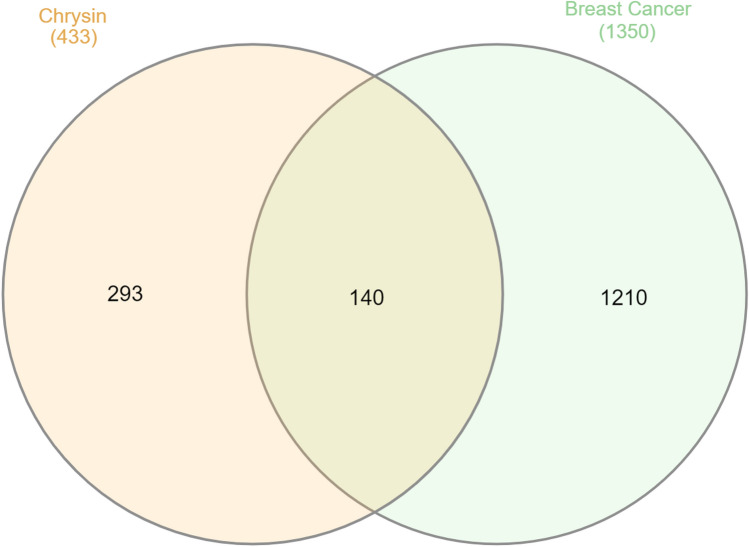
Chrysin is one of the natural flavonoid compounds Sourced from various plant source, mainly in propolis and honey, demonstrates effective Cancer-suppressing properties, particularly in Breast cancer (BC). However, the specific molecular mechanisms underlying its efficacy in breast cancer treatment have remained elusive. This study employed network pharmacology combined with a molecular docking approach to uncover the intricate details of Chrysin's impact on breast cancer. Utilizing databases such as GeneCards, and disgenet, Pharmmapper, ctd database, Chrysin and potential breast cancer targets were meticulously curated. Through a strategic process of mapping and screening, core targets essential for Chrysin's efficacy in breast cancer treatment were identified. Further refinement through Venn diagram analysis, considering 1350 breast cancer target genes and 433 Chrysin-related targets, identified 140 intersection targets. Subsequent construction of protein-protein interaction networks of 140 intersecting using the STRING and Cytoscape software highlighted these ten targets as core candidates. Functional annotation and pathway analysis, performed using the ShinyGO database, unveiled that the key targets were significantly associated with the Prostate cancer pathways and IL17 signaling pathways. Molecular docking results underscored Chrysin's effective binding to these ten key targets, forming stable protein-ligand complexes. Molecular docking analyses were then conducted to evaluate the impact of Chrysin in the key targets, revealing TP53, JUN, HIF1A, ALB, CASP3, STAT3, BCL2, TNF, AKT1, and IL6 as pivotal players. In summary, this investigation provides valuable revelations into the essential targets and molecular processes through which Chrysin exerts its anti-breast cancer effects. These findings not only enhance our understanding of Chrysin's pharmacological actions in breast cancer but also lay a theoretical groundwork for future investigations into the therapeutic mechanisms of Chrysin in this context.





 京公网安备 11010802042870号
京ICP备2023020795号-1
京公网安备 11010802042870号
京ICP备2023020795号-1

 分享
分享
 求助内容:
求助内容: 应助结果提醒方式:
 扫码关注我们
