Chao Zhang, Xiaohang Liu, Ruohua Yan, Xiaolu Nie, Yaguang Peng, Nan Zhou, Xiaoxia Peng
{"title":"The development and validation of a prediction model for post-AKI outcomes of pediatric inpatients.","authors":"Chao Zhang, Xiaohang Liu, Ruohua Yan, Xiaolu Nie, Yaguang Peng, Nan Zhou, Xiaoxia Peng","doi":"10.1093/ckj/sfaf007","DOIUrl":null,"url":null,"abstract":"<p><strong>Background: </strong>Acute kidney injury (AKI) is common in hospitalized children. A post-AKI outcomes prediction model is important for the early detection of important clinical outcomes associated with AKI so that early management of pediatric AKI patients can be initiated.</p><p><strong>Methods: </strong>Three retrospective cohorts were set up based on two pediatric hospitals in China, in which 8205 children suffered AKI during hospitalization. Two clinical outcomes were evaluated, i.e. hospital mortality and dialysis within 28 days after AKI occurrence. A Genetic Algorithm was used for feature selection, and a Random Forest model was built to predict clinical outcomes. Subsequently, a temporal validation set and an external validation set were used to evaluate the performance of the prediction model. Finally, the stratification ability of the prediction model for the risk of mortality was compared with a commonly used mortality risk score, the pediatric critical illness score (PCIS).</p><p><strong>Results: </strong>The prediction model performed well for the prediction of hospital mortality with an area under the receiver operating curve (AUROC) of 0.854 [95% confidence interval (CI) 0.816-0.888], and the AUROC was >0.850 for both temporal and external validation. For the prediction of dialysis, the AUROC was 0.889 (95% CI 0.871-0.906). In addition, the AUROC of the prediction model for hospital mortality was superior to that of PCIS (<i>P </i>< .0001 in both temporal and external validation).</p><p><strong>Conclusions: </strong>The new proposed post-AKI outcomes prediction model shows potential applicability in clinical settings.</p>","PeriodicalId":10435,"journal":{"name":"Clinical Kidney Journal","volume":"18 2","pages":"sfaf007"},"PeriodicalIF":4.6000,"publicationDate":"2025-01-09","publicationTypes":"Journal Article","fieldsOfStudy":null,"isOpenAccess":false,"openAccessPdf":"https://www.ncbi.nlm.nih.gov/pmc/articles/PMC11843026/pdf/","citationCount":"0","resultStr":null,"platform":"Semanticscholar","paperid":null,"PeriodicalName":"Clinical Kidney Journal","FirstCategoryId":"3","ListUrlMain":"https://doi.org/10.1093/ckj/sfaf007","RegionNum":2,"RegionCategory":"医学","ArticlePicture":[],"TitleCN":null,"AbstractTextCN":null,"PMCID":null,"EPubDate":"2025/2/1 0:00:00","PubModel":"eCollection","JCR":"Q1","JCRName":"UROLOGY & NEPHROLOGY","Score":null,"Total":0}
引用次数: 0
Abstract
Background: Acute kidney injury (AKI) is common in hospitalized children. A post-AKI outcomes prediction model is important for the early detection of important clinical outcomes associated with AKI so that early management of pediatric AKI patients can be initiated.
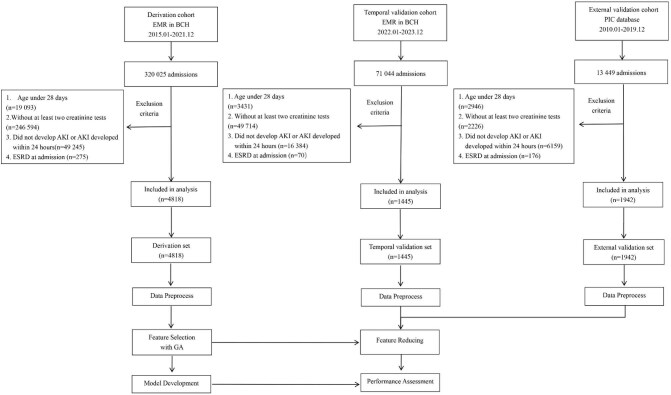
Methods: Three retrospective cohorts were set up based on two pediatric hospitals in China, in which 8205 children suffered AKI during hospitalization. Two clinical outcomes were evaluated, i.e. hospital mortality and dialysis within 28 days after AKI occurrence. A Genetic Algorithm was used for feature selection, and a Random Forest model was built to predict clinical outcomes. Subsequently, a temporal validation set and an external validation set were used to evaluate the performance of the prediction model. Finally, the stratification ability of the prediction model for the risk of mortality was compared with a commonly used mortality risk score, the pediatric critical illness score (PCIS).
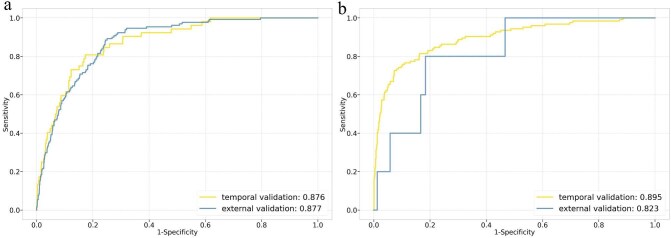
Results: The prediction model performed well for the prediction of hospital mortality with an area under the receiver operating curve (AUROC) of 0.854 [95% confidence interval (CI) 0.816-0.888], and the AUROC was >0.850 for both temporal and external validation. For the prediction of dialysis, the AUROC was 0.889 (95% CI 0.871-0.906). In addition, the AUROC of the prediction model for hospital mortality was superior to that of PCIS (P < .0001 in both temporal and external validation).
Conclusions: The new proposed post-AKI outcomes prediction model shows potential applicability in clinical settings.
期刊介绍:
About the Journal
Clinical Kidney Journal: Clinical and Translational Nephrology (ckj), an official journal of the ERA-EDTA (European Renal Association-European Dialysis and Transplant Association), is a fully open access, online only journal publishing bimonthly. The journal is an essential educational and training resource integrating clinical, translational and educational research into clinical practice. ckj aims to contribute to a translational research culture among nephrologists and kidney pathologists that helps close the gap between basic researchers and practicing clinicians and promote sorely needed innovation in the Nephrology field. All research articles in this journal have undergone peer review.




 京公网安备 11010802042870号
京ICP备2023020795号-1
京公网安备 11010802042870号
京ICP备2023020795号-1

 分享
分享
 求助内容:
求助内容: 应助结果提醒方式:
 扫码关注我们
