Anthony Huffman, Mehul Gautam, Arya Gandhi, Priscilla Du, Lauren Austin, Kallan Roan, Jie Zheng, Yongqun He
{"title":"Systematic collection, annotation, and pattern analysis of viral vaccines in the VIOLIN vaccine knowledgebase.","authors":"Anthony Huffman, Mehul Gautam, Arya Gandhi, Priscilla Du, Lauren Austin, Kallan Roan, Jie Zheng, Yongqun He","doi":"10.3389/fcimb.2025.1509226","DOIUrl":null,"url":null,"abstract":"<p><strong>Background: </strong>Viral vaccines have been proven significant in protecting us against viral diseases such as COVID-19. To better understand and design viral vaccines, it is critical to systematically collect, annotate, and analyse various viral vaccines and identify enriched patterns from these viral vaccines.</p><p><strong>Methods: </strong>We systematically collected experimentally verified viral vaccines from the literature, manually annotated, and stored the information in the VIOLIN vaccine database. The annotated information included basic vaccine names, pathogens and diseases, vaccine components, vaccine formulations, and their induced host responses. Enriched patterns were identified from our systematical analysis of the viral vaccines and vaccine antigens.</p><p><strong>Results: </strong>A total of 2,847 viral vaccines against 95 viral species (including 72 RNA viral species and 23 DNA viral species) were collected, manually annotated, and stored in the VIOLIN vaccine database. These viral vaccines used 542 vaccine antigens. A taxonomical analysis found various DNA and RNA viruses covered by the viral vaccines. These vaccines target different viral life cycle stages (e.g., viral entry, assembly, exit, and immune evasion) as identified in top ranked human, animal vaccines, and HPV vaccines. The vaccine antigen proteins also show up in different virion locations in viruses such as HRSV vaccines. Both structural and non-structural viral proteins have been used for viral vaccine development. Protective vaccine antigens tend to have a protegenicity score of >85% based on the Vaxign-ML calculation, which measures predicted suitability for vaccine use. While predicted adhesins still have significantly higher chances of being protective antigens, only 21.42% of protective viral vaccine antigens were predicted to be adhesins. Furthermore, our Gene Ontology (GO) enrichment analysis using a customized Fisher's exact test identified many enriched patterns such as viral entry into the host cell, DNA/RNA/ATP/ion binding, and suppression of host type 1 interferon-mediated signaling pathway. The viral vaccines and their associated entities and relations are ontologically modeled and represented in the Vaccine Ontology (VO). A VIOLIN web interface was developed to support user friendly queries of viral vaccines.</p><p><strong>Discussion: </strong>Viral vaccines were systematically collected and annotated in the VIOLIN vaccine knowledgebase, and the analysis of these viral vaccines identified many insightful patterns.</p>","PeriodicalId":12458,"journal":{"name":"Frontiers in Cellular and Infection Microbiology","volume":"15 ","pages":"1509226"},"PeriodicalIF":4.8000,"publicationDate":"2025-02-07","publicationTypes":"Journal Article","fieldsOfStudy":null,"isOpenAccess":false,"openAccessPdf":"https://www.ncbi.nlm.nih.gov/pmc/articles/PMC11842373/pdf/","citationCount":"0","resultStr":null,"platform":"Semanticscholar","paperid":null,"PeriodicalName":"Frontiers in Cellular and Infection Microbiology","FirstCategoryId":"3","ListUrlMain":"https://doi.org/10.3389/fcimb.2025.1509226","RegionNum":2,"RegionCategory":"医学","ArticlePicture":[],"TitleCN":null,"AbstractTextCN":null,"PMCID":null,"EPubDate":"2025/1/1 0:00:00","PubModel":"eCollection","JCR":"Q2","JCRName":"IMMUNOLOGY","Score":null,"Total":0}
引用次数: 0
Abstract
Background: Viral vaccines have been proven significant in protecting us against viral diseases such as COVID-19. To better understand and design viral vaccines, it is critical to systematically collect, annotate, and analyse various viral vaccines and identify enriched patterns from these viral vaccines.
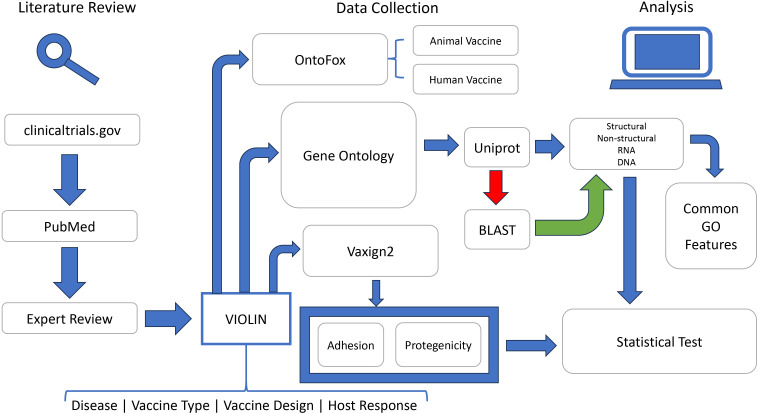
Methods: We systematically collected experimentally verified viral vaccines from the literature, manually annotated, and stored the information in the VIOLIN vaccine database. The annotated information included basic vaccine names, pathogens and diseases, vaccine components, vaccine formulations, and their induced host responses. Enriched patterns were identified from our systematical analysis of the viral vaccines and vaccine antigens.
Results: A total of 2,847 viral vaccines against 95 viral species (including 72 RNA viral species and 23 DNA viral species) were collected, manually annotated, and stored in the VIOLIN vaccine database. These viral vaccines used 542 vaccine antigens. A taxonomical analysis found various DNA and RNA viruses covered by the viral vaccines. These vaccines target different viral life cycle stages (e.g., viral entry, assembly, exit, and immune evasion) as identified in top ranked human, animal vaccines, and HPV vaccines. The vaccine antigen proteins also show up in different virion locations in viruses such as HRSV vaccines. Both structural and non-structural viral proteins have been used for viral vaccine development. Protective vaccine antigens tend to have a protegenicity score of >85% based on the Vaxign-ML calculation, which measures predicted suitability for vaccine use. While predicted adhesins still have significantly higher chances of being protective antigens, only 21.42% of protective viral vaccine antigens were predicted to be adhesins. Furthermore, our Gene Ontology (GO) enrichment analysis using a customized Fisher's exact test identified many enriched patterns such as viral entry into the host cell, DNA/RNA/ATP/ion binding, and suppression of host type 1 interferon-mediated signaling pathway. The viral vaccines and their associated entities and relations are ontologically modeled and represented in the Vaccine Ontology (VO). A VIOLIN web interface was developed to support user friendly queries of viral vaccines.
Discussion: Viral vaccines were systematically collected and annotated in the VIOLIN vaccine knowledgebase, and the analysis of these viral vaccines identified many insightful patterns.
期刊介绍:
Frontiers in Cellular and Infection Microbiology is a leading specialty journal, publishing rigorously peer-reviewed research across all pathogenic microorganisms and their interaction with their hosts. Chief Editor Yousef Abu Kwaik, University of Louisville is supported by an outstanding Editorial Board of international experts. This multidisciplinary open-access journal is at the forefront of disseminating and communicating scientific knowledge and impactful discoveries to researchers, academics, clinicians and the public worldwide.
Frontiers in Cellular and Infection Microbiology includes research on bacteria, fungi, parasites, viruses, endosymbionts, prions and all microbial pathogens as well as the microbiota and its effect on health and disease in various hosts. The research approaches include molecular microbiology, cellular microbiology, gene regulation, proteomics, signal transduction, pathogenic evolution, genomics, structural biology, and virulence factors as well as model hosts. Areas of research to counteract infectious agents by the host include the host innate and adaptive immune responses as well as metabolic restrictions to various pathogenic microorganisms, vaccine design and development against various pathogenic microorganisms, and the mechanisms of antibiotic resistance and its countermeasures.






 京公网安备 11010802042870号
京ICP备2023020795号-1
京公网安备 11010802042870号
京ICP备2023020795号-1

 分享
分享
 求助内容:
求助内容: 应助结果提醒方式:
 扫码关注我们
