Jan Mizner MD, PhD , Ahmed Beela MD , Hana Linkova MD , Jana Vesela MSc , Ondrej Sussenbek MD , Petr Stros MD , Radovan Smisek MSc, PhD , Pavel Jurak MSc, PhD , Pavel Leinveber MSc , Jolana Lipoldova MD, PhD , Andrej Nagy MD , Petr Waldauf MD, PhD , Joost Lumens MSc, PhD , Kevin Vernooy MD, PhD , Frits Prinzen MD, PhD , Karol Curila MD, MSc, PhD
{"title":"Electrical and mechanical interventricular dyssynchrony coupling in patients with bradycardia: A UHF-ECG validation trial","authors":"Jan Mizner MD, PhD , Ahmed Beela MD , Hana Linkova MD , Jana Vesela MSc , Ondrej Sussenbek MD , Petr Stros MD , Radovan Smisek MSc, PhD , Pavel Jurak MSc, PhD , Pavel Leinveber MSc , Jolana Lipoldova MD, PhD , Andrej Nagy MD , Petr Waldauf MD, PhD , Joost Lumens MSc, PhD , Kevin Vernooy MD, PhD , Frits Prinzen MD, PhD , Karol Curila MD, MSc, PhD","doi":"10.1016/j.hrthm.2025.02.031","DOIUrl":null,"url":null,"abstract":"<div><h3>Background</h3><div>Ultra-high-frequency electrocardiography (UHF-ECG) is a noninvasive tool visualizing the ventricular activation sequence. It was never compared with other methods of dyssynchrony assessment in patients with bradycardia.</div></div><div><h3>Objective</h3><div>We aimed to compare UHF-ECG interventricular electrical dyssynchrony (e-DYS) with interventricular mechanical delay (IVMD) measured by echocardiography in patients receiving right ventricular pacing (RVP) or conduction system pacing (CSP).</div></div><div><h3>Methods</h3><div>Fifty-three patients with advanced atrioventricular conduction disease and preserved ventricular systolic function were prospectively assigned to RVP (n=32 [60 %]) or CSP (n=21 [40 %]). IVMD was measured as the time difference between left ventricular and right ventricular preejection periods. Interventricular e-DYS was calculated by software as the time difference between activation in V<sub>1</sub> and V<sub>7</sub> chest electrodes using UHF-ECG.</div></div><div><h3>Results</h3><div>The median age of patients was 75 (interquartile range 72–80) years, and both groups had similar clinical characteristics. Baseline IVMD and interventricular e-DYS were similar in the entire population (−2 [−8 to 5] ms vs−1 [−6 to 5] ms, respectively; <em>P</em>=.52). Both methods showed the same dyssynchrony trends after pacemaker implantation; that is, while both IVMD and interventricular e-DYS increased in the RVP group (IVMD 28 [23–33] ms vs interventricular e-DYS 26 [19–33] ms; <em>P</em>=.99), they remained low in the CSP group (IVMD −7 [−16 to 2] ms vs interventricular e-DYS −5 [−12 to 2] ms; <em>P</em>=.91). There was a moderate overall correlation between IVMD and interventricular e-DYS for all studied ventricular rhythms (<em>R</em>=0.74).</div></div><div><h3>Conclusion</h3><div>UHF-ECG noninvasively expresses interventricular dyssynchrony from V<sub>7</sub>–V<sub>1</sub> chest leads with similar results to echocardiography. RVP increases interventricular dyssynchrony, while CSP preserves synchronous ventricular activation.</div></div>","PeriodicalId":12886,"journal":{"name":"Heart rhythm","volume":"22 9","pages":"Pages 2382-2390"},"PeriodicalIF":5.7000,"publicationDate":"2025-09-01","publicationTypes":"Journal Article","fieldsOfStudy":null,"isOpenAccess":false,"openAccessPdf":"","citationCount":"0","resultStr":null,"platform":"Semanticscholar","paperid":null,"PeriodicalName":"Heart rhythm","FirstCategoryId":"3","ListUrlMain":"https://www.sciencedirect.com/science/article/pii/S1547527125002012","RegionNum":2,"RegionCategory":"医学","ArticlePicture":[],"TitleCN":null,"AbstractTextCN":null,"PMCID":null,"EPubDate":"2025/2/21 0:00:00","PubModel":"Epub","JCR":"Q1","JCRName":"CARDIAC & CARDIOVASCULAR SYSTEMS","Score":null,"Total":0}
引用次数: 0
Abstract
Background
Ultra-high-frequency electrocardiography (UHF-ECG) is a noninvasive tool visualizing the ventricular activation sequence. It was never compared with other methods of dyssynchrony assessment in patients with bradycardia.
Objective
We aimed to compare UHF-ECG interventricular electrical dyssynchrony (e-DYS) with interventricular mechanical delay (IVMD) measured by echocardiography in patients receiving right ventricular pacing (RVP) or conduction system pacing (CSP).
Methods
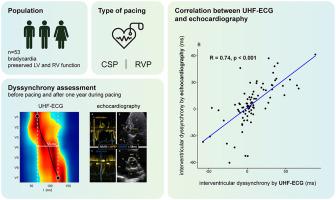
Fifty-three patients with advanced atrioventricular conduction disease and preserved ventricular systolic function were prospectively assigned to RVP (n=32 [60 %]) or CSP (n=21 [40 %]). IVMD was measured as the time difference between left ventricular and right ventricular preejection periods. Interventricular e-DYS was calculated by software as the time difference between activation in V1 and V7 chest electrodes using UHF-ECG.
Results
The median age of patients was 75 (interquartile range 72–80) years, and both groups had similar clinical characteristics. Baseline IVMD and interventricular e-DYS were similar in the entire population (−2 [−8 to 5] ms vs−1 [−6 to 5] ms, respectively; P=.52). Both methods showed the same dyssynchrony trends after pacemaker implantation; that is, while both IVMD and interventricular e-DYS increased in the RVP group (IVMD 28 [23–33] ms vs interventricular e-DYS 26 [19–33] ms; P=.99), they remained low in the CSP group (IVMD −7 [−16 to 2] ms vs interventricular e-DYS −5 [−12 to 2] ms; P=.91). There was a moderate overall correlation between IVMD and interventricular e-DYS for all studied ventricular rhythms (R=0.74).
Conclusion
UHF-ECG noninvasively expresses interventricular dyssynchrony from V7–V1 chest leads with similar results to echocardiography. RVP increases interventricular dyssynchrony, while CSP preserves synchronous ventricular activation.
期刊介绍:
HeartRhythm, the official Journal of the Heart Rhythm Society and the Cardiac Electrophysiology Society, is a unique journal for fundamental discovery and clinical applicability.
HeartRhythm integrates the entire cardiac electrophysiology (EP) community from basic and clinical academic researchers, private practitioners, engineers, allied professionals, industry, and trainees, all of whom are vital and interdependent members of our EP community.
The Heart Rhythm Society is the international leader in science, education, and advocacy for cardiac arrhythmia professionals and patients, and the primary information resource on heart rhythm disorders. Its mission is to improve the care of patients by promoting research, education, and optimal health care policies and standards.



 京公网安备 11010802042870号
京ICP备2023020795号-1
京公网安备 11010802042870号
京ICP备2023020795号-1

 分享
分享
 求助内容:
求助内容: 应助结果提醒方式:
 扫码关注我们
