Yaseen Hussain , Ben-Gang You , Linyu Huang , Xiaoyin Liu , Amos Dormocara , Kiramat Ali Shah , Tariq Ali , Qing-Ri Cao , Beom-Jin Lee , Serag Eldin I. Elbehairi , Haroon Iqbal , Jing-Hao Cui
{"title":"Dissolving microneedles for melanoma: Most recent updates, challenges, and future perspectives","authors":"Yaseen Hussain , Ben-Gang You , Linyu Huang , Xiaoyin Liu , Amos Dormocara , Kiramat Ali Shah , Tariq Ali , Qing-Ri Cao , Beom-Jin Lee , Serag Eldin I. Elbehairi , Haroon Iqbal , Jing-Hao Cui","doi":"10.1016/j.ijpharm.2025.125382","DOIUrl":null,"url":null,"abstract":"<div><div>Skin cancer is one among the common types of cancers, affecting millions of individual globally. The conventional anticancer therapy such as chemotherapy results in worst systemic and local side effects as well as inhibit the growth of healthy cells around the tumor cells. Dissolving microneedles (DMNs) is a groundbreaking technology with less invasive and more targeted features. Physically, these tiny dissolving needles deliver the anticancer payloads drug to the tumor site after its direct application on the skin surface. Specifically, the DMNs release the anticancer drug cargoes into the cancerous cell sparing the healthy cells around the tumor, thus has provided a significant contribution in the landscape of traditional skin cancer therapy. This targeted therapeutic approach of dissolving microneedles shows a significant therapeutic outcome in decreasing the growth of cancer cells in pre-clinical studies. Dissolving microneedles (DMNs) have demonstrated effectiveness in the targeted delivery of drugs, genes, and vaccines specifically at the site of skin tumors. This method mimics the localized release of adjuvants and immunomodulators, leading to significant humoral and cellular immune responses that are beneficial for skin cancer therapy. In this review, the current trends and potential roles of dissolving microneedles in delivering therapeutic agents focused on treating skin melanoma have been highlighted, drawing insights from recent literature. This emphasizes the promising applications of DMNs in enhancing treatment outcomes for skin cancer patients. Lastly, future perspectives were identified for improving the therapeutic potential and translation of DMNs into clinic.</div></div>","PeriodicalId":14187,"journal":{"name":"International Journal of Pharmaceutics","volume":"673 ","pages":"Article 125382"},"PeriodicalIF":5.2000,"publicationDate":"2025-02-21","publicationTypes":"Journal Article","fieldsOfStudy":null,"isOpenAccess":false,"openAccessPdf":"","citationCount":"0","resultStr":null,"platform":"Semanticscholar","paperid":null,"PeriodicalName":"International Journal of Pharmaceutics","FirstCategoryId":"3","ListUrlMain":"https://www.sciencedirect.com/science/article/pii/S0378517325002182","RegionNum":2,"RegionCategory":"医学","ArticlePicture":[],"TitleCN":null,"AbstractTextCN":null,"PMCID":null,"EPubDate":"","PubModel":"","JCR":"Q1","JCRName":"PHARMACOLOGY & PHARMACY","Score":null,"Total":0}
引用次数: 0
Abstract
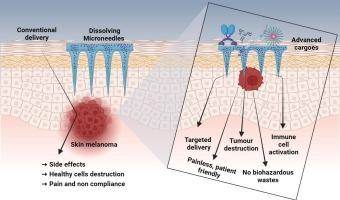
Skin cancer is one among the common types of cancers, affecting millions of individual globally. The conventional anticancer therapy such as chemotherapy results in worst systemic and local side effects as well as inhibit the growth of healthy cells around the tumor cells. Dissolving microneedles (DMNs) is a groundbreaking technology with less invasive and more targeted features. Physically, these tiny dissolving needles deliver the anticancer payloads drug to the tumor site after its direct application on the skin surface. Specifically, the DMNs release the anticancer drug cargoes into the cancerous cell sparing the healthy cells around the tumor, thus has provided a significant contribution in the landscape of traditional skin cancer therapy. This targeted therapeutic approach of dissolving microneedles shows a significant therapeutic outcome in decreasing the growth of cancer cells in pre-clinical studies. Dissolving microneedles (DMNs) have demonstrated effectiveness in the targeted delivery of drugs, genes, and vaccines specifically at the site of skin tumors. This method mimics the localized release of adjuvants and immunomodulators, leading to significant humoral and cellular immune responses that are beneficial for skin cancer therapy. In this review, the current trends and potential roles of dissolving microneedles in delivering therapeutic agents focused on treating skin melanoma have been highlighted, drawing insights from recent literature. This emphasizes the promising applications of DMNs in enhancing treatment outcomes for skin cancer patients. Lastly, future perspectives were identified for improving the therapeutic potential and translation of DMNs into clinic.
期刊介绍:
The International Journal of Pharmaceutics is the third most cited journal in the "Pharmacy & Pharmacology" category out of 366 journals, being the true home for pharmaceutical scientists concerned with the physical, chemical and biological properties of devices and delivery systems for drugs, vaccines and biologicals, including their design, manufacture and evaluation. This includes evaluation of the properties of drugs, excipients such as surfactants and polymers and novel materials. The journal has special sections on pharmaceutical nanotechnology and personalized medicines, and publishes research papers, reviews, commentaries and letters to the editor as well as special issues.



 京公网安备 11010802042870号
京ICP备2023020795号-1
京公网安备 11010802042870号
京ICP备2023020795号-1

 分享
分享
 求助内容:
求助内容: 应助结果提醒方式:
 扫码关注我们
