{"title":"[Construction and Validation of A Prognostic Model for Lung Adenocarcinoma \u2029Based on Ferroptosis-related Genes].","authors":"Zhanrui Zhang, Wenhao Zhao, Zixuan Hu, Chen Ding, Hua Huang, Guowei Liang, Hongyu Liu, Jun Chen","doi":"10.3779/j.issn.1009-3419.2025.102.04","DOIUrl":null,"url":null,"abstract":"<p><strong>Background: </strong>Ferroptosis-related genes play a crucial role in regulating intracellular iron homeostasis and lipid peroxidation, and they are involved in the regulation of tumor growth and drug resistance. The expression of ferroptosis-related genes in tumor tissues can be used to predict patients' future survival times, aiding doctors and patients in anticipating disease progression. Based on the sequencing data of lung adenocarcinoma (LUAD) patients from The Cancer Genome Atlas (TCGA) database, this study identified genes involved in the regulation of ferroptosis, constructed a prognostic model, and evaluated the predictive performance of the model.</p><p><strong>Methods: </strong>A total of 1467 ferroptosis-related genes were obtained from the GeneCards database. Gene expression profiles and clinical data from 541 LUAD patients were collected from the TCGA database. The expression data of all ferroptosis-related genes were extracted, and differentially expressed genes were identified using R software. Survival analysis was performed on these genes to screen for those with prognostic value. Subsequently, a prognostic risk scoring model for ferroptosis-related genes was constructed using LASSO regression model. Each LUAD patient sample was scored, and the patients were divided into high-risk and low-risk groups based on the median score. Receiver operating characteristic (ROC) curves were plotted, and the area under the curve (AUC) was calculated. Kaplan-Meier survival curves were generated to assess model performance, followed by validation in an external dataset. Finally, univariate and multivariate Cox regression analyses were conducted to evaluate the independent prognostic value and clinical relevance of the model.</p><p><strong>Results: </strong>Through survival analysis, 121 ferroptosis-related genes associated with prognosis were initially identified. Based on this, a LUAD prognostic risk scoring model was constructed using 12 ferroptosis-related genes (ALG3, C1QTNF6, CCT6A, GLS2, KRT6A, LDHA, NUPR1, OGFRP1, PCSK9, TRIM6, IGF2BP1 and MIR31HG). The results indicated that patients in the high-risk group had significantly shorter survival time than those in the low-risk group (P<0.001), and the model demonstrated good predictive performance in both the training set (1-yr AUC=0.721) and the external validation set (1-yr AUC=0.768). Risk scores were significantly associated with the prognosis of LUAD patients in both univariate and multivariate Cox regression analyses (P<0.001), suggesting that this score is an important prognostic factor for LUAD patients.</p><p><strong>Conclusions: </strong>This study successfully established a LUAD risk scoring model composed of 12 ferroptosis-related genes. In the future, this model is expected to be used in conjunction with the tumor-node-metastasis (TNM) staging system for prognostic predictions in LUAD patients.</p>","PeriodicalId":39317,"journal":{"name":"中国肺癌杂志","volume":"28 1","pages":"22-32"},"PeriodicalIF":0.0000,"publicationDate":"2025-01-20","publicationTypes":"Journal Article","fieldsOfStudy":null,"isOpenAccess":false,"openAccessPdf":"https://www.ncbi.nlm.nih.gov/pmc/articles/PMC11848621/pdf/","citationCount":"0","resultStr":null,"platform":"Semanticscholar","paperid":null,"PeriodicalName":"中国肺癌杂志","FirstCategoryId":"3","ListUrlMain":"https://doi.org/10.3779/j.issn.1009-3419.2025.102.04","RegionNum":0,"RegionCategory":null,"ArticlePicture":[],"TitleCN":null,"AbstractTextCN":null,"PMCID":null,"EPubDate":"","PubModel":"","JCR":"Q4","JCRName":"Medicine","Score":null,"Total":0}
引用次数: 0
Abstract
Background: Ferroptosis-related genes play a crucial role in regulating intracellular iron homeostasis and lipid peroxidation, and they are involved in the regulation of tumor growth and drug resistance. The expression of ferroptosis-related genes in tumor tissues can be used to predict patients' future survival times, aiding doctors and patients in anticipating disease progression. Based on the sequencing data of lung adenocarcinoma (LUAD) patients from The Cancer Genome Atlas (TCGA) database, this study identified genes involved in the regulation of ferroptosis, constructed a prognostic model, and evaluated the predictive performance of the model.
Methods: A total of 1467 ferroptosis-related genes were obtained from the GeneCards database. Gene expression profiles and clinical data from 541 LUAD patients were collected from the TCGA database. The expression data of all ferroptosis-related genes were extracted, and differentially expressed genes were identified using R software. Survival analysis was performed on these genes to screen for those with prognostic value. Subsequently, a prognostic risk scoring model for ferroptosis-related genes was constructed using LASSO regression model. Each LUAD patient sample was scored, and the patients were divided into high-risk and low-risk groups based on the median score. Receiver operating characteristic (ROC) curves were plotted, and the area under the curve (AUC) was calculated. Kaplan-Meier survival curves were generated to assess model performance, followed by validation in an external dataset. Finally, univariate and multivariate Cox regression analyses were conducted to evaluate the independent prognostic value and clinical relevance of the model.
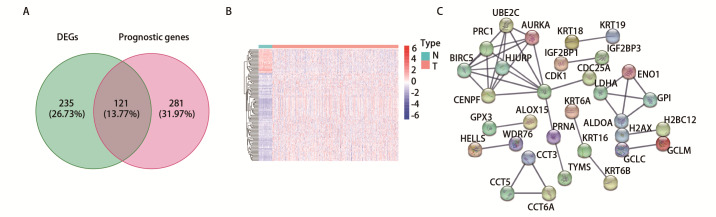
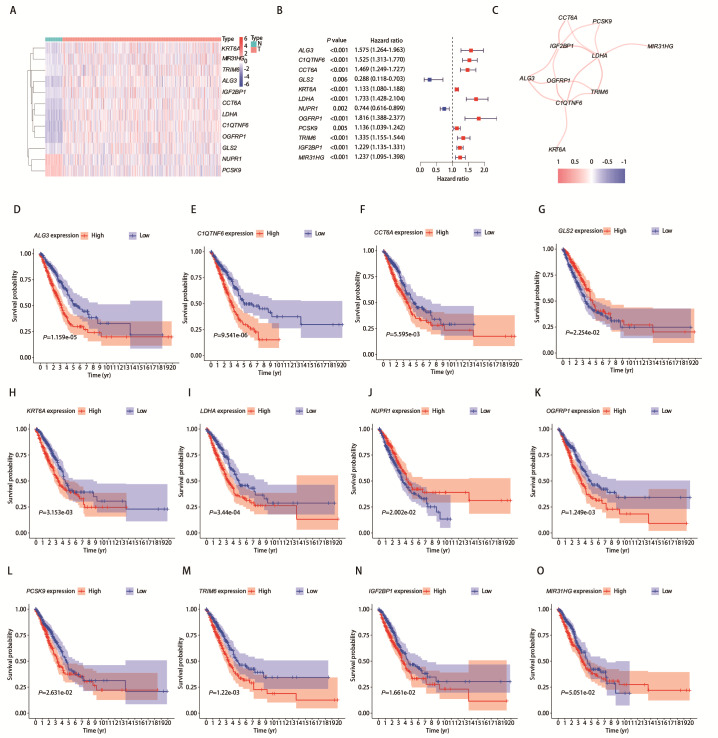
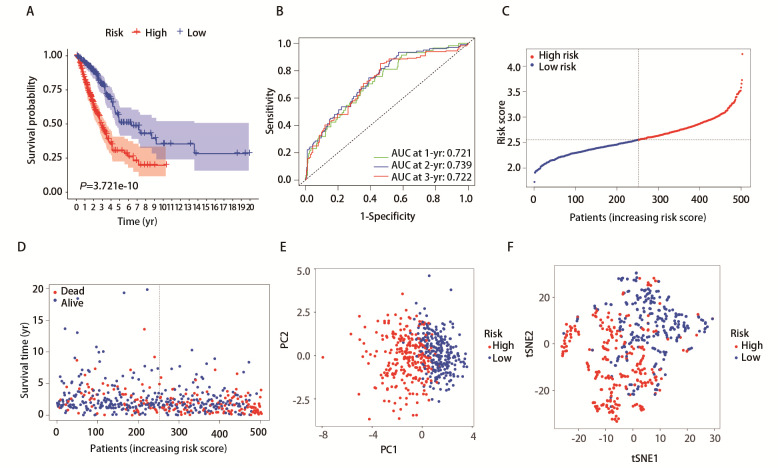
Results: Through survival analysis, 121 ferroptosis-related genes associated with prognosis were initially identified. Based on this, a LUAD prognostic risk scoring model was constructed using 12 ferroptosis-related genes (ALG3, C1QTNF6, CCT6A, GLS2, KRT6A, LDHA, NUPR1, OGFRP1, PCSK9, TRIM6, IGF2BP1 and MIR31HG). The results indicated that patients in the high-risk group had significantly shorter survival time than those in the low-risk group (P<0.001), and the model demonstrated good predictive performance in both the training set (1-yr AUC=0.721) and the external validation set (1-yr AUC=0.768). Risk scores were significantly associated with the prognosis of LUAD patients in both univariate and multivariate Cox regression analyses (P<0.001), suggesting that this score is an important prognostic factor for LUAD patients.
Conclusions: This study successfully established a LUAD risk scoring model composed of 12 ferroptosis-related genes. In the future, this model is expected to be used in conjunction with the tumor-node-metastasis (TNM) staging system for prognostic predictions in LUAD patients.
背景:嗜铁相关基因在调节细胞内铁稳态和脂质过氧化中起着至关重要的作用,并参与肿瘤生长和耐药的调控。肿瘤组织中凋亡相关基因的表达可用于预测患者未来的生存时间,帮助医生和患者预测疾病进展。本研究基于the Cancer Genome Atlas (TCGA)数据库中肺腺癌(LUAD)患者的测序数据,鉴定出参与铁死亡调控的基因,构建预后模型,并对模型的预测性能进行评估。方法:从GeneCards数据库中获得1467个嗜铁相关基因。从TCGA数据库中收集541例LUAD患者的基因表达谱和临床数据。提取所有嗜铁相关基因的表达数据,利用R软件鉴定差异表达基因。对这些基因进行生存分析,筛选具有预后价值的基因。随后,采用LASSO回归模型构建了嗜铁相关基因的预后风险评分模型。对每个LUAD患者样本进行评分,根据中位评分将患者分为高危组和低危组。绘制受试者工作特征(ROC)曲线,计算曲线下面积(AUC)。生成Kaplan-Meier生存曲线来评估模型的性能,然后在外部数据集中进行验证。最后,进行单因素和多因素Cox回归分析,评估该模型的独立预后价值和临床相关性。结果:通过生存分析,初步鉴定出121个与预后相关的铁中毒相关基因。在此基础上,利用12个凋亡相关基因(ALG3、C1QTNF6、CCT6A、GLS2、KRT6A、LDHA、NUPR1、OGFRP1、PCSK9、TRIM6、IGF2BP1和MIR31HG)构建LUAD预后风险评分模型。结果显示,高危组患者的生存时间明显短于低危组(p)。结论:本研究成功建立了由12个枯铁相关基因组成的LUAD风险评分模型。在未来,该模型有望与肿瘤-淋巴结-转移(TNM)分期系统一起用于LUAD患者的预后预测。
期刊介绍:
Chinese Journal of Lung Cancer(CJLC, pISSN 1009-3419, eISSN 1999-6187), a monthly Open Access journal, is hosted by Chinese Anti-Cancer Association, Chinese Antituberculosis Association, Tianjin Medical University General Hospital. CJLC was indexed in DOAJ, EMBASE/SCOPUS, Chemical Abstract(CA), CSA-Biological Science, HINARI, EBSCO-CINAHL,CABI Abstract, Global Health, CNKI, etc. Editor-in-Chief: Professor Qinghua ZHOU.



 京公网安备 11010802042870号
京ICP备2023020795号-1
京公网安备 11010802042870号
京ICP备2023020795号-1

 分享
分享
 求助内容:
求助内容: 应助结果提醒方式:
 扫码关注我们
