Alfonso Galderisi, Jacopo Bonet, Heba M Ismail, Antoinette Moran, Paolo Fiorina, Emanuele Bosi, Alessandra Petrelli
{"title":"Metabolic Phenotype of Stage 1 and Stage 2 Type 1 Diabetes Using Modeling of β Cell Function.","authors":"Alfonso Galderisi, Jacopo Bonet, Heba M Ismail, Antoinette Moran, Paolo Fiorina, Emanuele Bosi, Alessandra Petrelli","doi":"10.1210/clinem/dgaf086","DOIUrl":null,"url":null,"abstract":"<p><strong>Background: </strong>Staging preclinical type 1 diabetes (T1D) and monitoring the response to disease-modifying treatments rely on the oral glucose tolerance test (OGTT). However, it is unknown whether OGTT-derived measures of beta cell function can detect subtle changes in metabolic phenotype, thus limiting their usability as endpoints in prevention trials.</p><p><strong>Objective: </strong>To describe the metabolic phenotype of people with Stage 1 and Stage 2 T1D using metabolic modelling of β cell function.</p><p><strong>Methods: </strong>We characterized the metabolic phenotype of individuals with islet autoimmunity in the absence (Stage 1) or presence (Stage 2) of dysglycemia. Participants were screened at a TrialNet site and underwent a 5-point, 2-hour OGTT. Standard measures of insulin secretion (area under the curve, C-peptide, Homeostatic Model Assessment [HOMA] 2-B) and sensitivity (HOMA Insulin Resistance, HOMA2-S, Matsuda Index) and oral minimal model-derived insulin secretion (φ total), sensitivity (sensitivity index), and clearance were adopted to characterize the cohort.</p><p><strong>Results: </strong>Thirty participants with Stage 1 and 27 with Stage 2T1D were selected. Standard metrics of insulin secretion and sensitivity did not differ between Stage 1 and Stage 2 T1D, while the oral minimal model revealed lower insulin secretion (P < .001) and sensitivity (P = .034) in those with Stage 2 T1D, as well as increased insulin clearance (P = .006). A higher baseline φ total was associated with reduced odds of disease progression, independent of stage (OR 0.92 [0.86, 0.98], P = .016).</p><p><strong>Conclusion: </strong>The oral minimal model describes the differential metabolic phenotype of Stage 1 and Stage 2 T1D and identifies the φ total as a progression predictor. This supports its use as a sensitive tool and endpoint for T1D prevention trials.</p>","PeriodicalId":50238,"journal":{"name":"Journal of Clinical Endocrinology & Metabolism","volume":" ","pages":"3168-3178"},"PeriodicalIF":5.1000,"publicationDate":"2025-10-16","publicationTypes":"Journal Article","fieldsOfStudy":null,"isOpenAccess":false,"openAccessPdf":"https://www.ncbi.nlm.nih.gov/pmc/articles/PMC12527456/pdf/","citationCount":"0","resultStr":null,"platform":"Semanticscholar","paperid":null,"PeriodicalName":"Journal of Clinical Endocrinology & Metabolism","FirstCategoryId":"3","ListUrlMain":"https://doi.org/10.1210/clinem/dgaf086","RegionNum":2,"RegionCategory":"医学","ArticlePicture":[],"TitleCN":null,"AbstractTextCN":null,"PMCID":null,"EPubDate":"","PubModel":"","JCR":"Q1","JCRName":"ENDOCRINOLOGY & METABOLISM","Score":null,"Total":0}
引用次数: 0
Abstract
Background: Staging preclinical type 1 diabetes (T1D) and monitoring the response to disease-modifying treatments rely on the oral glucose tolerance test (OGTT). However, it is unknown whether OGTT-derived measures of beta cell function can detect subtle changes in metabolic phenotype, thus limiting their usability as endpoints in prevention trials.
Objective: To describe the metabolic phenotype of people with Stage 1 and Stage 2 T1D using metabolic modelling of β cell function.
Methods: We characterized the metabolic phenotype of individuals with islet autoimmunity in the absence (Stage 1) or presence (Stage 2) of dysglycemia. Participants were screened at a TrialNet site and underwent a 5-point, 2-hour OGTT. Standard measures of insulin secretion (area under the curve, C-peptide, Homeostatic Model Assessment [HOMA] 2-B) and sensitivity (HOMA Insulin Resistance, HOMA2-S, Matsuda Index) and oral minimal model-derived insulin secretion (φ total), sensitivity (sensitivity index), and clearance were adopted to characterize the cohort.
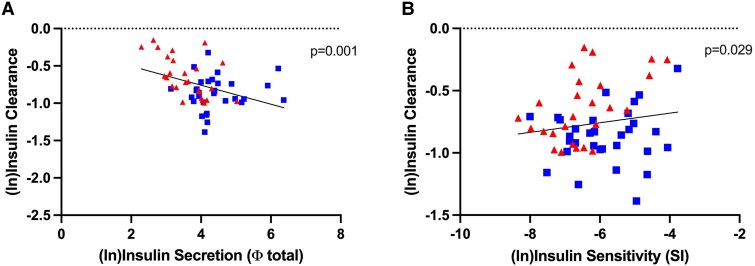
Results: Thirty participants with Stage 1 and 27 with Stage 2T1D were selected. Standard metrics of insulin secretion and sensitivity did not differ between Stage 1 and Stage 2 T1D, while the oral minimal model revealed lower insulin secretion (P < .001) and sensitivity (P = .034) in those with Stage 2 T1D, as well as increased insulin clearance (P = .006). A higher baseline φ total was associated with reduced odds of disease progression, independent of stage (OR 0.92 [0.86, 0.98], P = .016).
Conclusion: The oral minimal model describes the differential metabolic phenotype of Stage 1 and Stage 2 T1D and identifies the φ total as a progression predictor. This supports its use as a sensitive tool and endpoint for T1D prevention trials.
期刊介绍:
The Journal of Clinical Endocrinology & Metabolism is the world"s leading peer-reviewed journal for endocrine clinical research and cutting edge clinical practice reviews. Each issue provides the latest in-depth coverage of new developments enhancing our understanding, diagnosis and treatment of endocrine and metabolic disorders. Regular features of special interest to endocrine consultants include clinical trials, clinical reviews, clinical practice guidelines, case seminars, and controversies in clinical endocrinology, as well as original reports of the most important advances in patient-oriented endocrine and metabolic research. According to the latest Thomson Reuters Journal Citation Report, JCE&M articles were cited 64,185 times in 2008.





 京公网安备 11010802042870号
京ICP备2023020795号-1
京公网安备 11010802042870号
京ICP备2023020795号-1

 分享
分享
 求助内容:
求助内容: 应助结果提醒方式:
 扫码关注我们
