Nikita Sivakumar, Cindy Zhang, Connie Chang-Chien, Pan Gu, Yikun Li, Yi Yang, Darin Rosen, Tijana Tuhy, Ilton M Cubero Salazar, Matthew Kauffman, Rachel L Damico, Casey Overby Taylor, Joseph L Greenstein, Steven Hsu, Paul M Hassoun, Catherine E Simpson
{"title":"An Unsupervised Approach to Derive Right Ventricular Pressure-Volume Loop Phenotypes in Pulmonary Hypertension.","authors":"Nikita Sivakumar, Cindy Zhang, Connie Chang-Chien, Pan Gu, Yikun Li, Yi Yang, Darin Rosen, Tijana Tuhy, Ilton M Cubero Salazar, Matthew Kauffman, Rachel L Damico, Casey Overby Taylor, Joseph L Greenstein, Steven Hsu, Paul M Hassoun, Catherine E Simpson","doi":"10.1002/pul2.70057","DOIUrl":null,"url":null,"abstract":"<p><p>Although right ventricle (RV) dysfunction drives clinical worsening in pulmonary hypertension (PH), information about RV function has not been well integrated in PH risk assessment. The gold standard for assessing RV function and ventriculo-arterial coupling is the construction of multi-beat pressure-volume (PV) loops. PV loops are technically challenging to acquire and not feasible for routine clinical use. Therefore, we aimed to map standard clinically available measurements to emergent PV loop phenotypes. One hundred and one patients with suspected PH underwent right heart catheterization (RHC) with exercise, multi-beat PV loop measurement, and same-day cardiac magnetic resonance imaging (CMR). We applied unsupervised <i>k</i>-means clustering on 10 PV loop metrics to obtain three patient groups with unique RV functional phenotypes and times to clinical worsening. We integrated RHC and CMR measurements to train a random forest classifier that predicts the PV loop patient group with high discrimination (AUC = 0.93). The most informative variable for PV loop phenotype prediction was exercise mean pulmonary arterial pressure (mPAP). Distinct and clinically meaningful PV loop phenotypes exist that can be predicted using clinically accessible hemodynamic and RV-centric measurements. Exercise mPAP may inform RV pressure-volume relationships.</p>","PeriodicalId":20927,"journal":{"name":"Pulmonary Circulation","volume":"15 1","pages":"e70057"},"PeriodicalIF":2.5000,"publicationDate":"2025-02-20","publicationTypes":"Journal Article","fieldsOfStudy":null,"isOpenAccess":false,"openAccessPdf":"https://www.ncbi.nlm.nih.gov/pmc/articles/PMC11842459/pdf/","citationCount":"0","resultStr":null,"platform":"Semanticscholar","paperid":null,"PeriodicalName":"Pulmonary Circulation","FirstCategoryId":"3","ListUrlMain":"https://doi.org/10.1002/pul2.70057","RegionNum":4,"RegionCategory":"医学","ArticlePicture":[],"TitleCN":null,"AbstractTextCN":null,"PMCID":null,"EPubDate":"2025/1/1 0:00:00","PubModel":"eCollection","JCR":"Q2","JCRName":"CARDIAC & CARDIOVASCULAR SYSTEMS","Score":null,"Total":0}
引用次数: 0
Abstract
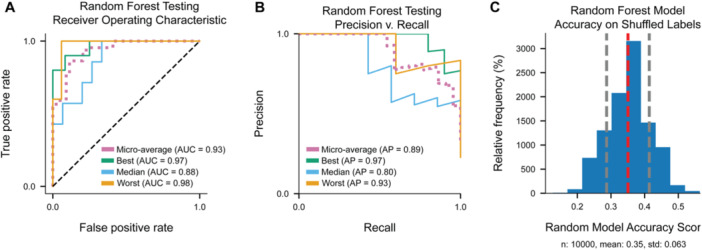
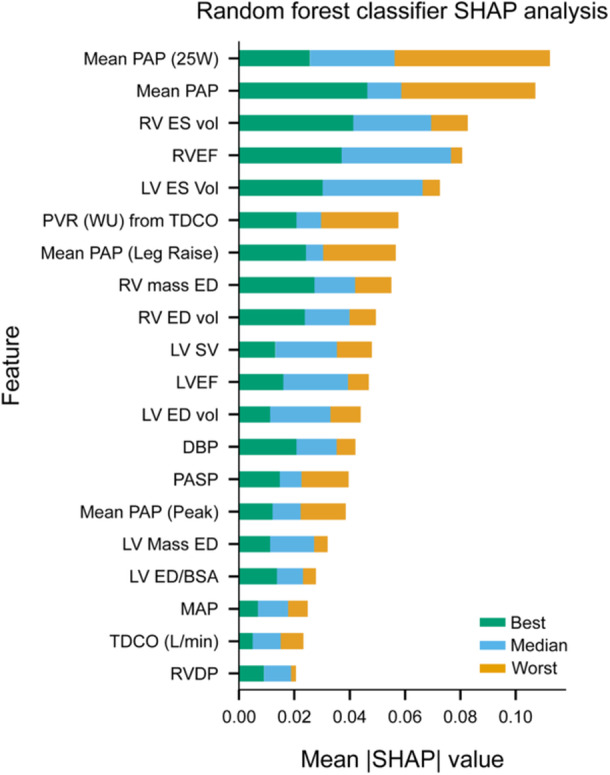
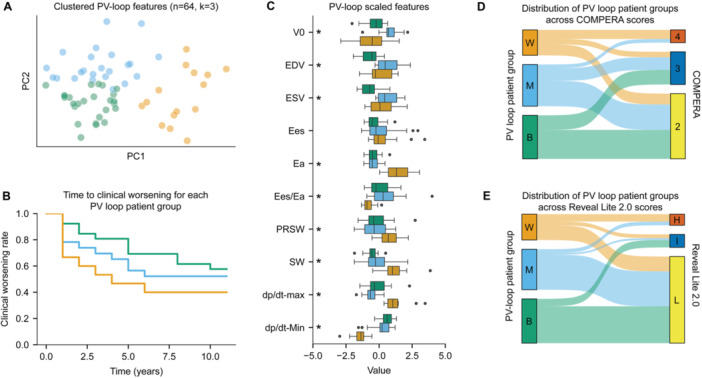
Although right ventricle (RV) dysfunction drives clinical worsening in pulmonary hypertension (PH), information about RV function has not been well integrated in PH risk assessment. The gold standard for assessing RV function and ventriculo-arterial coupling is the construction of multi-beat pressure-volume (PV) loops. PV loops are technically challenging to acquire and not feasible for routine clinical use. Therefore, we aimed to map standard clinically available measurements to emergent PV loop phenotypes. One hundred and one patients with suspected PH underwent right heart catheterization (RHC) with exercise, multi-beat PV loop measurement, and same-day cardiac magnetic resonance imaging (CMR). We applied unsupervised k-means clustering on 10 PV loop metrics to obtain three patient groups with unique RV functional phenotypes and times to clinical worsening. We integrated RHC and CMR measurements to train a random forest classifier that predicts the PV loop patient group with high discrimination (AUC = 0.93). The most informative variable for PV loop phenotype prediction was exercise mean pulmonary arterial pressure (mPAP). Distinct and clinically meaningful PV loop phenotypes exist that can be predicted using clinically accessible hemodynamic and RV-centric measurements. Exercise mPAP may inform RV pressure-volume relationships.
期刊介绍:
Pulmonary Circulation''s main goal is to encourage basic, translational, and clinical research by investigators, physician-scientists, and clinicans, in the hope of increasing survival rates for pulmonary hypertension and other pulmonary vascular diseases worldwide, and developing new therapeutic approaches for the diseases. Freely available online, Pulmonary Circulation allows diverse knowledge of research, techniques, and case studies to reach a wide readership of specialists in order to improve patient care and treatment outcomes.



 京公网安备 11010802042870号
京ICP备2023020795号-1
京公网安备 11010802042870号
京ICP备2023020795号-1

 分享
分享
 求助内容:
求助内容: 应助结果提醒方式:
 扫码关注我们
