Comparison of inflammatory markers before and after nanoliposomal irinotecan and fluorouracil with folic acid in patients with pancreatic cancer: results from the NAPOLEON-2 study (NN-2302).
{"title":"Comparison of inflammatory markers before and after nanoliposomal irinotecan and fluorouracil with folic acid in patients with pancreatic cancer: results from the NAPOLEON-2 study (NN-2302).","authors":"Tomonori Araki, Kohei Hayashi, Mototsugu Shimokawa, Taiga Otsuka, Yuki Sonoda, Takuya Honda, Taro Shibuki, Junichi Nakazawa, Shiho Arima, Keisuke Miwa, Futa Koga, Yujiro Ueda, Yoshihito Kubotsu, Hozumi Shimokawa, Shigeyuki Takeshita, Kazuo Nishikawa, Azusa Komori, Satoshi Otsu, Ayumu Hosokawa, Tatsunori Sakai, Hisanobu Oda, Machiko Kawahira, Shuji Arita, Hiroki Taguchi, Kengo Tsuneyoshi, Toshihiro Fujita, Takahiro Sakae, Yasunori Kawaguchi, Tsuyoshi Shirakawa, Toshihiko Mizuta, Kenji Mitsugi","doi":"10.1177/17588359251320768","DOIUrl":null,"url":null,"abstract":"<p><strong>Background: </strong>Relationships between cancer onset, progression, and inflammation have been reported; yet, the significance of inflammatory markers before and after treatment with nanoliposomal irinotecan and fluorouracil with folic acid (NFF) is unclear.</p><p><strong>Objectives: </strong>We aimed to (1) investigate whether worsening inflammation is associated with disease progression and whether it can be used as a biomarker by comparing inflammatory markers before and after treatment with NFF and (2) verify which is a superior biomarker.</p><p><strong>Design: </strong>This was a preplanned analysis of a retrospective cohort of the NAPOLEON-2 study, a multicenter observational study. Patients from 20 institutions were enrolled. Those with unresectable pancreatic cancer who received NFF as a second-line or later-line treatment between June 1, 2020, and May 31, 2021, were included.</p><p><strong>Methods: </strong>The primary endpoint was overall survival, and the main secondary endpoint was progression-free survival. The following inflammatory markers were assessed: neutrophil-to-lymphocyte ratio (NLR), platelet-to-lymphocyte ratio, Prognostic Nutrition Index (PNI), C-reactive protein/albumin ratio (CAR), Glasgow prognostic score (GPS), Prognostic Index (PI), and Komori score.</p><p><strong>Results: </strong>A total of 161 patients were enrolled. The CAR, NLR, GPS (1 vs 2), PI (1 vs 2), PNI, and Komori score were useful pre-NFF biomarkers (hazard ratios (HRs): 2.59, 2.28, 2.76/3.35, 2.16/18.89, 2.13, and 3.39, respectively). The CAR, NLR, GPS (compared with a score of 1/2), and PI (compared with a score of 1/2) were useful post-NFF biomarkers (HRs: 2.63, 1.88, 2.54/3.09, 2.30/5.39, respectively). In terms of the receiver operating characteristic curve and Akaike information criterion, the CAR, GPS, and PI showed favorable trends, and overall, CAR was a useful biomarker.</p><p><strong>Conclusion: </strong>Inflammatory markers can be used as biomarkers both before and after NFF treatment, and CAR may be useful. We hope these findings will contribute to the selection of appropriate treatment options.</p>","PeriodicalId":23053,"journal":{"name":"Therapeutic Advances in Medical Oncology","volume":"17 ","pages":"17588359251320768"},"PeriodicalIF":4.2000,"publicationDate":"2025-02-21","publicationTypes":"Journal Article","fieldsOfStudy":null,"isOpenAccess":false,"openAccessPdf":"https://www.ncbi.nlm.nih.gov/pmc/articles/PMC11843724/pdf/","citationCount":"0","resultStr":null,"platform":"Semanticscholar","paperid":null,"PeriodicalName":"Therapeutic Advances in Medical Oncology","FirstCategoryId":"3","ListUrlMain":"https://doi.org/10.1177/17588359251320768","RegionNum":2,"RegionCategory":"医学","ArticlePicture":[],"TitleCN":null,"AbstractTextCN":null,"PMCID":null,"EPubDate":"2025/1/1 0:00:00","PubModel":"eCollection","JCR":"Q2","JCRName":"ONCOLOGY","Score":null,"Total":0}
引用次数: 0
Abstract
Background: Relationships between cancer onset, progression, and inflammation have been reported; yet, the significance of inflammatory markers before and after treatment with nanoliposomal irinotecan and fluorouracil with folic acid (NFF) is unclear.
Objectives: We aimed to (1) investigate whether worsening inflammation is associated with disease progression and whether it can be used as a biomarker by comparing inflammatory markers before and after treatment with NFF and (2) verify which is a superior biomarker.
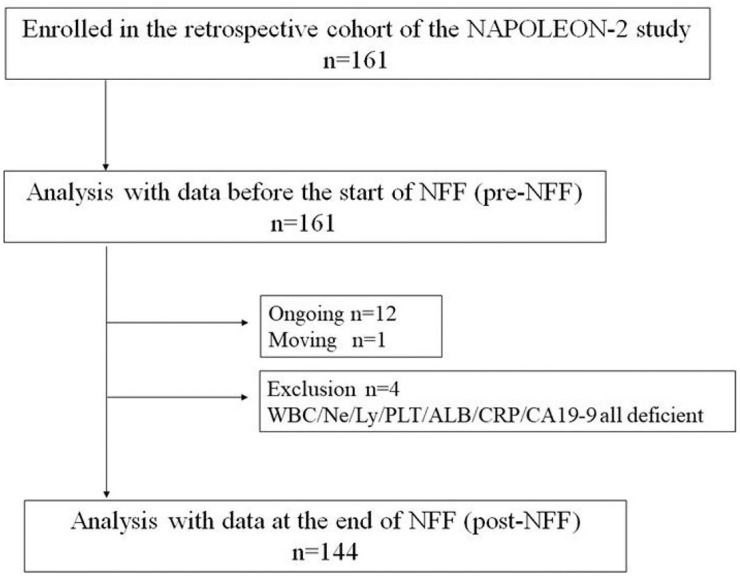
Design: This was a preplanned analysis of a retrospective cohort of the NAPOLEON-2 study, a multicenter observational study. Patients from 20 institutions were enrolled. Those with unresectable pancreatic cancer who received NFF as a second-line or later-line treatment between June 1, 2020, and May 31, 2021, were included.
Methods: The primary endpoint was overall survival, and the main secondary endpoint was progression-free survival. The following inflammatory markers were assessed: neutrophil-to-lymphocyte ratio (NLR), platelet-to-lymphocyte ratio, Prognostic Nutrition Index (PNI), C-reactive protein/albumin ratio (CAR), Glasgow prognostic score (GPS), Prognostic Index (PI), and Komori score.
Results: A total of 161 patients were enrolled. The CAR, NLR, GPS (1 vs 2), PI (1 vs 2), PNI, and Komori score were useful pre-NFF biomarkers (hazard ratios (HRs): 2.59, 2.28, 2.76/3.35, 2.16/18.89, 2.13, and 3.39, respectively). The CAR, NLR, GPS (compared with a score of 1/2), and PI (compared with a score of 1/2) were useful post-NFF biomarkers (HRs: 2.63, 1.88, 2.54/3.09, 2.30/5.39, respectively). In terms of the receiver operating characteristic curve and Akaike information criterion, the CAR, GPS, and PI showed favorable trends, and overall, CAR was a useful biomarker.
Conclusion: Inflammatory markers can be used as biomarkers both before and after NFF treatment, and CAR may be useful. We hope these findings will contribute to the selection of appropriate treatment options.
背景:癌症的发生、进展和炎症之间的关系已经有报道;然而,纳米脂质体伊立替康和氟尿嘧啶联合叶酸(NFF)治疗前后炎症标志物的意义尚不清楚。目的:我们的目的是(1)通过比较NFF治疗前后的炎症标志物,研究炎症恶化是否与疾病进展相关,是否可以作为生物标志物使用;(2)验证哪一个是更好的生物标志物。设计:这是一项多中心观察性研究NAPOLEON-2的回顾性队列预先计划分析。入选的患者来自20家机构。纳入了在2020年6月1日至2021年5月31日期间接受NFF作为二线或后期治疗的不可切除胰腺癌患者。方法:主要终点是总生存期,次要终点是无进展生存期。评估以下炎症标志物:中性粒细胞与淋巴细胞比值(NLR)、血小板与淋巴细胞比值、预后营养指数(PNI)、c反应蛋白/白蛋白比值(CAR)、格拉斯哥预后评分(GPS)、预后指数(PI)和小森评分。结果:共纳入161例患者。CAR、NLR、GPS (1 vs 2)、PI (1 vs 2)、PNI和Komori评分是有用的nff前生物标志物(风险比分别为2.59、2.28、2.76/3.35、2.16/18.89、2.13和3.39)。CAR、NLR、GPS(评分为1/2)和PI(评分为1/2)是有用的nff后生物标志物(hr分别为2.63、1.88、2.54/3.09和2.30/5.39)。在受试者工作特征曲线和赤池信息准则方面,CAR、GPS和PI均表现出良好的趋势,总体而言,CAR是一种有用的生物标志物。结论:炎症标志物可以作为NFF治疗前后的生物标志物,CAR可能是有用的。我们希望这些发现将有助于选择适当的治疗方案。
期刊介绍:
Therapeutic Advances in Medical Oncology is an open access, peer-reviewed journal delivering the highest quality articles, reviews, and scholarly comment on pioneering efforts and innovative studies in the medical treatment of cancer. The journal has a strong clinical and pharmacological focus and is aimed at clinicians and researchers in medical oncology, providing a forum in print and online for publishing the highest quality articles in this area. This journal is a member of the Committee on Publication Ethics (COPE).





 京公网安备 11010802042870号
京ICP备2023020795号-1
京公网安备 11010802042870号
京ICP备2023020795号-1

 分享
分享
 求助内容:
求助内容: 应助结果提醒方式:
 扫码关注我们
