S Raghavendra, S K Abhilash, Venu Madhav Nookala, Jayashree Shetty, Praveen Gurunath Bharathi
{"title":"MPAR-RCNN: a multi-task network for multiple person detection with attribute recognition.","authors":"S Raghavendra, S K Abhilash, Venu Madhav Nookala, Jayashree Shetty, Praveen Gurunath Bharathi","doi":"10.3389/frai.2025.1454488","DOIUrl":null,"url":null,"abstract":"<p><p>Multi-label attribute recognition is a critical task in computer vision, with applications ranging across diverse fields. This problem often involves detecting objects with multiple attributes, necessitating sophisticated models capable of both high-level differentiation and fine-grained feature extraction. The integration of object detection and attribute recognition typically relies on approaches such as dual-stage networks, where accurate predictions depend on advanced feature extraction techniques, such as Region of Interest (RoI) pooling. To meet these demands, an efficient method that achieves both reliable detection and attribute classification in a unified framework is essential. This study introduces an innovative MTL framework designed to incorporate Multi-Person Attribute Recognition (MPAR) within a single-model architecture. Named MPAR-RCNN, this framework unifies object detection and attribute recognition tasks through a spatially aware, shared backbone, facilitating efficient and accurate multi-label prediction. Unlike the traditional Fast Region-based Convolutional Neural Network (R-CNN), which separately manages person detection and attribute classification with a dual-stage network, the MPAR-RCNN architecture optimizes both tasks within a single structure. Validated on the WIDER (Web Image Dataset for Event Recognition) dataset, the proposed model demonstrates an improvement over current state-of-the-art (SOTA) architectures, showcasing its potential in advancing multi-label attribute recognition.</p>","PeriodicalId":33315,"journal":{"name":"Frontiers in Artificial Intelligence","volume":"8 ","pages":"1454488"},"PeriodicalIF":4.7000,"publicationDate":"2025-02-07","publicationTypes":"Journal Article","fieldsOfStudy":null,"isOpenAccess":false,"openAccessPdf":"https://www.ncbi.nlm.nih.gov/pmc/articles/PMC11842310/pdf/","citationCount":"0","resultStr":null,"platform":"Semanticscholar","paperid":null,"PeriodicalName":"Frontiers in Artificial Intelligence","FirstCategoryId":"1085","ListUrlMain":"https://doi.org/10.3389/frai.2025.1454488","RegionNum":0,"RegionCategory":null,"ArticlePicture":[],"TitleCN":null,"AbstractTextCN":null,"PMCID":null,"EPubDate":"2025/1/1 0:00:00","PubModel":"eCollection","JCR":"Q2","JCRName":"COMPUTER SCIENCE, ARTIFICIAL INTELLIGENCE","Score":null,"Total":0}
引用次数: 0
Abstract
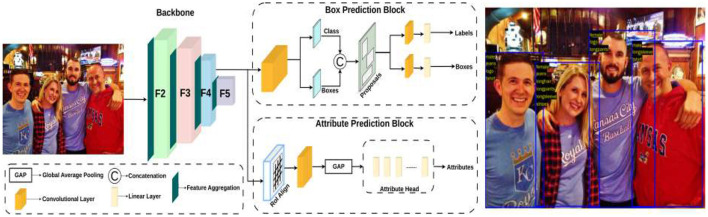
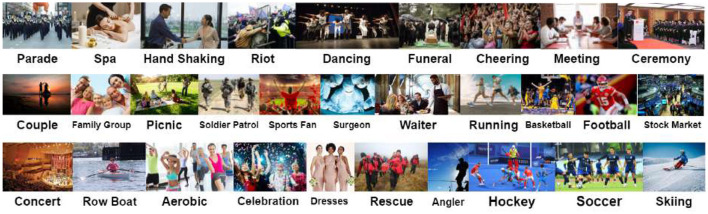
Multi-label attribute recognition is a critical task in computer vision, with applications ranging across diverse fields. This problem often involves detecting objects with multiple attributes, necessitating sophisticated models capable of both high-level differentiation and fine-grained feature extraction. The integration of object detection and attribute recognition typically relies on approaches such as dual-stage networks, where accurate predictions depend on advanced feature extraction techniques, such as Region of Interest (RoI) pooling. To meet these demands, an efficient method that achieves both reliable detection and attribute classification in a unified framework is essential. This study introduces an innovative MTL framework designed to incorporate Multi-Person Attribute Recognition (MPAR) within a single-model architecture. Named MPAR-RCNN, this framework unifies object detection and attribute recognition tasks through a spatially aware, shared backbone, facilitating efficient and accurate multi-label prediction. Unlike the traditional Fast Region-based Convolutional Neural Network (R-CNN), which separately manages person detection and attribute classification with a dual-stage network, the MPAR-RCNN architecture optimizes both tasks within a single structure. Validated on the WIDER (Web Image Dataset for Event Recognition) dataset, the proposed model demonstrates an improvement over current state-of-the-art (SOTA) architectures, showcasing its potential in advancing multi-label attribute recognition.





 京公网安备 11010802042870号
京ICP备2023020795号-1
京公网安备 11010802042870号
京ICP备2023020795号-1

 分享
分享
 求助内容:
求助内容: 应助结果提醒方式:
 扫码关注我们
