Pedro Rocha, Rafael Bach, Laura Masfarré, Sharia Hernandez, Nil Navarro-Gorro, Adrià Rossell, Xavier Villanueva, Mario Giner, Ignacio Sanchéz, Miguel Galindo, Raúl Del Rey-Vergara, Albert Iñañez, Beatriz Sanchéz-Espiridion, Wei Lu, Ariadna Acedo-Terrades, Pau Berenguer-Molins, Albert Sánchez-Font, Roberto Chalela, Victor Curull, Álvaro Taus, Max Hardy-Werbin, Mark Sausen, Andrew Georgiadis, James White, Jennifer B Jackson, Laura Moliner, Sergi Clavé, Beatriz Bellosillo, Ana Rovira, Ignacio Wistuba, Luisa M Solis Soto, Júlia Perera-Bel, Edurne Arriola
{"title":"Molecular and immunological features associated with long-term benefits in metastatic NSCLC patients undergoing immune checkpoint blockade.","authors":"Pedro Rocha, Rafael Bach, Laura Masfarré, Sharia Hernandez, Nil Navarro-Gorro, Adrià Rossell, Xavier Villanueva, Mario Giner, Ignacio Sanchéz, Miguel Galindo, Raúl Del Rey-Vergara, Albert Iñañez, Beatriz Sanchéz-Espiridion, Wei Lu, Ariadna Acedo-Terrades, Pau Berenguer-Molins, Albert Sánchez-Font, Roberto Chalela, Victor Curull, Álvaro Taus, Max Hardy-Werbin, Mark Sausen, Andrew Georgiadis, James White, Jennifer B Jackson, Laura Moliner, Sergi Clavé, Beatriz Bellosillo, Ana Rovira, Ignacio Wistuba, Luisa M Solis Soto, Júlia Perera-Bel, Edurne Arriola","doi":"10.1080/2162402X.2025.2469377","DOIUrl":null,"url":null,"abstract":"<p><strong>Introduction: </strong>Immunotherapy is firmly established as a treatment regimen in various solid tumors, driven by its exceptional benefits in a selected group of patients. Despite widespread adoption of immune checkpoint blockade (ICB) across diverse solid tumors, the quest for a clinically informative biomarker for long-term benefit remains unmet.</p><p><strong>Methods: </strong>A total of 49 patients with metastatic NSCLC treated with ICB were included. Long-term (LTR) and short-term responders (STR) were defined as those with a response to ICB lasting more than 24 months or less than 6 months, respectively. Longitudinal blood specimens were collected before ICB treatment initiation and early-on treatment. Plasma ctDNA next-generation sequencing panel (NGS) and serum proteomics were performed. GeoMx DSP on baseline tumor tissue was performed in a subset of patients.</p><p><strong>Results: </strong>Our analysis revealed specific characteristics of LTR compared with STR, namely higher PD-L1 in tumor cells (<i>p</i> = 0.005) and higher incidence of irAEs (<i>p</i> = 0.001). Genomic features associated with lack of benefit from ICB included co-occurring mutations in KRAS/STK11 and TP53/KMT2D (<i>p</i> < 0.05). At a baseline, LTR patients exhibited higher serum levels of proteins related with apoptosis (CASP8, PRKRA), chemotaxis, immune proteasome, processing of MHC class I (S100A4, PSMD9, RNF41) and immune homeostasis (HAVCR1, ARG1) (<i>p</i> < 0.05). Protein spatial profiling of tumor samples showed higher levels of proteins linked with the presence of immune cells (CD45), T cells (CD8), antigen presentation (HLA-DR) and immune regulation proteins (PD-L1, IDO1) within the tumor and tumor stroma component (<i>p</i> < 0.05) in LTR patients. Serum longitudinal analysis identified a set of proteins that presented distinct dynamics in LTR compared to STR, making them interesting candidates to evaluate as early predictors of treatment efficacy.</p><p><strong>Conclusions: </strong>Our multimodal analysis of patients with metastatic NSCLC treated with ICB identified clinicopathological and immunological features associated with long-term benefits. The presence of preexisting antitumor immunity emerged as a strong predictor of long-term benefits, providing insights for potential biomarkers and therapeutic strategies for enhancing ICB outcomes in metastatic NSCLC.</p>","PeriodicalId":48714,"journal":{"name":"Oncoimmunology","volume":"14 1","pages":"2469377"},"PeriodicalIF":6.5000,"publicationDate":"2025-12-01","publicationTypes":"Journal Article","fieldsOfStudy":null,"isOpenAccess":false,"openAccessPdf":"https://www.ncbi.nlm.nih.gov/pmc/articles/PMC11853546/pdf/","citationCount":"0","resultStr":null,"platform":"Semanticscholar","paperid":null,"PeriodicalName":"Oncoimmunology","FirstCategoryId":"3","ListUrlMain":"https://doi.org/10.1080/2162402X.2025.2469377","RegionNum":2,"RegionCategory":"医学","ArticlePicture":[],"TitleCN":null,"AbstractTextCN":null,"PMCID":null,"EPubDate":"2025/2/24 0:00:00","PubModel":"Epub","JCR":"Q1","JCRName":"IMMUNOLOGY","Score":null,"Total":0}
引用次数: 0
Abstract
Introduction: Immunotherapy is firmly established as a treatment regimen in various solid tumors, driven by its exceptional benefits in a selected group of patients. Despite widespread adoption of immune checkpoint blockade (ICB) across diverse solid tumors, the quest for a clinically informative biomarker for long-term benefit remains unmet.
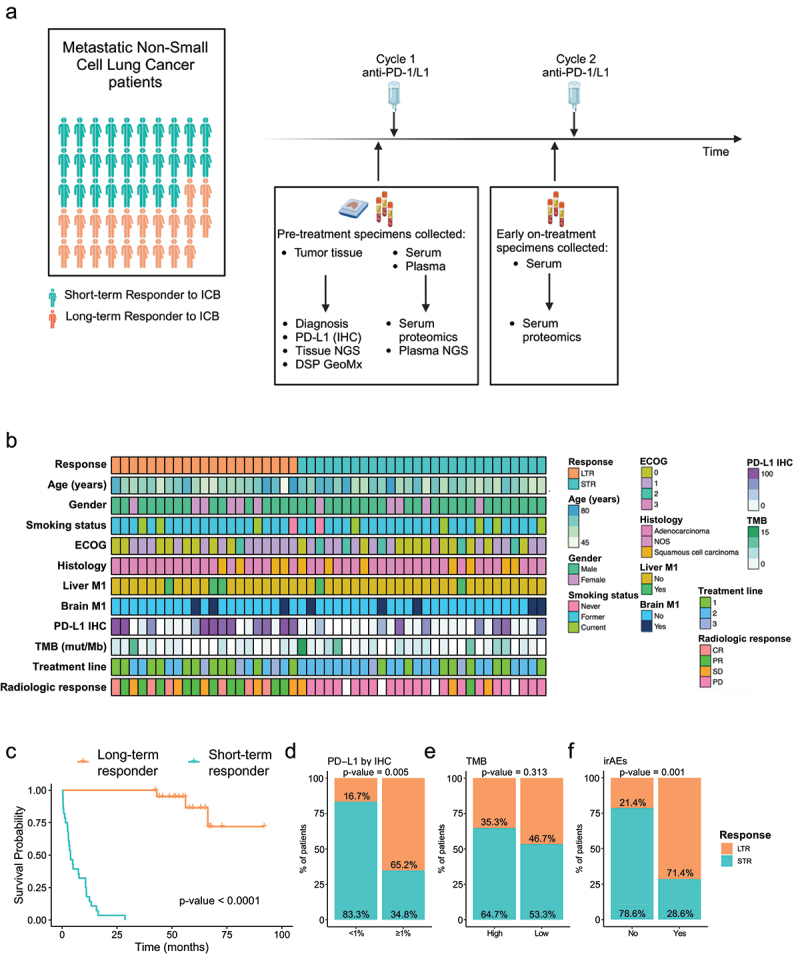
Methods: A total of 49 patients with metastatic NSCLC treated with ICB were included. Long-term (LTR) and short-term responders (STR) were defined as those with a response to ICB lasting more than 24 months or less than 6 months, respectively. Longitudinal blood specimens were collected before ICB treatment initiation and early-on treatment. Plasma ctDNA next-generation sequencing panel (NGS) and serum proteomics were performed. GeoMx DSP on baseline tumor tissue was performed in a subset of patients.
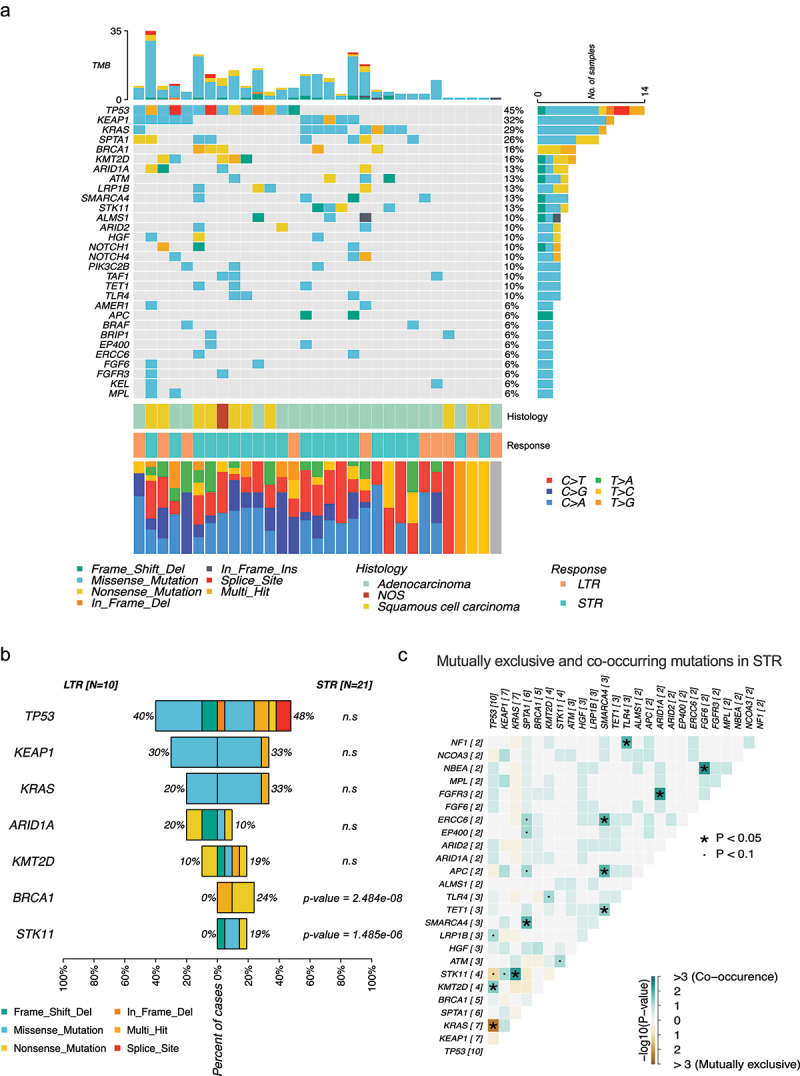
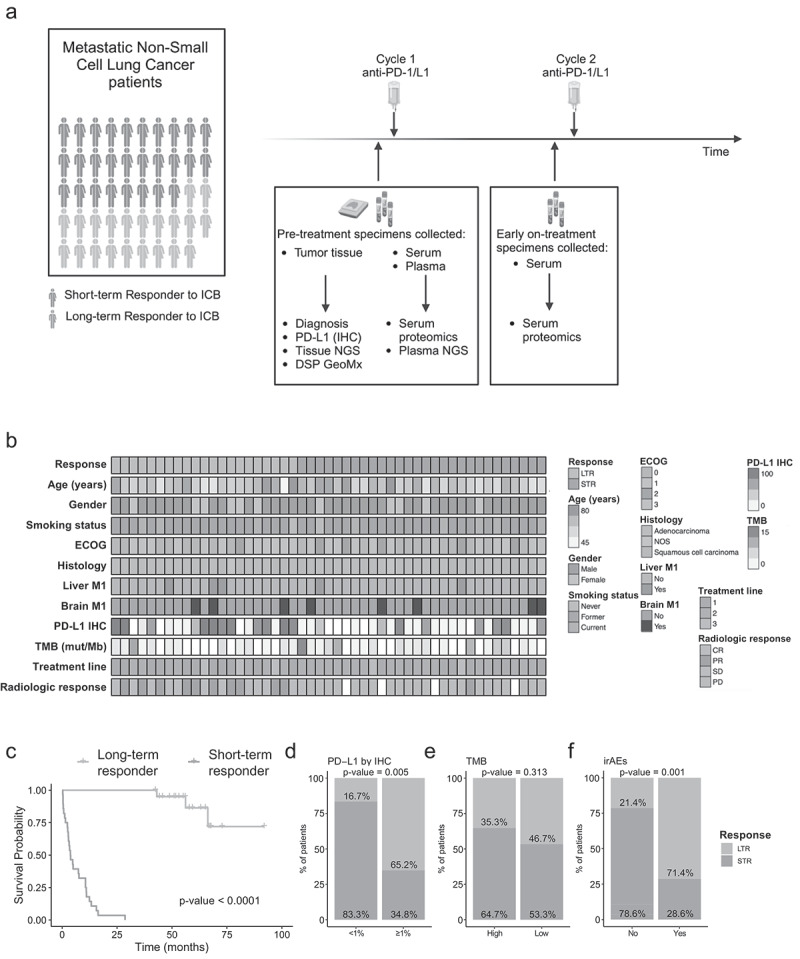
Results: Our analysis revealed specific characteristics of LTR compared with STR, namely higher PD-L1 in tumor cells (p = 0.005) and higher incidence of irAEs (p = 0.001). Genomic features associated with lack of benefit from ICB included co-occurring mutations in KRAS/STK11 and TP53/KMT2D (p < 0.05). At a baseline, LTR patients exhibited higher serum levels of proteins related with apoptosis (CASP8, PRKRA), chemotaxis, immune proteasome, processing of MHC class I (S100A4, PSMD9, RNF41) and immune homeostasis (HAVCR1, ARG1) (p < 0.05). Protein spatial profiling of tumor samples showed higher levels of proteins linked with the presence of immune cells (CD45), T cells (CD8), antigen presentation (HLA-DR) and immune regulation proteins (PD-L1, IDO1) within the tumor and tumor stroma component (p < 0.05) in LTR patients. Serum longitudinal analysis identified a set of proteins that presented distinct dynamics in LTR compared to STR, making them interesting candidates to evaluate as early predictors of treatment efficacy.
Conclusions: Our multimodal analysis of patients with metastatic NSCLC treated with ICB identified clinicopathological and immunological features associated with long-term benefits. The presence of preexisting antitumor immunity emerged as a strong predictor of long-term benefits, providing insights for potential biomarkers and therapeutic strategies for enhancing ICB outcomes in metastatic NSCLC.
期刊介绍:
OncoImmunology is a dynamic, high-profile, open access journal that comprehensively covers tumor immunology and immunotherapy.
As cancer immunotherapy advances, OncoImmunology is committed to publishing top-tier research encompassing all facets of basic and applied tumor immunology.
The journal covers a wide range of topics, including:
-Basic and translational studies in immunology of both solid and hematological malignancies
-Inflammation, innate and acquired immune responses against cancer
-Mechanisms of cancer immunoediting and immune evasion
-Modern immunotherapies, including immunomodulators, immune checkpoint inhibitors, T-cell, NK-cell, and macrophage engagers, and CAR T cells
-Immunological effects of conventional anticancer therapies.



 京公网安备 11010802042870号
京ICP备2023020795号-1
京公网安备 11010802042870号
京ICP备2023020795号-1

 分享
分享
 求助内容:
求助内容: 应助结果提醒方式:
 扫码关注我们
