Dorothea Dumuid, Ashley B. Yamanaka, Kar Hau Chong, Anthony D. Okely, Lynne R. Wilkens, Yurii B. Shvetsov, Chloe P. Lozano, Rachel Novotny
{"title":"Diet, Activity and Sleep Clusters Associated With Obesity Markers of Children in the US-Affiliated Pacific","authors":"Dorothea Dumuid, Ashley B. Yamanaka, Kar Hau Chong, Anthony D. Okely, Lynne R. Wilkens, Yurii B. Shvetsov, Chloe P. Lozano, Rachel Novotny","doi":"10.1111/apa.70012","DOIUrl":null,"url":null,"abstract":"<div>\n \n \n <section>\n \n <h3> Aim</h3>\n \n <p>Among children in the US-Affiliated Pacific, we aimed to identify lifestyle clusters and associations with obesity.</p>\n </section>\n \n <section>\n \n <h3> Methods</h3>\n \n <p>Movement behaviours, diet and anthropometrics were from the Children's Healthy Living Program (<i>n</i> = 1780; 2012–2015). Partitioning-around-medoids identified clusters; regression examined differences in anthropometrics.</p>\n </section>\n \n <section>\n \n <h3> Results</h3>\n \n <p>Among 2–5-year-olds, boys' clusters were: (1) high %energy from (<i>E</i>%) fat and sedentary behaviour; (2) high screen time and energy intake and (3) long sleep. Body mass index z-score (zBMI) was lower in Cluster 3 versus 1 (−0.28 [−0.50; −0.07], <i>p</i> = 0.01). Girls' clusters were: (1) high energy intake; (2) low <i>E</i>% fat and (3) high physical activity and sleep. zBMI was lower in Cluster 3 versus 1 (−0.34 [−0.55; −0.13], <i>p</i> = 0.002). Among 6–8-year-olds, boys' clusters were: (1) high screen time; (2) high energy intake; (3) high <i>E</i>% protein; (4) long sleep and (5) high sedentary time and low <i>E</i>% saturated fat. Compared with Cluster 1, zBMI was lower in Clusters 3 (−0.43 [−0.84; −0.02], <i>p</i> = 0.04), 4 (−0.64 [−1.08; −0.20], <i>p</i> = 0.004) and 5 (−0.93 [−1.35; −0.51], <i>p</i> < 0.001). Girls' clusters were: (1) high <i>E</i>% fat and protein; (2) high screen time and energy intake; (3) short sleep and high physical activity (4) long sleep and (5) low sedentary time. Compared with Cluster 1, zBMI was lower in Clusters 2 (−0.57 [−0.98; −0.17], <i>p</i> = 0.006), 3 (−0.48 [−0.81; −0.14], <i>p</i> = 0.005) and 5 (−0.50 [−0.83; −0.18], <i>p</i> = 0.003).</p>\n </section>\n \n <section>\n \n <h3> Conclusion</h3>\n \n <p>Various lifestyle patterns support healthy body weight.</p>\n </section>\n \n <section>\n \n <h3> Trial Registration</h3>\n \n <p>ClinicalTrials.gov identifier: NCT01881373</p>\n </section>\n </div>","PeriodicalId":55562,"journal":{"name":"Acta Paediatrica","volume":"114 7","pages":"1642-1652"},"PeriodicalIF":2.1000,"publicationDate":"2025-02-24","publicationTypes":"Journal Article","fieldsOfStudy":null,"isOpenAccess":false,"openAccessPdf":"https://onlinelibrary.wiley.com/doi/epdf/10.1111/apa.70012","citationCount":"0","resultStr":null,"platform":"Semanticscholar","paperid":null,"PeriodicalName":"Acta Paediatrica","FirstCategoryId":"3","ListUrlMain":"https://onlinelibrary.wiley.com/doi/10.1111/apa.70012","RegionNum":4,"RegionCategory":"医学","ArticlePicture":[],"TitleCN":null,"AbstractTextCN":null,"PMCID":null,"EPubDate":"","PubModel":"","JCR":"Q1","JCRName":"PEDIATRICS","Score":null,"Total":0}
引用次数: 0
Abstract
Aim
Among children in the US-Affiliated Pacific, we aimed to identify lifestyle clusters and associations with obesity.
Methods
Movement behaviours, diet and anthropometrics were from the Children's Healthy Living Program (n = 1780; 2012–2015). Partitioning-around-medoids identified clusters; regression examined differences in anthropometrics.
Results
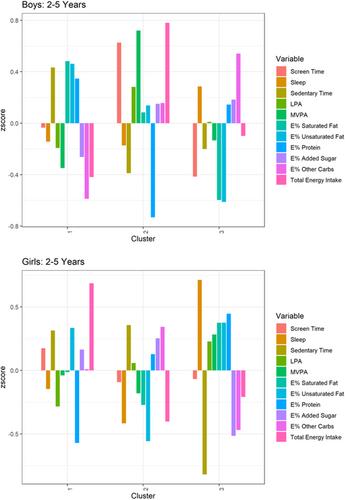
Among 2–5-year-olds, boys' clusters were: (1) high %energy from (E%) fat and sedentary behaviour; (2) high screen time and energy intake and (3) long sleep. Body mass index z-score (zBMI) was lower in Cluster 3 versus 1 (−0.28 [−0.50; −0.07], p = 0.01). Girls' clusters were: (1) high energy intake; (2) low E% fat and (3) high physical activity and sleep. zBMI was lower in Cluster 3 versus 1 (−0.34 [−0.55; −0.13], p = 0.002). Among 6–8-year-olds, boys' clusters were: (1) high screen time; (2) high energy intake; (3) high E% protein; (4) long sleep and (5) high sedentary time and low E% saturated fat. Compared with Cluster 1, zBMI was lower in Clusters 3 (−0.43 [−0.84; −0.02], p = 0.04), 4 (−0.64 [−1.08; −0.20], p = 0.004) and 5 (−0.93 [−1.35; −0.51], p < 0.001). Girls' clusters were: (1) high E% fat and protein; (2) high screen time and energy intake; (3) short sleep and high physical activity (4) long sleep and (5) low sedentary time. Compared with Cluster 1, zBMI was lower in Clusters 2 (−0.57 [−0.98; −0.17], p = 0.006), 3 (−0.48 [−0.81; −0.14], p = 0.005) and 5 (−0.50 [−0.83; −0.18], p = 0.003).
Conclusion
Various lifestyle patterns support healthy body weight.
期刊介绍:
Acta Paediatrica is a peer-reviewed monthly journal at the forefront of international pediatric research. It covers both clinical and experimental research in all areas of pediatrics including:
neonatal medicine
developmental medicine
adolescent medicine
child health and environment
psychosomatic pediatrics
child health in developing countries



 京公网安备 11010802042870号
京ICP备2023020795号-1
京公网安备 11010802042870号
京ICP备2023020795号-1

 分享
分享
 求助内容:
求助内容: 应助结果提醒方式:
 扫码关注我们
