Neda Razaz, Jenny Bolk, Hillary Graham, Eleni Tsamantioti, Kari Johansson, Martina Persson, Mikael Norman
{"title":"Severe Neonatal Morbidity Across Gestational Age: Monitoring Infants at High Risk of Mortality","authors":"Neda Razaz, Jenny Bolk, Hillary Graham, Eleni Tsamantioti, Kari Johansson, Martina Persson, Mikael Norman","doi":"10.1111/apa.70038","DOIUrl":null,"url":null,"abstract":"<div>\n \n \n <section>\n \n <h3> Aim</h3>\n \n <p>This study aimed to quantify temporal trends in severe neonatal morbidity (SNM) and examine its association with neonatal mortality, stratified by gestational age.</p>\n </section>\n \n <section>\n \n <h3> Methods</h3>\n \n <p>This study included all live births in Sweden from 2007 to 2021. SNM types and subtypes were identified based on diagnoses and procedure codes for births ≥ 22 weeks' gestation, including complications within 27 days. Rates were calculated by gestational age, and temporal changes were assessed using rate ratios (RR) and 95% confidence intervals (CI). Adjusted relative risks (aRR) of neonatal death were also estimated.</p>\n </section>\n \n <section>\n \n <h3> Results</h3>\n \n <p>From 2007 to 2021, 47,048 (2.8%) cases of SNM were identified, rising from 2.2% in 2007 to 3.6% in 2021, mainly due to increased resuscitation/mechanical ventilation rates across all gestational ages. Infections rose among infants born at ≥ 37 weeks (0.59% in 2007–2011 to 0.77% in 2017–2021, RR 1.30, 95% CI, 1.24–1.37), but declined in those born at 22–31 weeks. Neurological morbidity, especially seizures, slightly increased in term and moderately preterm infants. Except for infants born at 22–27 weeks, neonatal mortality risks among infants with SNM were higher in infants with greater gestational ages.</p>\n </section>\n \n <section>\n \n <h3> Conclusion</h3>\n \n <p>Despite advances in neonatal care, SNM prevalence in Sweden increased from 2007 to 2021 across all gestational ages.</p>\n </section>\n </div>","PeriodicalId":55562,"journal":{"name":"Acta Paediatrica","volume":"114 8","pages":"1847-1856"},"PeriodicalIF":2.1000,"publicationDate":"2025-02-24","publicationTypes":"Journal Article","fieldsOfStudy":null,"isOpenAccess":false,"openAccessPdf":"https://onlinelibrary.wiley.com/doi/epdf/10.1111/apa.70038","citationCount":"0","resultStr":null,"platform":"Semanticscholar","paperid":null,"PeriodicalName":"Acta Paediatrica","FirstCategoryId":"3","ListUrlMain":"https://onlinelibrary.wiley.com/doi/10.1111/apa.70038","RegionNum":4,"RegionCategory":"医学","ArticlePicture":[],"TitleCN":null,"AbstractTextCN":null,"PMCID":null,"EPubDate":"","PubModel":"","JCR":"Q1","JCRName":"PEDIATRICS","Score":null,"Total":0}
引用次数: 0
Abstract
Aim
This study aimed to quantify temporal trends in severe neonatal morbidity (SNM) and examine its association with neonatal mortality, stratified by gestational age.
Methods
This study included all live births in Sweden from 2007 to 2021. SNM types and subtypes were identified based on diagnoses and procedure codes for births ≥ 22 weeks' gestation, including complications within 27 days. Rates were calculated by gestational age, and temporal changes were assessed using rate ratios (RR) and 95% confidence intervals (CI). Adjusted relative risks (aRR) of neonatal death were also estimated.
Results
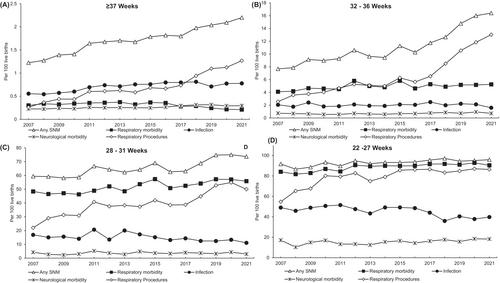
From 2007 to 2021, 47,048 (2.8%) cases of SNM were identified, rising from 2.2% in 2007 to 3.6% in 2021, mainly due to increased resuscitation/mechanical ventilation rates across all gestational ages. Infections rose among infants born at ≥ 37 weeks (0.59% in 2007–2011 to 0.77% in 2017–2021, RR 1.30, 95% CI, 1.24–1.37), but declined in those born at 22–31 weeks. Neurological morbidity, especially seizures, slightly increased in term and moderately preterm infants. Except for infants born at 22–27 weeks, neonatal mortality risks among infants with SNM were higher in infants with greater gestational ages.
Conclusion
Despite advances in neonatal care, SNM prevalence in Sweden increased from 2007 to 2021 across all gestational ages.
期刊介绍:
Acta Paediatrica is a peer-reviewed monthly journal at the forefront of international pediatric research. It covers both clinical and experimental research in all areas of pediatrics including:
neonatal medicine
developmental medicine
adolescent medicine
child health and environment
psychosomatic pediatrics
child health in developing countries



 京公网安备 11010802042870号
京ICP备2023020795号-1
京公网安备 11010802042870号
京ICP备2023020795号-1

 分享
分享
 求助内容:
求助内容: 应助结果提醒方式:
 扫码关注我们
