Development and validation of a machine learning model to predict cognitive behavioral therapy outcome in obsessive-compulsive disorder using clinical and neuroimaging data.
Laurens A van de Mortel, Willem B Bruin, Pino Alonso, Sara Bertolín, Jamie D Feusner, Joyce Guo, Kristen Hagen, Bjarne Hansen, Anders Lillevik Thorsen, Ignacio Martínez-Zalacaín, Jose M Menchón, Erika L Nurmi, Joseph O'Neill, John C Piacentini, Eva Real, Cinto Segalàs, Carles Soriano-Mas, Sophia I Thomopoulos, Dan J Stein, Paul M Thompson, Odile A van den Heuvel, Guido A van Wingen
{"title":"Development and validation of a machine learning model to predict cognitive behavioral therapy outcome in obsessive-compulsive disorder using clinical and neuroimaging data.","authors":"Laurens A van de Mortel, Willem B Bruin, Pino Alonso, Sara Bertolín, Jamie D Feusner, Joyce Guo, Kristen Hagen, Bjarne Hansen, Anders Lillevik Thorsen, Ignacio Martínez-Zalacaín, Jose M Menchón, Erika L Nurmi, Joseph O'Neill, John C Piacentini, Eva Real, Cinto Segalàs, Carles Soriano-Mas, Sophia I Thomopoulos, Dan J Stein, Paul M Thompson, Odile A van den Heuvel, Guido A van Wingen","doi":"10.1101/2025.02.14.25322265","DOIUrl":null,"url":null,"abstract":"<p><p>Cognitive behavioral therapy (CBT) is a first-line treatment for obsessive-compulsive disorder (OCD), but clinical response is difficult to predict. In this study, we aimed to develop predictive models using clinical and neuroimaging data from the multicenter Enhancing Neuro-Imaging and Genetics through Meta-Analysis (ENIGMA)-OCD consortium. Baseline clinical and resting-state functional magnetic imaging (rs-fMRI) data from 159 adult patients aged 18-60 years (88 female) with OCD who received CBT at four treatment/neuroimaging sites were included. Fractional amplitude of low frequency fluctuations, regional homogeneity and atlas-based functional connectivity were computed. Clinical CBT response and remission were predicted using support vector machine and random forest classifiers on clinical data only, rs-fMRI data only, and the combination of both clinical and rs-fMRI data. The use of only clinical data yielded an area under the ROC curve (AUC) of 0.69 for predicting remission (p=0.001). Lower baseline symptom severity, younger age, an absence of cleaning obsessions, unmedicated status, and higher education had the highest model impact in predicting remission. The best predictive performance using only rs-fMRI was obtained with regional homogeneity for remission (AUC=0.59). Predicting response with rsf-MRI generally did not exceed chance level. Machine learning models based on clinical data may thus hold promise in predicting remission after CBT for OCD, but the predictive power of multicenter rs-fMRI data is limited.</p>","PeriodicalId":94281,"journal":{"name":"medRxiv : the preprint server for health sciences","volume":" ","pages":""},"PeriodicalIF":0.0000,"publicationDate":"2025-02-14","publicationTypes":"Journal Article","fieldsOfStudy":null,"isOpenAccess":false,"openAccessPdf":"https://www.ncbi.nlm.nih.gov/pmc/articles/PMC11844585/pdf/","citationCount":"0","resultStr":null,"platform":"Semanticscholar","paperid":null,"PeriodicalName":"medRxiv : the preprint server for health sciences","FirstCategoryId":"1085","ListUrlMain":"https://doi.org/10.1101/2025.02.14.25322265","RegionNum":0,"RegionCategory":null,"ArticlePicture":[],"TitleCN":null,"AbstractTextCN":null,"PMCID":null,"EPubDate":"","PubModel":"","JCR":"","JCRName":"","Score":null,"Total":0}
引用次数: 0
Abstract
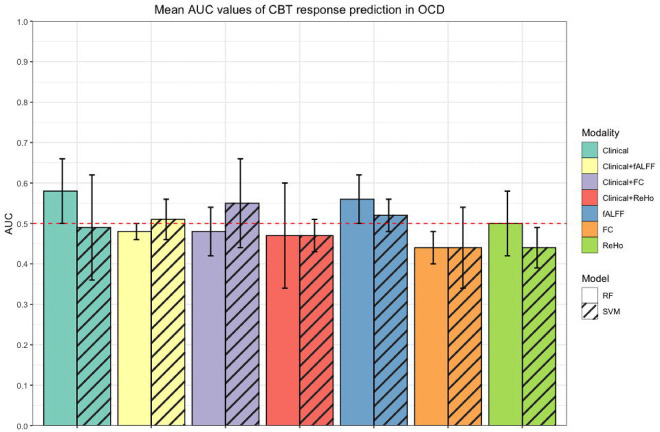
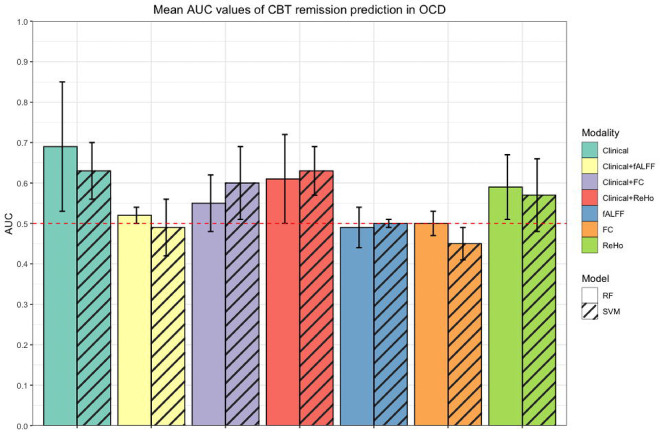
Cognitive behavioral therapy (CBT) is a first-line treatment for obsessive-compulsive disorder (OCD), but clinical response is difficult to predict. In this study, we aimed to develop predictive models using clinical and neuroimaging data from the multicenter Enhancing Neuro-Imaging and Genetics through Meta-Analysis (ENIGMA)-OCD consortium. Baseline clinical and resting-state functional magnetic imaging (rs-fMRI) data from 159 adult patients aged 18-60 years (88 female) with OCD who received CBT at four treatment/neuroimaging sites were included. Fractional amplitude of low frequency fluctuations, regional homogeneity and atlas-based functional connectivity were computed. Clinical CBT response and remission were predicted using support vector machine and random forest classifiers on clinical data only, rs-fMRI data only, and the combination of both clinical and rs-fMRI data. The use of only clinical data yielded an area under the ROC curve (AUC) of 0.69 for predicting remission (p=0.001). Lower baseline symptom severity, younger age, an absence of cleaning obsessions, unmedicated status, and higher education had the highest model impact in predicting remission. The best predictive performance using only rs-fMRI was obtained with regional homogeneity for remission (AUC=0.59). Predicting response with rsf-MRI generally did not exceed chance level. Machine learning models based on clinical data may thus hold promise in predicting remission after CBT for OCD, but the predictive power of multicenter rs-fMRI data is limited.




 京公网安备 11010802042870号
京ICP备2023020795号-1
京公网安备 11010802042870号
京ICP备2023020795号-1

 分享
分享

 求助内容:
求助内容: 应助结果提醒方式:
 扫码关注我们
