{"title":"Influenza a virus subtype H9N2 infection induces respiratory microbiota dysbiosis in chickens via type-I interferon-mediated mechanisms.","authors":"Samson Oladokun, Mohammadali Alizadeh, Amirul I Mallick, Fatemeh Fazel, Janan Shoja Doost, Katherine Blake, Myles St Denis, Sugandha Raj, Shayan Sharif","doi":"10.1093/femsmc/xtaf001","DOIUrl":null,"url":null,"abstract":"<p><p>Avian influenza virus (AIV) poses significant threats to poultry and human health. This study investigates the impact of H9N2 AIV infection on the respiratory microbiota of chickens using 16S rRNA gene sequencing. Total 48 one-day-old specific pathogen-free chickens were assigned to six groups: a control and five post-infection groups (days 1, 3, 5, 7, and 9). After a 15-day microbiota stabilization period, the infected chickens received a viral inoculum (10<sup>7</sup> TCID50/ml) via ocular, intra-nasal, and intra-tracheal routes. Tracheal and broncho-alveolar lavage samples were analyzed. Significant reductions in microbiota diversity were observed on days 5, 7, and 9 post-infection, compared to d0 controls. Permutational Multivariate Analysis of Variance confirmed significant beta diversity differences (<i>P</i> = 0.001) between infected and uninfected groups. The microbial shifts from d5 to d9 were marked by increased Proteobacteria, decreased Actinobacteria and Firmicutes, and a rise in Dickeya. Elevated type-I interferon (IFN-β) and viperin gene expression at d5 coincided with reduced microbiota diversity, highlighting the respiratory microbiota's role in modulating host responses to AIV H9N2 infection and suggesting potential biomarkers for respiratory dysbiosis.</p>","PeriodicalId":73024,"journal":{"name":"FEMS microbes","volume":"6 ","pages":"xtaf001"},"PeriodicalIF":4.0000,"publicationDate":"2025-02-03","publicationTypes":"Journal Article","fieldsOfStudy":null,"isOpenAccess":false,"openAccessPdf":"https://www.ncbi.nlm.nih.gov/pmc/articles/PMC11843552/pdf/","citationCount":"0","resultStr":null,"platform":"Semanticscholar","paperid":null,"PeriodicalName":"FEMS microbes","FirstCategoryId":"1085","ListUrlMain":"https://doi.org/10.1093/femsmc/xtaf001","RegionNum":0,"RegionCategory":null,"ArticlePicture":[],"TitleCN":null,"AbstractTextCN":null,"PMCID":null,"EPubDate":"2025/1/1 0:00:00","PubModel":"eCollection","JCR":"","JCRName":"","Score":null,"Total":0}
引用次数: 0
Abstract
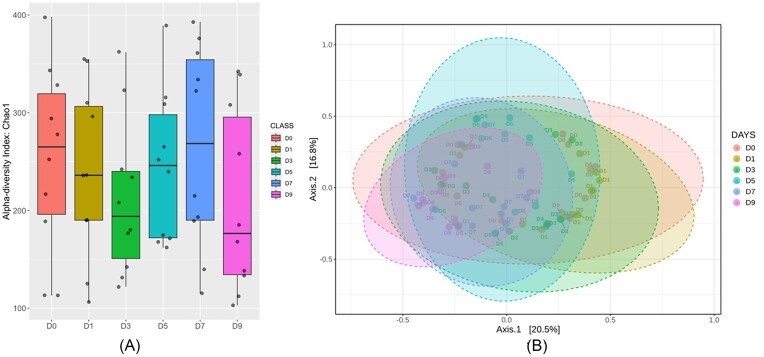
Avian influenza virus (AIV) poses significant threats to poultry and human health. This study investigates the impact of H9N2 AIV infection on the respiratory microbiota of chickens using 16S rRNA gene sequencing. Total 48 one-day-old specific pathogen-free chickens were assigned to six groups: a control and five post-infection groups (days 1, 3, 5, 7, and 9). After a 15-day microbiota stabilization period, the infected chickens received a viral inoculum (107 TCID50/ml) via ocular, intra-nasal, and intra-tracheal routes. Tracheal and broncho-alveolar lavage samples were analyzed. Significant reductions in microbiota diversity were observed on days 5, 7, and 9 post-infection, compared to d0 controls. Permutational Multivariate Analysis of Variance confirmed significant beta diversity differences (P = 0.001) between infected and uninfected groups. The microbial shifts from d5 to d9 were marked by increased Proteobacteria, decreased Actinobacteria and Firmicutes, and a rise in Dickeya. Elevated type-I interferon (IFN-β) and viperin gene expression at d5 coincided with reduced microbiota diversity, highlighting the respiratory microbiota's role in modulating host responses to AIV H9N2 infection and suggesting potential biomarkers for respiratory dysbiosis.



 京公网安备 11010802042870号
京ICP备2023020795号-1
京公网安备 11010802042870号
京ICP备2023020795号-1

 分享
分享

 求助内容:
求助内容: 应助结果提醒方式:
 扫码关注我们
