Julia Guillebaud, Janin Nouhin, Vibol Hul, Thavry Hoem, Oudamdaniel Yanneth, Mala Sim, Limmey Khun, Y Phalla, Sreymom Ken, Leakhena Pum, Reaksa Lim, Channa Meng, Kimtuo Chhel, Sithun Nuon, Sreyleak Hoem, Kunthy Nguon, Malen Chan, Sowath Ly, Erik A Karlsson, Jean-Marc Reynes, Anavaj Sakunthabhai, Philippe Dussart, Veasna Duong
{"title":"Burden of rodent-borne viruses in rodents and zoonotic risk in human in Cambodia: a descriptive and observational study.","authors":"Julia Guillebaud, Janin Nouhin, Vibol Hul, Thavry Hoem, Oudamdaniel Yanneth, Mala Sim, Limmey Khun, Y Phalla, Sreymom Ken, Leakhena Pum, Reaksa Lim, Channa Meng, Kimtuo Chhel, Sithun Nuon, Sreyleak Hoem, Kunthy Nguon, Malen Chan, Sowath Ly, Erik A Karlsson, Jean-Marc Reynes, Anavaj Sakunthabhai, Philippe Dussart, Veasna Duong","doi":"10.1101/2025.02.09.25321973","DOIUrl":null,"url":null,"abstract":"<p><strong>Background: </strong>Rodent-borne viruses, including hantaviruses, arenaviruses, and rodent hepatitis virus (HEV-C), pose significant health threats to humans, causing severe diseases such as hepatitis, respiratory illness, and hemorrhagic fevers. In Cambodia, data on these viruses remain limited, and their burdens on human health are unknown. This study investigated the presences of these viruses in rodents and assessed potential human exposure across diverse environmental and socio-economic contexts in Cambodia.</p><p><strong>Methods: </strong>The study was conducted in urban, semi-urban, and rural areas of Cambodia during the rainy (2020) and dry seasons (2022). Rodents were screened for arenavirus, hantavirus, and HEV-C using RT-PCR. Human serum samples from the same site were tested for IgG antibodies using ELISA. Factors associated with virus spillover into humans were analyzed.</p><p><strong>Findings: </strong>Among 750 rodents, 9.7% carried at least one virus: 5.2% arenavirus, 3.3% hantavirus, and 1.9% HEV-C. Infection rates were highest in urban (14.5%), followed by semi-urban (11.9%) and rural (2.1%) interfaces. Arenavirus was more prevalent during the rainy season, while hantavirus and HEV-C remained consistent across seasons. Seroprevalence in human was 12.7% for arenavirus, 10.0% for hantavirus, and 24.2% for HEV. Higher arenavirus seroprevalence was associated with urban recidency and lower education level. Hantavirus seroprevalence was associated with urban residency, acute hepatitis history, and flood-prone living areas. HEV seroprevalence increased with urban residency, increasing age, and medical condition history.</p><p><strong>Interpretation: </strong>Our findings highlighted the need for rodent control, improved market infrastructure, enhanced waste management, and public awareness on hygiene practices and zoonotic risks, especially in urban and high-risk areas.</p>","PeriodicalId":94281,"journal":{"name":"medRxiv : the preprint server for health sciences","volume":" ","pages":""},"PeriodicalIF":0.0000,"publicationDate":"2025-02-12","publicationTypes":"Journal Article","fieldsOfStudy":null,"isOpenAccess":false,"openAccessPdf":"https://www.ncbi.nlm.nih.gov/pmc/articles/PMC11844583/pdf/","citationCount":"0","resultStr":null,"platform":"Semanticscholar","paperid":null,"PeriodicalName":"medRxiv : the preprint server for health sciences","FirstCategoryId":"1085","ListUrlMain":"https://doi.org/10.1101/2025.02.09.25321973","RegionNum":0,"RegionCategory":null,"ArticlePicture":[],"TitleCN":null,"AbstractTextCN":null,"PMCID":null,"EPubDate":"","PubModel":"","JCR":"","JCRName":"","Score":null,"Total":0}
引用次数: 0
Abstract
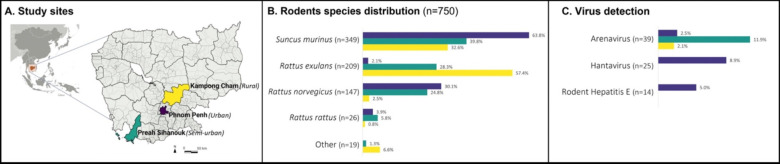
Background: Rodent-borne viruses, including hantaviruses, arenaviruses, and rodent hepatitis virus (HEV-C), pose significant health threats to humans, causing severe diseases such as hepatitis, respiratory illness, and hemorrhagic fevers. In Cambodia, data on these viruses remain limited, and their burdens on human health are unknown. This study investigated the presences of these viruses in rodents and assessed potential human exposure across diverse environmental and socio-economic contexts in Cambodia.
Methods: The study was conducted in urban, semi-urban, and rural areas of Cambodia during the rainy (2020) and dry seasons (2022). Rodents were screened for arenavirus, hantavirus, and HEV-C using RT-PCR. Human serum samples from the same site were tested for IgG antibodies using ELISA. Factors associated with virus spillover into humans were analyzed.
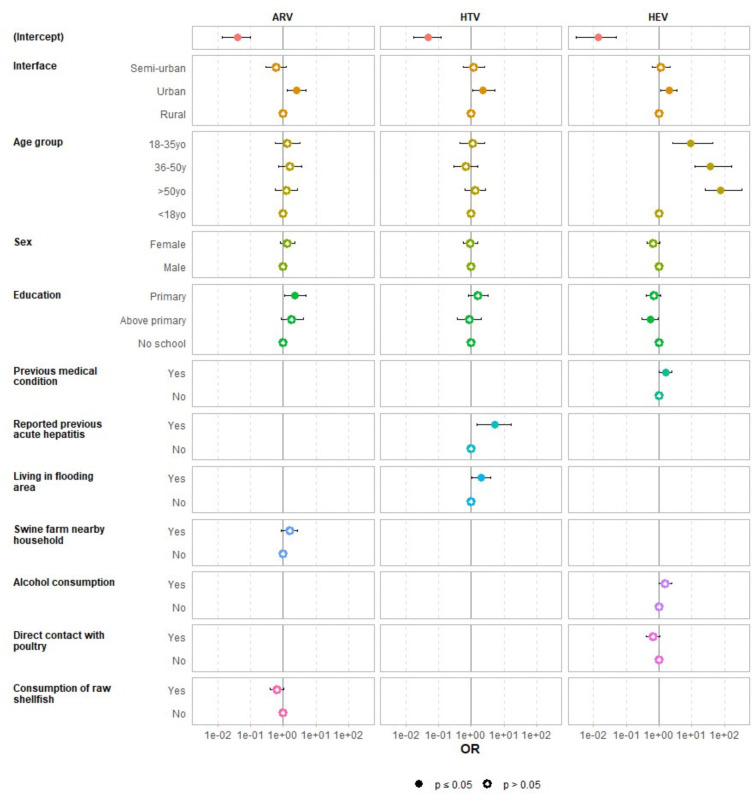
Findings: Among 750 rodents, 9.7% carried at least one virus: 5.2% arenavirus, 3.3% hantavirus, and 1.9% HEV-C. Infection rates were highest in urban (14.5%), followed by semi-urban (11.9%) and rural (2.1%) interfaces. Arenavirus was more prevalent during the rainy season, while hantavirus and HEV-C remained consistent across seasons. Seroprevalence in human was 12.7% for arenavirus, 10.0% for hantavirus, and 24.2% for HEV. Higher arenavirus seroprevalence was associated with urban recidency and lower education level. Hantavirus seroprevalence was associated with urban residency, acute hepatitis history, and flood-prone living areas. HEV seroprevalence increased with urban residency, increasing age, and medical condition history.
Interpretation: Our findings highlighted the need for rodent control, improved market infrastructure, enhanced waste management, and public awareness on hygiene practices and zoonotic risks, especially in urban and high-risk areas.



 京公网安备 11010802042870号
京ICP备2023020795号-1
京公网安备 11010802042870号
京ICP备2023020795号-1

 分享
分享

 求助内容:
求助内容: 应助结果提醒方式:
 扫码关注我们
